Isabella Beeton’s dishes for children, The Book of Household Management · London
What Did Victorian Children Eat?
Victorian children ate milk, bread, rice puddings and plain cakes, often in a nursery, while workhouse and asylum children ate what the rules allowed.
Victorian children ate bread and milk, milk soups, rice and suet puddings baked or boiled for hours, and cake made from bread dough with a little sugar and butter worked in. In a house that kept a nurse, they ate much of it upstairs in a nursery of their own. Isabella Beeton’s Book of Household Management of 1861 marks several dishes as meant for children and counts some of them by the child. Children in the new workhouses, in orphan asylums and in poor homes ate whatever the rules and the money allowed, and that could look very different from the advice the same decades printed.
Dinner from the same joint
Beeton’s book assumes a nursery with its own table. Describing the mistress’s day, she notes that in many houses “a nursery dinner is provided for the children at about one o’clock,” and the mistress and the older members of the family take their luncheon at the same time “from the same joint.” The usual plan was for the joint to come to the lady’s table first “and afterwards carried to the nursery.”
Servants did the carrying. In a large house, by Beeton’s account of the nursery staff, the under nursemaid “brings up and removes the nursery meals,” and the nursemaids “take their meals in the nursery together, after the children of the family have done.” In a smaller family the housemaid or the maid-of-all-work carried the trays up.
That is a well-off household, and Beeton wrote for one. Her chapter on rearing children has a line on what poorer babies got: bread, she wrote, was “the universal régime with the labouring poor.”
Dishes counted by the child
Most recipes in the book end with a line saying how many persons they serve. A few count children instead, and they are among the plainest things in it.
Her milk soup, “a Nice Dish for Children,” is two quarts of milk boiled with salt, cinnamon and sugar, thickened with six egg yolks and poured over thin slices of bread. It was “Sufficient for 10 children” at an average cost of 8d. a quart (about £3.40 today, by UK consumer prices from the Bank of England). It sits among the fruit and vegetable soups, between a soup maigre and an onion soup.
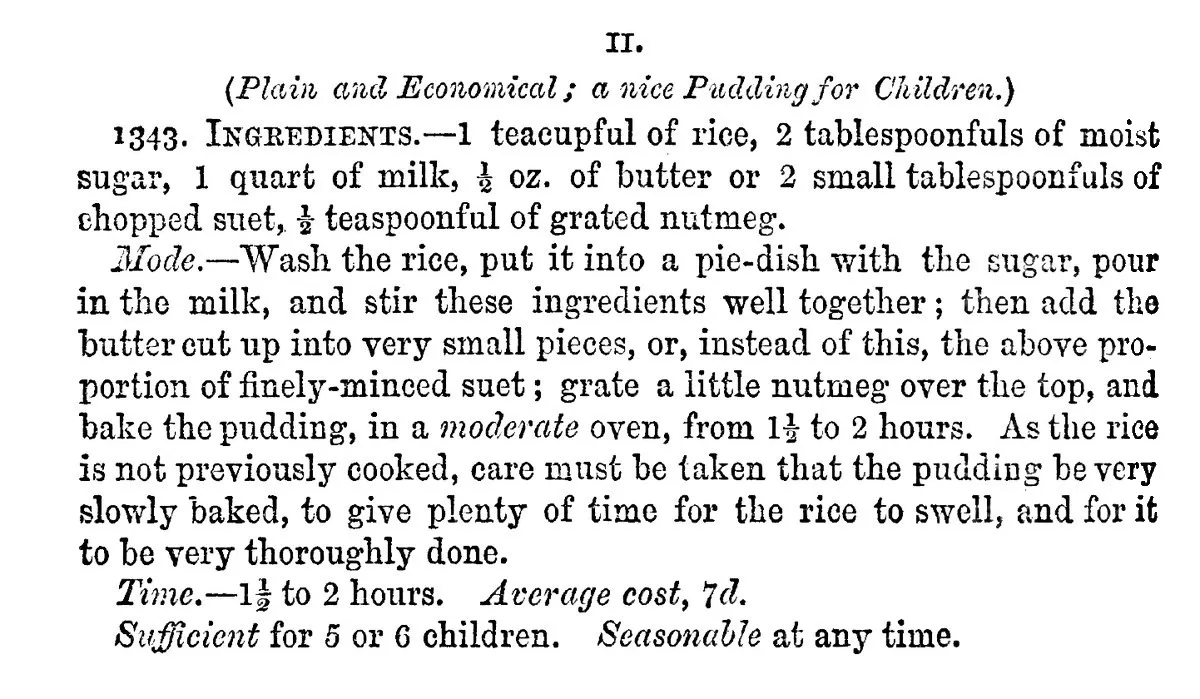
The rice pudding headed “Plain and Economical; a nice Pudding for Children” is a teacupful of raw rice, two tablespoons of moist sugar and a quart of milk in a pie dish, with a little butter or chopped suet and nutmeg on top. Beeton wants it baked “very slowly,” up to two hours, “to give plenty of time for the rice to swell.” It cost 7d. and fed five or six children. The baked rice pudding printed just above it has eggs, beef marrow, currants, brandy and a rim of puff paste.
The cakes and Christmas puddings follow the same pattern. “A Nice Plain Cake for Children” starts from a quartern of bread dough, bought from the baker if you didn’t bake at home, with a quarter pound each of sugar and butter, warm milk and half a grated nutmeg or caraway seeds kneaded in. Beeton’s “Very Good” Christmas pudding is fruit, crumbs, suet, eggs and brandy; the one she wrote “for children” stretches its raisins and currants with a pound of flour and a pound of crumbs, leaves out the brandy, and feeds nine or ten.
The book never says why children got the plain version. The recipes show what the plainness meant in practice: milk, flour, bread and rice doing most of the work, and the dearer ingredients cut back.
What the books believed
Beeton’s advice spends far more words on babies than on older children. What follows is history: these are 1861 opinions on feeding infants, and they differ a good deal from today’s advice. Current guidance, such as the CDC’s on starting solid foods (opens in a new tab), waits until a baby is about six months old before giving any food other than breast milk or formula. Beeton’s three months for bread was early by that measure. Her chapter lists the usual infant foods, from arrowroot and bread to baked flour, biscuit powder and semolina, and takes them apart one by one. Arrowroot, she wrote, was “the least efficacious, though, perhaps, the most believed in,” and “a thin, flatulent, and innutritious food.” Bread should never be given to an infant under three months. She recommended the farinaceous food sold in packets, and dismissed a common fear: “Many persons entertain a belief that cow’s milk is hurtful to infants,” which she called “a very great mistake.” Arrowroot also turned up as a pudding; Eliza Leslie’s Arrowroot Blancmange (1837) sets milk with it.
For older children Beeton handed the page to Florence Nightingale, quoting her Notes on Nursing at the end of the nursemaid’s duties. “Don’t treat your children like sick,” Nightingale wrote, “don’t dose them with tea. Let them eat meat and drink milk, or half a glass of light beer.” She wanted fresh air, cool bedrooms, play, “more liberty, and less schooling,” and “more attention to food and less to physic.” The light beer, like the rest of this advice, belongs to its century.
The workhouse rules of 1836
Children in the workhouse ate by rule. After the Poor Law Amendment Act of 1834, the Poor Law Commissioners reorganized relief in England and Wales around union workhouses, and their Second Annual Report of 1836 prints the “Orders and Regulations to be observed in the Workhouse,” with a blank left for the union’s name.
Inmates were sorted into classes. “Children under seven years of age” made one class; boys from seven to 13 and girls from seven to 16 made two more. Meals for the aged and infirm, the sick and children “shall be provided at such times and in such manner as the board of guardians may direct.” Rule XIX set the ceiling for everyone: the diet was “in no case to exceed, in quantity and quality of food, the ordinary diet of the able-bodied labourers living within the same district.” Rule XX banned “wine, beer, or other spirituous or fermented liquors” for any pauper, unless the medical officer ordered them in writing.
The rules leave the actual portions to each union’s board and its own dietary table, which this report doesn’t print. They do give the measure a child’s bowl was held to: no better than what the laboring families nearby could put on their own tables.
Even a Christmas dinner was a change to the rules that had to be asked for. On December 17, 1852, the clerk to the Mansfield Union in Nottinghamshire wrote to the Poor Law Board in London that the town had raised a subscription “to afford a treat of Roast Beef and Plum pudding to the inmates of the Workhouse on Christmas Day next [instead of the usual diet of the day],” as the workhouse rules, the General Consolidated Order, allowed. The guardians feared “great inconvenience” from giving it on the day itself and asked leave to serve it on December 31 or January 1.
Porridge and dripping in York, 1899
What a poor British household actually set in front of its children survives in the budgets Seebohm Rowntree collected for Poverty: A Study of Town Life (1901), his survey of working-class York. One was kept by a soldier’s widow he calls Mrs. X, a Scotswoman of 33 with five children, the eldest under seven and the youngest 14 months. She had 15s. a week to live on (about £83 today), more than a quarter of it went on rent, and in the week ending 7 July 1899 she spent 7s. 9½d. on food. “The children have porridge almost every day for breakfast,” Rowntree wrote, “Sunday excepted, when they often have bread fried in dripping.” She baked her own bread and “never owes a farthing.”
Her menu for that week has the milk, bread and puddings the advice books asked for, on far less money. Breakfast was porridge and milk, or bread and milk, with bread and butter or dripping and a cup of tea. Dinner was sheep’s liver with onions, potato pie, meat pie with cabbage, pea soup, fish, or stewed giblets with Yorkshire pudding, and on four days a semolina or rice pudding. Tea was bread and dripping, and supper bread and cheese or bread and milk. The milk came as a quart of skimmed and half a pint of new each day. For all her careful buying, Rowntree reckoned the diet “more than 22 per cent below standard requirements.”
An orphan asylum’s week, 1899
Across the Atlantic, one institution’s real menu survives because a chemist printed it beside her own advice. Ellen H. Richards, instructor in sanitary chemistry at the Massachusetts Institute of Technology, put an “Actual Bill of Fare” from an unnamed American orphan asylum into her book The Cost of Food (1901). It cost 9.5 cents per person a day, “average for six months, 1899” (about $3.80 today, by US consumer prices, using the Minneapolis Fed and BLS CPI-U tables).
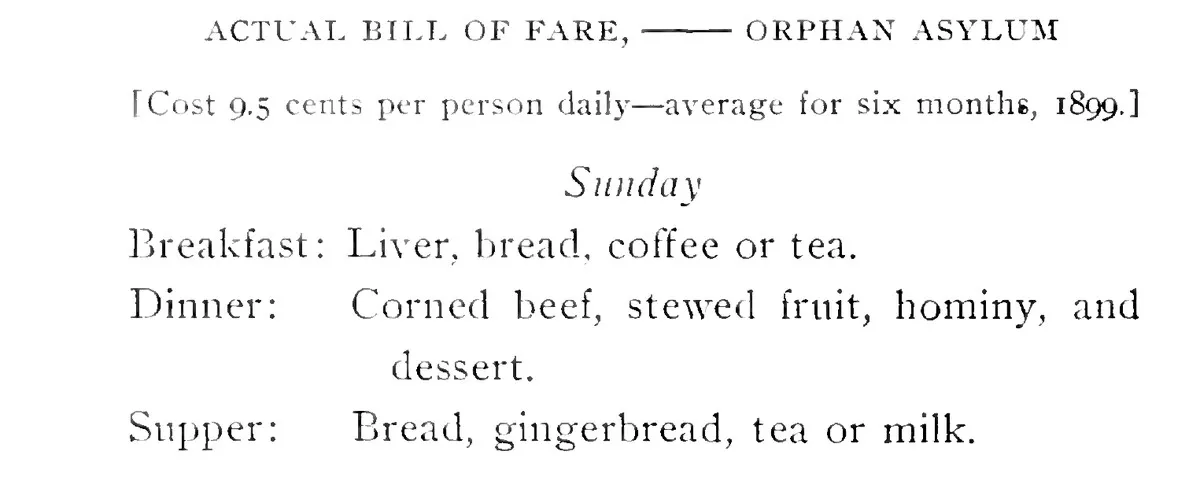 The orphan asylum’s Sunday, from Ellen H. Richards, The Cost of Food: A Study in Dietaries (New York: John Wiley & Sons, 1901), p. 64.
Breakfast was liver, sausage, scrapple, oatmeal, gravy or plain bread and butter, with coffee or tea every day of the week. Dinner was the solid meal: corned beef, roast beef, hash, pork and beans, Brunswick stew or ham, nearly always with potatoes, and slaw, hominy, rice or cabbage beside them. Supper was bread with butter, molasses or apple butter, once biscuit and once gingerbread, and tea or milk.
Richards printed her answer around it. For young children kept at city or charitable charge, she wrote, “soup must take the place of milk to a certain extent,” because a sufficient milk diet cost 12 to 16 cents a day, out of the question where only 9 cents was allowed. “Of course tea and coffee are not to be thought of.” Cocoa was too dear, though even a flavor of it in hot milk was “much to be preferred to the day-long decoction of shells so popular with institution cooks.” Her proposed menu for a children’s home, at 11 cents a day at the prices of 1898, opens the week with boiled rice or hominy and molasses, then oatmeal with milk and sugar, with “cereal coffee or milk” to drink, and puts pudding, apple sauce, prune sauce and gingerbread at dinner and supper.
The two weeks are a cent and a half apart in cost and differ most in the cup. The advice said milk; the asylum poured coffee.
The recipes
These are four of Beeton’s dishes for children, set out as a day might run. The grouping is ours: her book shows what she recommended for a nursery table, not what any one nursery ate.
- Milk Soup for Children (1861): hot milk with cinnamon and sugar, thickened with egg yolks and poured over bread.
- Plain Baked Rice Pudding (1861) (opens in a new tab), on TuneMyRecipe, our sister site: the “nice Pudding for Children,” raw rice baked slowly in milk.
- Plain Cake for Children (1861): bread dough with sugar, butter, warm milk and nutmeg kneaded in, risen again in the tin.
- Plain Christmas Pudding for Children (1861): flour, crumbs, raisins, currants and suet, with no brandy, steamed for hours.
Beeton’s grown-up Christmas Plum Pudding (1861) shows what the children’s version leaves out, and What Did the Cratchits Eat for Christmas Dinner? follows a poorer family’s pudding in 1843.
Cooking it
On a December table, the Plain Christmas Pudding for Children (1861) can be steamed a day or two ahead and warmed through in an hour, and with no brandy in it, it was written for the children’s end of the table. For what Victorian children drank at their Christmas parties, Forgotten Drink, our sister site, asks What Did Victorian Children Drink at Christmas? (opens in a new tab)
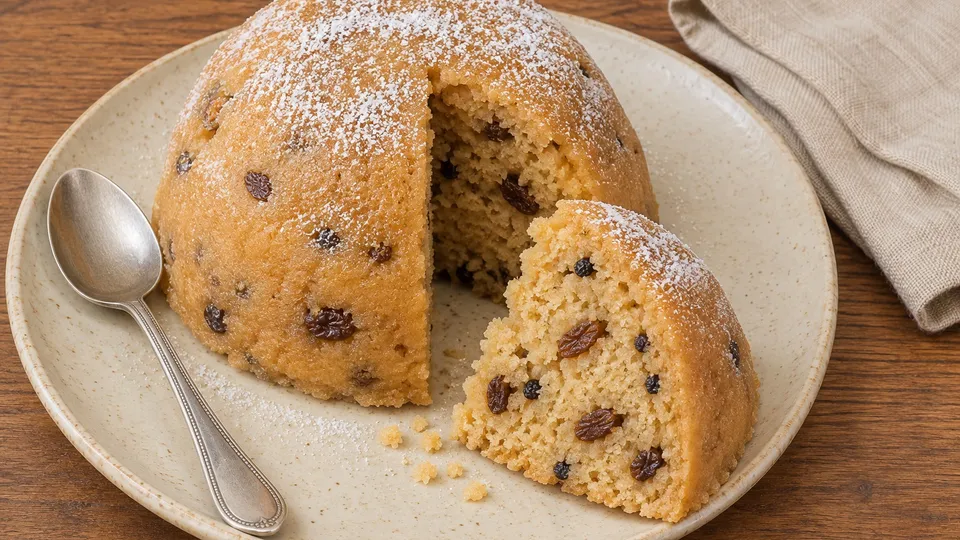 Cook it todayPlain Christmas Pudding for Children (1861)
Sources
- Isabella Beeton, The Book of Household Management (London: S. O. Beeton, 1861), p. 9; nos. 137, 1327, 1342–1343 and 1767 (pp. 72–73, 666, 675–676, 860); paras. 2402–2403, 2415, 2499–2502 and 2508 (pp. 1014, 1016, 1042–1044). Internet Archive (opens in a new tab).
- W. Goodacre, clerk to the Mansfield Union, letter to the Poor Law Board, Mansfield, December 17, 1852, The National Archives, MH 12/9363/397, folio 534. TNA Discovery (opens in a new tab).
- Poor Law Commissioners, Second Annual Report of the Poor Law Commissioners for England and Wales (London, 1836), “Orders and Regulations to be observed in the Workhouse,” pp. 96–99. Internet Archive (opens in a new tab).
- B. Seebohm Rowntree, Poverty: A Study of Town Life (London: Macmillan, 1901), pp. 269–270. Internet Archive (opens in a new tab).
- Ellen H. Richards, The Cost of Food: A Study in Dietaries (New York: John Wiley & Sons, 1901), pp. 63–66. Internet Archive (opens in a new tab).
- Centers for Disease Control and Prevention, “When, What, and How to Introduce Solid Foods,” for present-day guidance only. CDC (opens in a new tab).