Alexis Soyer’s model soup kitchen during the Great Famine · Royal Barracks, Dublin
What Did Soyer’s Dublin Soup Kitchen Serve in 1847?
Alexis Soyer’s Dublin famine soup kitchen of 1847 served a little beef, vegetables, flour and barley in timed batches; doctors said it held too little food.
A thick soup of a little beef, vegetable trimmings, flour and pearl barley. Alexis Soyer’s model kitchen beside the Royal Barracks in Dublin, opened on 5 April 1847 during the Great Famine, served soup to his own receipt: beef cut in inch squares and fried with dripping, onions, leeks, celery and turnips, then thickened with flour and barley and boiled for three hours. His hundred-gallon pot took twelve pounds of beef, about two ounces to the gallon. People ate at long tables in timed batches, and doctors in London, Edinburgh and Dublin said the soup held too little food.
A kitchen at the Royal Barracks
The potato failed in Ireland in 1845 and again, far worse, in 1846. The historian Ian Miller, in his study of the nutrition debates of those years, puts the losses at a third of the crop in 1845 and three quarters in 1846, at a time when an estimated 40 percent of the Irish population lived mainly on potatoes. About a million people died of starvation, typhus and other famine diseases between 1845 and 1849, by the Encyclopaedia Britannica’s count. With the workhouses overwhelmed, the government turned to soup kitchens under the Temporary Relief Act of 1847, and it sent Soyer, the celebrated French chef of the Reform Club in London, to Dublin.
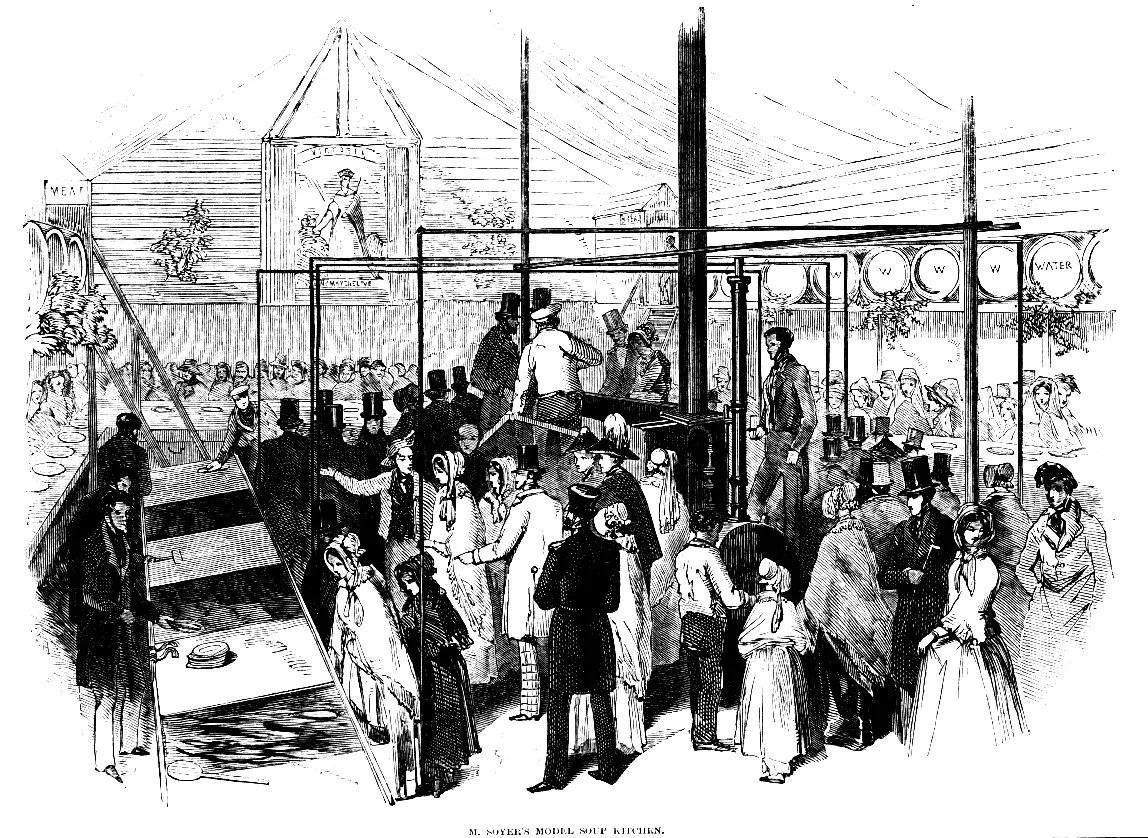
The Illustrated London News of 17 April described what he built. Its account, known today from a modern transcription, is mostly Soyer’s own plan: a steam boiler, a glaze pan of three hundred gallons, steam-heated pans holding a thousand gallons between them, and an oven for a hundredweight of bread. A hundred bowls stood on the tables, each with a spoon chained to it. A bell called in each hundred people, about every six minutes, which on his figures came to a thousand an hour, and a machine at the door counted everyone who passed. Each person was to leave with a quarter of a pound of bread or biscuit. On the Saturday after the opening, the paper reported, ladies of Dublin served the soup themselves, and nearly three thousand people were supplied.
The paper’s engraving, above, gives most of its space to the visitors in top hats and bonnets among the pipes and pans. The people being fed sit at long tables at the back, small and hard to make out.
What went into the pot
The same April issue printed Soyer’s receipt for a hundred gallons, and the list in the transcription matches, pound for pound, the one he reprinted ten years later in Soyer’s Culinary Campaign (1857). Per gallon, it comes to about two ounces of beef, six of flour and four of barley, with onions, leeks, celery and turnips by the pound and dripping to fry them.
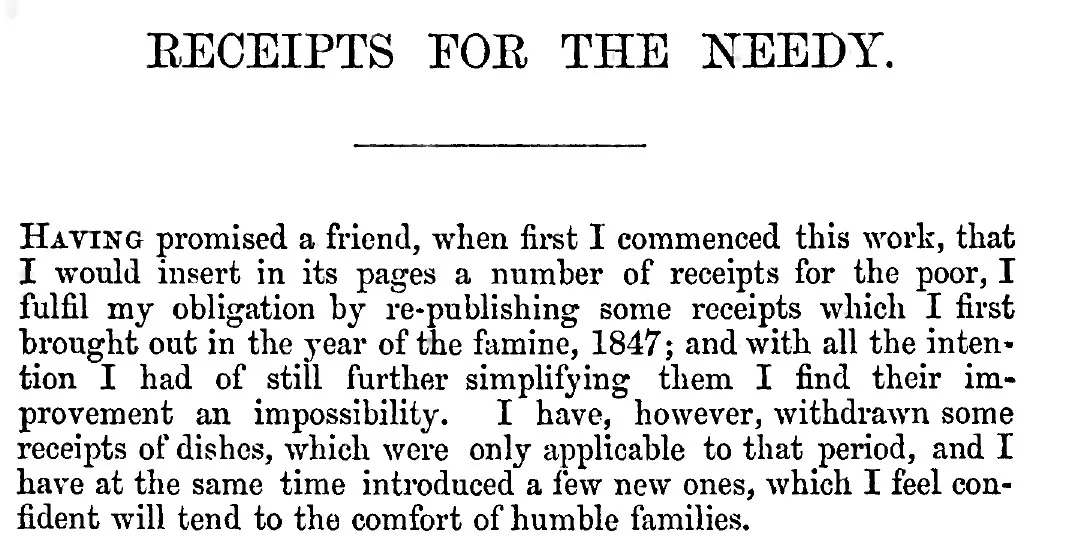 From Alexis Soyer, Soyer’s Culinary Campaign (London, 1857), p. 555.
In the 1857 book these soups open a section called “Receipts for the Needy,” which Soyer says reprints receipts “I first brought out in the year of the famine, 1847,” though he had “withdrawn some” and “introduced a few new ones.” His No. 1, for two gallons, is the household size of the boiler soup. A quarter of a pound of leg of beef goes in with dripping and two onions, and then the vegetables he wanted saved: the peeling of two turnips, fifteen green leaves or tops of celery and the green part of two leeks, “(the whole of which, I must observe, are always thrown away.)” Flour and barley thicken it, and it simmers three hours. His table prices the two gallons at sixpence, and he puts the soup at “three farthings per quart in London,” about 50p today by UK consumer prices (Bank of England).
He expected the objection. Nos. 1 and 2, he wrote, would not please “those who imagine that nothing can be good except plenty of animal food is used for the subsistence of man.” His answer was a promise: “the little animal substance I recommend, if closely followed, will produce all the nourishment requisite when amalgamated in the way described.”
Five shillings to watch
Not everyone in Dublin saw a model. The Freeman’s Journal, as Miller describes, attacked the opening as a show. On 10 April it called the occasion a soup fete and a degradation, and four days later it mocked the charge of five shillings a head (about £36 today) to watch the poor being fed, when the animals at the Zoological Gardens could be seen at feeding time for sixpence. The historian Norbert Götz describes the kitchen as a spectacle of mass feeding, and the engraving bears him out.
Too thin to live on?
The critics’ complaint was about quantity. In February 1847, before the Dublin kitchen opened, The Lancet reckoned that Soyer’s soups held less than three ounces of solid food to the quart, against the twelve to fourteen ounces a healthy person was then thought to need. The Edinburgh physician James Simpson wrote to the Chief Secretary for Ireland that most of Soyer’s soups had no meat in them. Queen Victoria’s physician Sir Henry Marsh argued in a pamphlet that a labourer’s food should be partly solid, because liquid soup passed through too quickly to sustain him. The chemist John Aldridge, reporting to the Royal Dublin Society, praised only one of Soyer’s soups, the one with fish in it.
These arguments rested on the chemistry of the 1840s, and Miller places them in their medical politics. In his account, no one on either side measured how the people who ate the soup fared. Count Rumford had made the same case for little meat to London’s soup houses in the 1790s, as What Was in London’s Penny Soup in 1799? tells.
Maize and a few potatoes
The other great relief food of those years was maize. Miller writes that Sir Robert Peel’s government bought £100,000 (about £17 million today) of Indian meal in America in the autumn of 1845, and that sales began in March 1846. It arrived unmilled and was often ground too coarsely, and he links the poorly ground meal to widespread illness.
Soyer’s No. 2, the receipt he names with No. 1 in his note on the 1847 receipts, is a maize soup: a quarter of a pound of beef, a few turnips or carrots and a pound and a half of maize flour to two gallons of water, boiled two hours and seasoned with drops of essence of garlic, mint and celery. “The great mistake at present in the use of Indian meal is, that it is not cooked enough, it being used similar to flour,” he wrote further on, and he wanted it simmered “never less than two hours.” The undated receipts that follow it in the 1857 book turn Indian meal into a stirabout with cheese and look to the coast, with fish cooked in oatmeal and a soup of beef and dillisk, the red seaweed better known as dulse.
The potato is scarce in these receipts. His No. 3 is No. 2 with a pound of potatoes added, for families who could get a few once a week. He describes them as people who had lived on the root and were now nearly without it, in the present tense of the famine years, and says each of them would “worship the day of the week” the soup came to the table.
Beyond the Barracks
Soyer’s shed drew the crowds and the engravers, but it was not the first soup kitchen in Ireland. Götz shows the relief committee of Skibbereen in County Cork opening its soup house on 7 November 1846, when the town’s workhouse could take no more, with forty gallons a day at first; a Quaker soup depot in Clonmel opened the same day. Skibbereen was feeding three thousand people a day by the end of January and about nine thousand through the spring. Götz argues that kitchens like Skibbereen’s, run by local committees, became the pattern for the national scheme, which between May and September 1847 fed up to three million people a day.
Eight years later Soyer took the same habit of weighing and measuring to the army hospitals of the Crimean War, as What Did Soyer Cook for the Soldiers at Scutari? follows.
The recipes
All three come from “Receipts for the Needy” in Soyer’s 1857 book, in his own order. No. 1 matches the Dublin pot, on the evidence of the newspaper’s list. In the passage that dates some of the section to 1847, Soyer names Nos. 1 and 2 as receipts he had made public, though the section was renumbered after 1847 (a cross-reference in No. 1 now points to the wrong receipt), so for No. 2 that rests on his word. No. 3 speaks of the potato failure as happening now. No list of what was served on a given day survives; the kitchen served soup, and these are three of Soyer’s soups for the famine.
- Soyer’s Soup No. 1 (1857): the two-gallon version of the Dublin receipt, cut to one gallon.
- Soyer’s Soup No. 2 (1857): maize flour with a little beef and turnip, boiled two hours.
- Soyer’s Potato Soup No. 3 (1857): No. 2 with diced potatoes, for the weeks a family could get some.
Cooking it
Make Soyer’s Soup No. 1 (1857) at its half size and the doctors’ arithmetic is on the board before you start: 55 grams of beef in four and a half liters of soup, and three hours at a bare simmer before the barley is soft. All three soups are in our Victorian recipes, with the mutton and barley he cooked at Scutari eight years later. At Scutari he gave recipes for the drinks in the wards as well, and Forgotten Drink, our sister site, makes his lemonade, rice water and barley water (opens in a new tab).
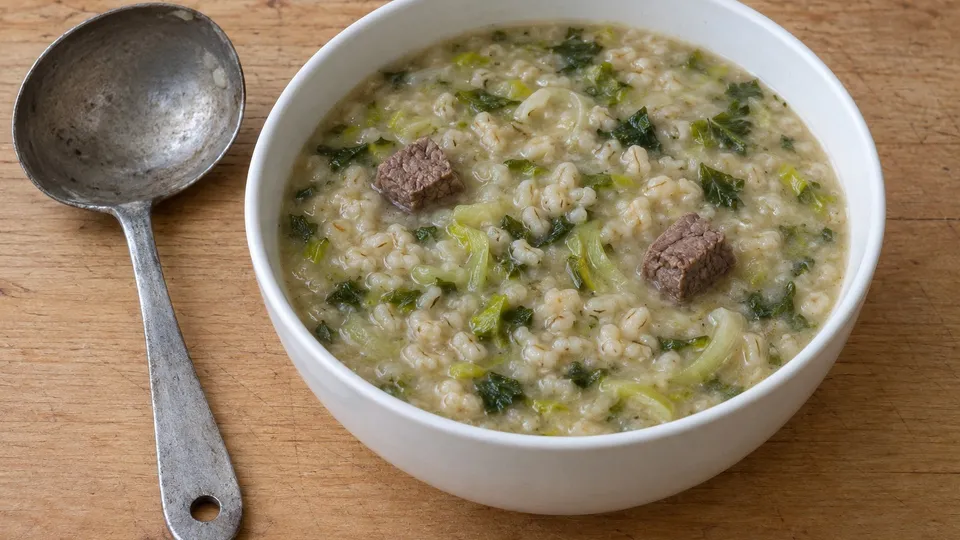 Cook it todaySoyer’s Soup No. 1 (1857)
Sources
- “M. Soyer’s Model Soup Kitchen,” Illustrated London News, 17 April 1847, p. 256, read in the transcription by Patricia Bixler Reber, Researching Food History (opens in a new tab), 4 September 2017.
- Alexis Soyer, Soyer’s Culinary Campaign (London: G. Routledge & Co.; New York: 18, Beekman Street, 1857), “Receipts for the Needy,” pp. 555–565. Internet Archive (opens in a new tab).
- Ian Miller, “The Chemistry of Famine: Nutritional Controversies and the Irish Famine, c.1845–7,” Medical History 56:4 (2012), 444–462. Cambridge Core (opens in a new tab).
- Norbert Götz, “Coping with the Great Irish Famine: the agency of Skibbereen,” Irish Historical Studies 50:177 (2026), 67–87. Cambridge Core (opens in a new tab).
- “Great Famine,” Encyclopaedia Britannica. Britannica (opens in a new tab).