Alexis Soyer’s hospital kitchens at Scutari · Scutari (Üsküdar), Constantinople
What Did Soyer Cook for the Soldiers at Scutari?
Mutton and barley soup, beef tea, broths and rice pudding, cooked by weight from the army ration: the hospital diets Alexis Soyer set up at Scutari in 1855.
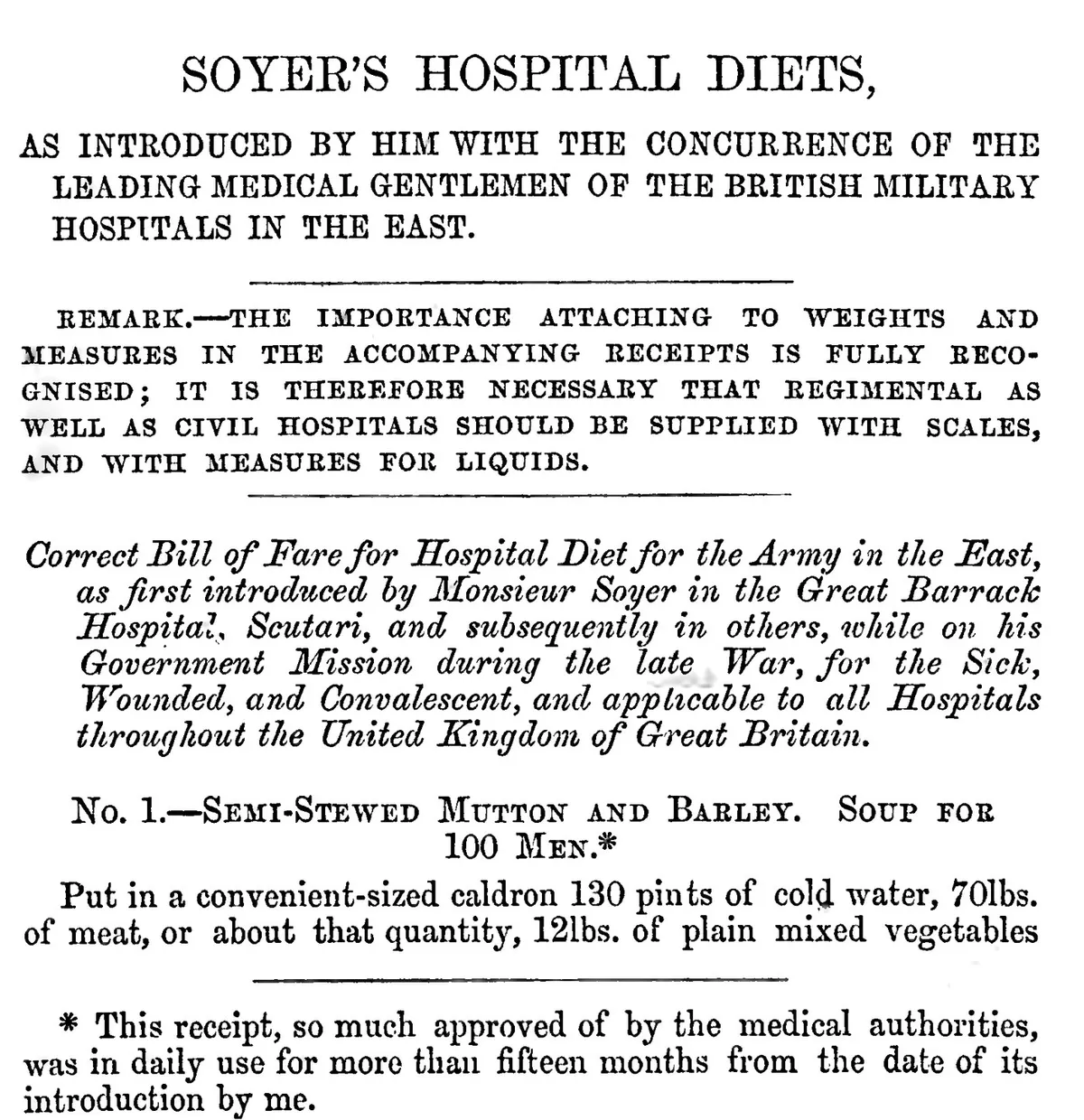
Soyer cooked soup, above all: a mutton and barley soup for the ordinary ward dinners, and beef tea, chicken and mutton broth, rice water, barley water and puddings for the men on extra diets, all made from the army rations the hospital already drew. His bigger change was in the cooking itself. He weighed everything, hung the receipts on the kitchen wall, timed the boiling, and worked on how a hot dinner could still be hot when it reached a bed at the far end of a corridor. Alexis Soyer, a London chef who had offered to go out at his own expense, did this at the British army hospitals at Scutari, across the Bosphorus from Constantinople, in the spring of 1855.
A chef at the Barrack Hospital
Soyer reached Constantinople, by his own account in Soyer’s Culinary Campaign (1857), on a “showery March day” in 1855, in the middle of the Crimean War, and sent word across the water to Lord William Paulet, who commanded at the Barrack Hospital in Scutari.
He did not find an empty field. His first stop was Florence Nightingale’s dietary kitchen, where he recognized a set of camp cooking pans the Duke of Cambridge had given to the hospital, every piece in use. “Miss Nightingale had a civilian cook as well as an assistant,” he wrote, and everything was in as good order as could be expected. His one complaint there was the charcoal, which “smoked terribly, and was nothing but dust,” and held up the diets.
Thin soup and tough mutton
The trouble was in the main kitchens and the wards. The rations were boiled by messes in great fixed coppers. Soyer went round the wards with Dr. Macgregor and Miss Nightingale at dinner and found the men eating their meat first and their soup after. Each had one plate, and what they called a plate “was a round and deep tin dish, which held a pound of meat and a pint of soup.” By the time the meat was carved, the soup was cold. He told them to cut the meat small in the dish and pour the boiling soup over it, so that both stayed warm.
Then he tasted. “The former was thin and without seasoning; the latter, mutton, tough and tasteless. The potatoes were watery.” In one ward the men said their meat was raw. Soyer blamed the skewer: each mess’s joints were tied tight on one stick, so the middle never cooked while the loose ends were overdone. The orderlies marked their messes with whatever came to hand, he says: a scrap of red cloth from an old jacket, a bunch of old buttons, and in one case a pair of old candle snuffers, all boiled with the meat every day.
After dinner had gone out, he found a copper still half full of broth with three inches of fat on top. “Throw it away, sir,” was the answer when he asked what became of it. “Do you call that water? I call it strong broth,” Soyer replied, and the next day he showed the men how to make soup of it. “Not less than seventy pounds of beef had been daily boiled in this manner, and without salt,” he wrote. The fat, in his view, cooked better than the rank butter bought in Constantinople.
A soup for six
Before changing anything at scale, Soyer drew six rations of everything allowed for soup and cooked them himself. “To eight pints of water I put four pounds of meat, a quarter of a pound of barley, a little salt and pepper, and the allowance of vegetables,” he wrote, and in about an hour several doctors were praising the result.
Dr. Cumming, the senior medical officer at Scutari, feared it would cost too much, until Soyer explained that he had used the meat of the half diet, the smaller of the two hospital rations. Cumming suggested putting the seasoning in with everything else from the start. Soyer agreed and said he could improve it further with “a small quantity of sugar and flour.” Both changes appear in the soup he printed in 1857 for a hundred men, though its amounts differ from the six-ration trial.
Receipts on the wall
Soyer’s method was arithmetic. He drew up one receipt by weight for beef soup and one by measure for mutton soup, the meat the convalescents mostly got, and hung copies in the kitchen with a set of scales. “Every soldier had become a cook,” he wrote. “So simple was this plan, that it was as easy to cook for thousands as it had before been for hundreds.”
Patient numbers changed daily, so all the coppers but one held a full 150 diets, and the last ran on a sliding scale. Numbered skewers of tinned iron replaced the buttons and snuffers, because “expedition, cleanliness, and proportion should be the motto of all such establishments.”
Opening day
Soyer opened his kitchen at the Barrack Hospital with a public trial, and he wrote later that he felt twenty years’ work was riding on it. He set his diets on a table, each beside the same diet made by the soldier cooks, and told Dr. Cumming that everything came from the usual allowance and would “cost about the same, or even less, when made in large quantities.” The first was beef tea. “Tasting my sample first, Doctor Cumming pronounced it good; the other, without taste or flavour. No. 1 was adopted.”
The broths, waters and jellies followed, and by half past twelve the kitchen was crowded with officers and doctors, and Lord William Paulet wrote a note on the spot, which Soyer printed: “I could not have believed that such an amelioration could have been produced from the same materials as allowed by Government.”
Getting dinner to the ward
A few days later Soyer closed the extra-diet kitchens, except Miss Nightingale’s and one under Dr. Taylor, and brought the cooking into one large kitchen. By his own count the twenty or so soldier cooks he discharged had “consumed daily ten times more fuel than was required”; two civilian cooks with six soldiers took over the extra diets.
The last problem was distance, since dinners cooled on the long way to the wards. “Miss Nightingale submitted a very excellent plan, which was adopted with success,” Soyer wrote: double cases filled with boiling water, which kept the food in their divisions hot much longer, two to each ward.
His field stove is harder to place at Scutari. Before leaving for the Crimea, Soyer told Paulet that he had used “the Turkish coppers at the hospital, which answer perfectly well,” and asked for the stoves he was expecting to be sent on to the Crimea.
What the book proves
A printed recipe, a doctor’s verdict on a sample and a soldier eating his dinner are three different things, and Soyer’s book is strong on the first two. It prints his hospital diets at the back as a “Correct Bill of Fare for Hospital Diet for the Army in the East, as first introduced by Monsieur Soyer in the Great Barrack Hospital, Scutari.” A footnote says the mutton and barley soup was “in daily use for more than fifteen months from the date of its introduction by me.” That is his claim, with no kitchen register or patient’s diet sheet beside it.
Florence Nightingale’s letter of 28 July 1856, as Soyer printed it, says he worked first in the hospitals of Scutari and then in the camp hospitals of the Crimea, and “took the soldiers’ rations and patients’ diets as they were, and converted them into wholesome and agreeable food.” That judges the food; whether it made men well is a question neither she nor Soyer answers with figures.
Soup by the copper was not new. London’s soup houses had printed receipts for a hundred gallons half a century earlier, as What Was in London’s Penny Soup in 1799? shows. Soyer’s addition was a sick ward at the end of the line: the weights, the timing and the carrying all aimed at a pint of soup that arrived hot.
The recipes
The three recipes come from the “Hospital Diets” at the back of Soyer’s 1857 book, his numbers 1, 3 and 27. They are his printed formulas; none records one patient’s tray, and the order here is ours.
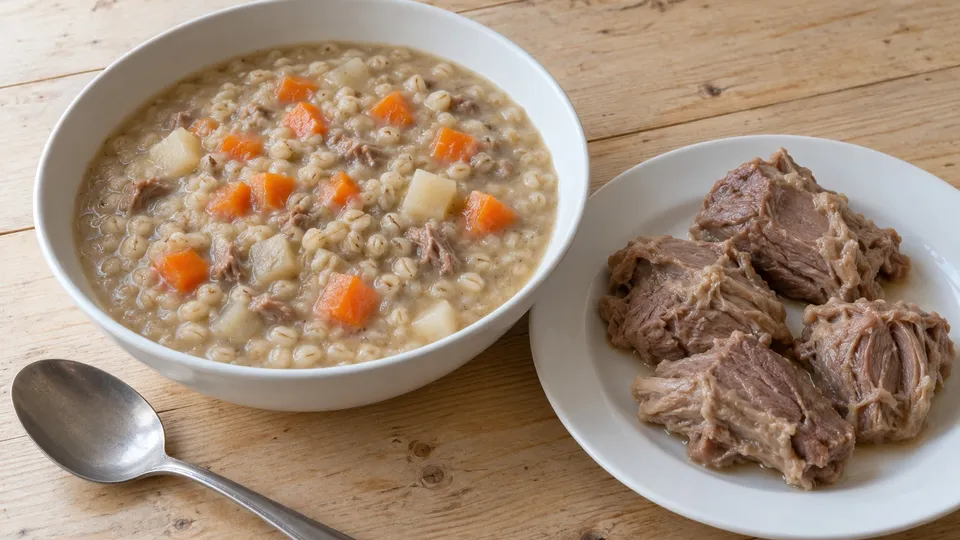
- Semi-Stewed Mutton and Barley (1857): the ward soup, Soyer’s No. 1, cut down from a hundred men to a home pot.
- Beef Tea (1857): the first sample tasted on opening day.
- Rich Rice Pudding (1857): rice in milk with lemon peel, set with eggs, a richer cousin of the puddings Soyer tried at Scutari.
Cooking it
The Semi-Stewed Mutton and Barley (1857) needs a bone-in lamb or mutton shoulder, a cup of barley and three hours of quiet simmering, and for the full Scutari effect, cut the meat into the bowl and ladle the boiling soup over it, the way Soyer told the men in the wards. The three hospital dishes are among our Victorian recipes, as are his soups for Dublin. Soyer and Nightingale both had views on the coffee pot too, and Forgotten Drink, our sister site, sets them side by side in why Victorians put chicory in their coffee (opens in a new tab).
 Cook it todaySemi-Stewed Mutton and Barley (1857)
Sources
- Alexis Soyer, Soyer’s Culinary Campaign: Being Historical Reminiscences of the Late War. With the Plain Art of Cookery for Military and Civil Institutions, the Army, Navy, Public, etc. etc. (London: G. Routledge & Co.; New York: 18, Beekman Street, 1857), pp. 83, 105, 114–116, 121–122, 124–125, 130–132, 134–135, 137, 417, 513–514, 520. Internet Archive (opens in a new tab).
- Sir Zachary Cope, “Alexis Soyer and the Crimean War,” Proceedings of the Nutrition Society 18 (1959), 6–8. Cambridge Core (opens in a new tab).