The soup house at Spitalfields, London · No. 53, Brick Lane, Spitalfields, London
What Was in London’s Penny Soup in 1799?
London’s soup houses of 1799 sold the poor a penny quart of beef, shin, split peas, Scotch barley and onions, simmered all night in iron boilers on Brick Lane.
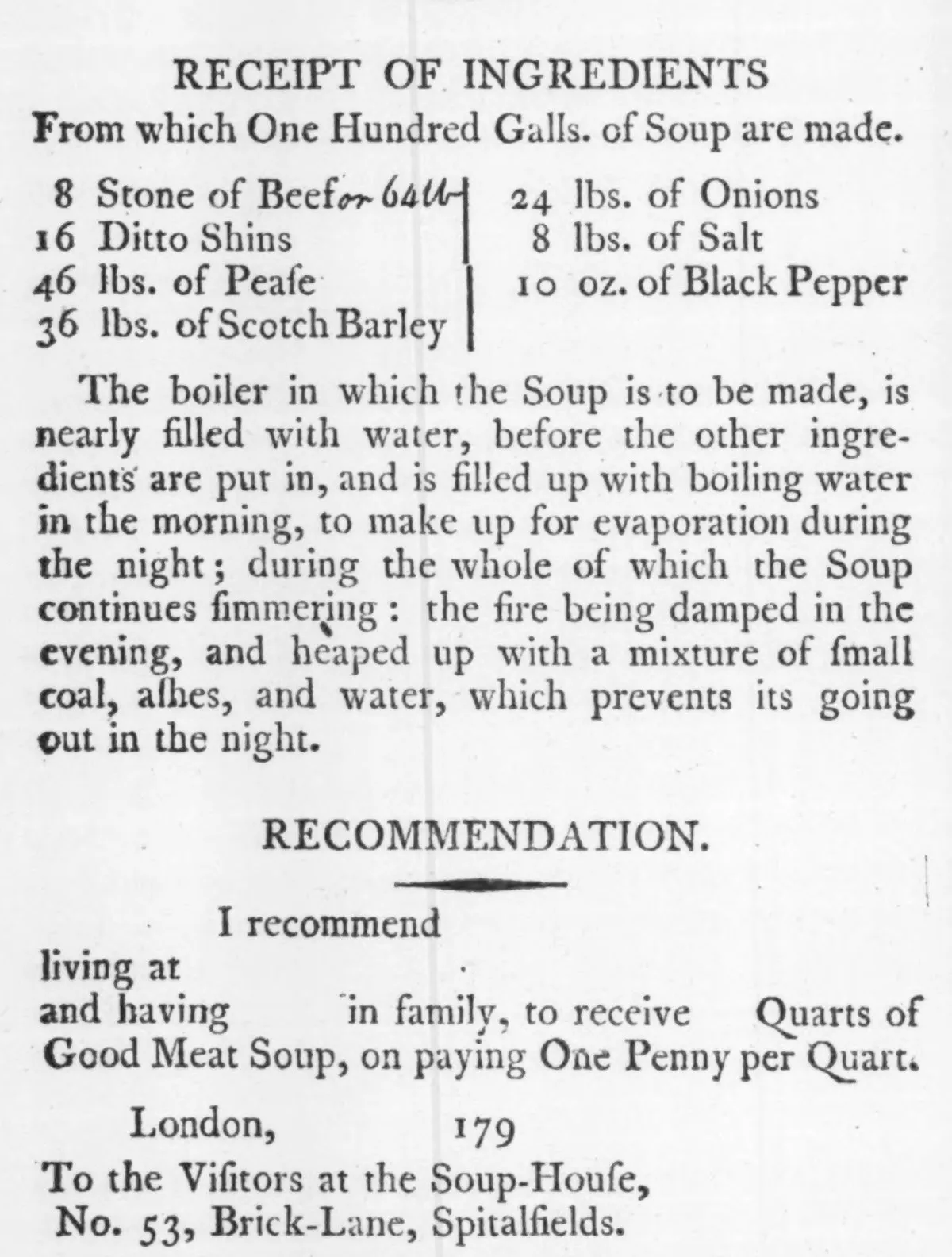
Beef, beef shins, split peas, Scotch barley, onions, salt and black pepper. That is the whole receipt for the soup the Spitalfields soup house on Brick Lane sold in the winters of the late 1790s, printed in 1799 so other towns could copy it: a hundred gallons at a time, simmered all night, sold the next morning at one penny a quart (about 70p today, by the Bank of England’s measure of UK prices). It was meat soup, thick with grain and peas, and its buyers took more than 150,000 quarts of it in one winter.
A penny a quart
The 1790s were hungry years in England, and the society’s account of 1799 opens on a failed harvest: bread had risen so far “that the small earnings of very many families are wholly expended in the purchase of it alone.” In the winter of 1797 a group of Londoners had formed a society to help the poor of Spitalfields, a district of silk weavers and other families “employed in manufactories.” They decided against giving out fuel or clothing, which could be traded for spirits or “conveyed to the pawnbroker’s shop,” or raw food the poor would have to cook. They chose food ready cooked instead, and of all foods “a Good Meat Soup,” because no other way of cooking gave as much nourishment for the money.
The soup was sold. A subscriber to the society signed a printed recommendation for a family, naming how many quarts it should have, and the family took it to the soup house between eleven and one with a penny for each quart. Two or three people in a family were allowed two quarts, four or five people three. The society thought the price would help those “laudably anxious to provide for their families by their own industry” and keep them off parish relief. It cost the society more than it charged: “rather more than 1¾d. per quart,” by its own account, about £1.20 today.
The numbers grew fast. In the winter of 1797 to 1798, the soup house was open 88 days and sold 114,502 quarts. The next winter it was open 125 days and sold 152,489. Four iron boilers on the premises could make upwards of 2,100 quarts a day, and the visitors on duty could serve it all in less than two and a half hours. Other soup houses opened across London on a similar plan, and the Spitalfields society published its accounts in 1799 so that towns and villages could follow.
The receipt
The receipt, “a copy of which is hung up in the Boiling house for reference,” is printed on page 14 of the society’s account. For a hundred gallons it takes 8 stone of beef (a hand in this copy has written “or 64 lb” beside it, using the butcher’s stone of 8 pounds), 16 more stone of shins (the receipt says “Ditto”), 46 pounds of peas, 36 pounds of Scotch barley, 24 pounds of onions, 8 pounds of salt and 10 ounces of black pepper.
The method is in the routine. At six in the evening, two of the society’s members on duty watched the day’s meat weighed, cut up and put into the boilers, and the peas and other ingredients weighed out. The boiler was “nearly filled with water” before anything went in. The fire was damped for the night with “a mixture of small coal, ashes, and water,” and the soup simmered until morning, when boiling water was added to make up what had evaporated. The keys of the larder and the store room went to the woman who lived in the house as superintendent, and before eleven the next morning the visitors were back to serve.
Per gallon, the receipt works out to about 10 ounces of beef, a little over a pound of shin, 7 ounces of peas, 6 of barley and 4 of onion. Simmered all night, peas and barley break down and thicken the soup, and the shins give it body. It is close to a modern split pea and barley soup with beef, salted harder than a modern cook would salt it.
Rumford’s argument
The best-known name in the soup business of those years was Benjamin Thompson, Count Rumford, an American-born soldier and scientist who had organized the feeding of the poor in Munich, and whose essays of the 1790s urged the British to do the same. The Munich soup, he wrote, had been copied at Hamburg, Geneva, Lausanne, Marseilles and Paris, and its “basis” was “barley, potatoes, and peas or beans.” In an advertisement printed in the third volume of his Essays (1802), he wrote that the soup houses lately formed in London and elsewhere were partly his doing: “The share I have had in bringing these establishments into use” made him anxious to point out their mistakes.
His first complaint went straight at Spitalfields’ kind of soup. “Many persons in this country are of opinion that a great deal of meat is necessary in order to make a good and wholesome soup,” he wrote, “but this is far from being the case in fact.” Soups thick with “farinacious matter,” barley, potatoes, peas or beans, and seasoned with salt, pepper, onions, a little salted herring, hung beef, bacon or cheese, were cheaper and, in his view, better. The poor should be given food they could later make “at their own dwellings, at a small expence”; selling them “rich and expensive meat soups at reduced prices” in a time of scarcity would, he warned, “operate as a great and a permanent evil to themselves and to society.”
His second point was bread. “No ingredient is, in my opinion, so indispensably necessary in the soups that are furnished to the poor as bread,” he wrote. Toasted or fried and broken into small pieces, it made a bowl last longer and fill more, and he was “confident that four ounces that would otherwise be eaten by the poor at their homes, would be saved” for every ounce put into the soup. In 1918 Americans were asked to stretch their grain the same way, as How Did You Feed a Hundred People Without Wheat in 1918? tells.
The Spitalfields receipt shares his barley and peas, but its meat is the whole point of its name, and it says nothing of bread.
Soup from the household
Not every soup for the poor came from a soup house. Maria Eliza Rundell’s A New System of Domestic Cookery, printed in London in 1806, has a section near the end, “Respecting the Poor,” with hints “to enable every family to assist the poor of their neighbourhood at a very trivial expence.” Among them is a baked soup: a pound of any meat, onions, carrots, a little rice, a pint of split peas and a gallon of water, covered close in an earthen pan and baked alongside the bread. She told the cook to save the water every joint was boiled in, the bones and the scraps from the plates, and to make some gallons of soup two or three times a week.
Rundell had lived through a time of scarcity too. “I found, in the time of scarcity, ten or fifteen gallons of soup could be dealt out weekly, at an expence not worth mentioning,” she wrote. If ten wealthy houses in the villages round London did the same, a hundred gallons a week would feed forty poor families. “What a relief to the labouring husband, instead of bread and cheese, to have a warm comfortable meal!”
Her book also has a soup with no meat at all. Her “Another Vegetable Soup” is onions, potatoes, carrots and turnips fried in butter, stewed for hours with celery, herbs and a crust of bread toasted “as brown and hard as possible.”
The recipes
The meat soup is the Spitalfields receipt cut down to one gallon; the method follows the society’s, with a stovetop in place of the overnight boiler. The other two are Rundell’s, from her first edition of 1806, a few years after the soup house winters.
- Spitalfields Meat Soup (1799): beef, shin, split peas, Scotch barley and onion, simmered long and well salted.
- Baked Soup for the Poor (1806): meat, split peas, rice and vegetables baked in a covered pot.
- Vegetable Soup with a Toasted Crust (1806): onions, roots and a hard-toasted crust stewed into a meatless broth.
Cooking it
Make the Spitalfields Meat Soup (1799) on a cold weekend: it wants five hours on the stove, and a pound and a quarter of shank with a cup each of split peas and barley makes enough for eight. Serve it as Rumford would have wanted, with toasted bread broken into the bowl. The Spitalfields pot is one of our 18th-century recipes. The same streets sold a hot drink before dawn, and Forgotten Drink, our sister site, tells the story of saloop (opens in a new tab), poured from London stalls until the 1840s.
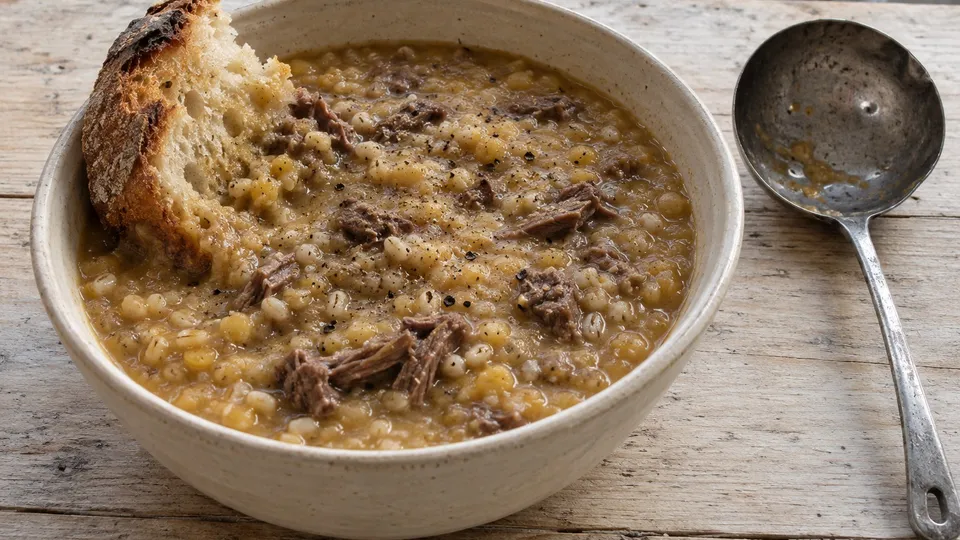 Cook it todaySpitalfields Meat Soup (1799)
Sources
- The Economy of an Institution, Established in Spitalfields, London, for the Purpose of Supplying the Poor with a Good Meat Soup, at One Penny per Quart (London: W. Phillips, 1799), pp. 3–14.
- Benjamin Thompson, Count Rumford, Essays, Political, Economical, and Philosophical, vol. III (London, 1802), Advertisement, pp. iv–vii.
- Maria Eliza Rundell, A New System of Domestic Cookery (London: J. Murray and J. Harding, 1806), pp. 98 and 264–266.