Spitalfields Meat Soup (1799)
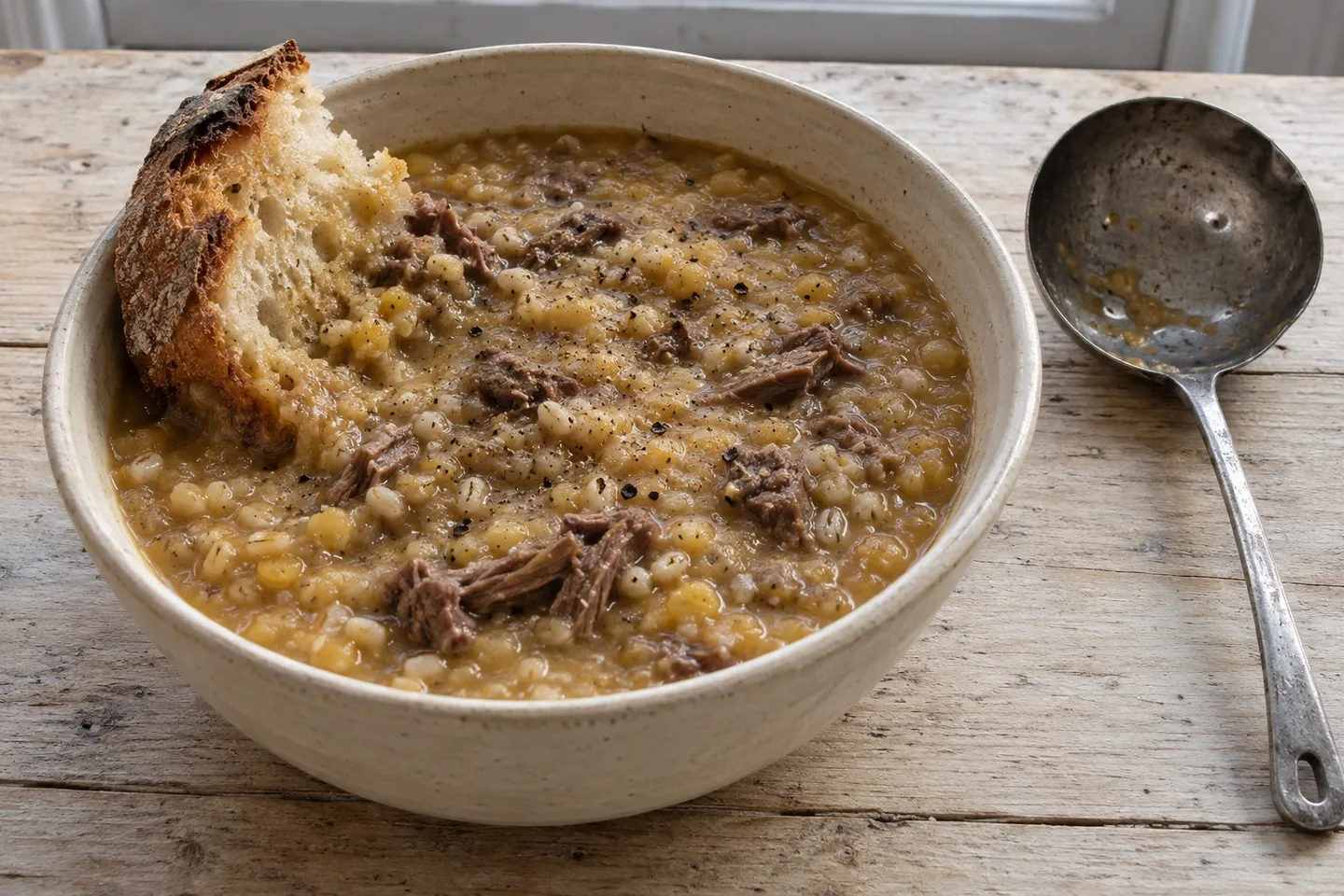
Reader ratingsSpitalfields meat soup, the penny-a-quart soup of the Spitalfields soup house, 1799: beef and shin simmered for hours with split peas, Scotch barley, onion, salt and black pepper.
- Recipe makes
- About 1 gallon, 8 servings
- Prep
- Cook
- Total
The soup house simmered it all night. On the stove it needs about 5 hours at the barest simmer; stir often once the peas and barley start to thicken it.
Beef soup thickened with split peas and barley, with toasted bread.
The story behind the recipe
A penny bought a quart of this soup in Spitalfields in the winters of the late 1790s, and the soup house on Brick Lane sold more than 150,000 quarts in a single winter. The society that ran it printed its “Receipt of Ingredients” in 1799 so that other towns could copy it: beef, shins, peas, Scotch barley, onions, salt and black pepper, a hundred gallons at a time.
What was in the penny soup?
There are no herbs, no carrots and no thickening besides the peas and barley: only beef, shin, peas, barley and onion, with a good deal of salt and some black pepper. The soup house made it overnight in iron boilers and served it from eleven the next morning; What Was in London’s Penny Soup in 1799? follows the routine from the weighing of the meat to the morning’s serving.
Read more about this recipe
Was it a good soup?
The society called it “a Good Meat Soup,” and its buyers seem to have agreed: when the soup house closed for the season, the account says, many families spoke of it with “regret, mingled with gratitude and commendation.” Count Rumford, the great promoter of soup for the poor, thought soups like it used too much meat. He would have broken bread into it, and so can you.
Making it today
Crosscut beef shank is sold for braising; the bone and its marrow give the soup the body the soup house got from its shins. Split peas and barley soften into a thick soup after a few hours. Keep the heat as low as it will go, stir from the bottom often in the last two hours, and add boiling water whenever it gets too thick to stir. Rundell’s Baked Soup for the Poor (1806) is the same idea made in a household oven.
RECEIPT OF INGREDIENTS
From which One Hundred Galls. of Soup are made.
8 Stone of Beef, 16 Ditto Shins, 46 lbs. of Pease, 36 lbs. of Scotch Barley, 24 lbs. of Onions, 8 lbs. of Salt, 10 oz. of Black Pepper.
The boiler in which the Soup is to be made, is nearly filled with water, before the other ingredients are put in, and is filled up with boiling water in the morning, to make up for evaporation during the night; during the whole of which the Soup continues simmering: the fire being damped in the evening, and heaped up with a mixture of small coal, ashes, and water, which prevents its going out in the night.
Recipe makes: About 1 gallon, 8 servings
Ingredients
For about 1 gallon, 8 servings. Quantities are shown as written.
Quantities as written here, for about 1 gallon, 8 servings.
- Bone-in beef shank, cut crosswise1.25 lb
- Boneless beef chuck, in 1-inch pieces0.67 lb
- Yellow split peas, rinsed1 cup
- Pot barley or pearl barley, rinsed1 cup
- Medium onion, chopped1
- Cold water, plus boiling water as needed5 quart
- Salt, plus more to taste1 tbsp
- Ground black pepper1 1/4 tsp
- Toasted bread, to serve (optional)
Measurement notes
Ingredients as written here
- 1¼ lb bone-in beef shank, cut crosswise
- ⅔ lb boneless beef chuck, in 1-inch pieces
- 1 cup yellow split peas, rinsed
- 1 cup pot barley or pearl barley, rinsed
- 1 medium onion, chopped
- 5 quarts cold water, plus boiling water as needed
- 1 tbsp salt, plus more to taste
- 1¼ tsp ground black pepper
- Toasted bread, to serve (optional)
Equipment
- Large heavy pot, at least 8 quarts, with a lid
 Kettle
- Long wooden spoon
- Cutting board and knife
Instructions
Pour the water into the pot and bring it to a boil.
Add the beef shank, beef chuck, split peas, barley, onion, salt and black pepper. Bring it back to a boil and skim off the gray foam that rises.
Turn the heat down as low as it will go, so the surface barely trembles. Cover the pot with the lid slightly ajar and simmer for about 5 hours, stirring from the bottom every half hour, and more often once the soup starts to thicken. Top it up with boiling water from the kettle whenever it gets too thick to stir easily.
When the shank meat falls from the bone, lift out the shank. Pull the meat and marrow from the bone, chop the meat and return it to the pot. Discard the bone.
Taste and add more salt if it needs it. The soup should be thick enough to coat the spoon, with the peas fully broken down.
Ladle it into bowls and serve hot, with toasted bread broken into it if you like.
Nutrition
340calories per serving
- Recipe makes
- About 1 gallon, 8 servings
- Servings
- 8
Estimated per serving (8) from USDA FoodData Central values for beef shank and chuck, split peas, pearl barley and onion; bread not included.
Recipe notes
When adjusting quantities
This is the soup house’s receipt cut from 100 gallons to one. It doubles well if your pot holds 10 quarts or more.
Notes
Quantities mentioned in these notes don’t change when you adjust the servings.
The soup house’s “stone” of meat was the butcher’s stone of 8 pounds, as a hand in the Internet Archive copy notes beside the beef (“or 64 lb”); the shins are read the same way. Our amounts are the receipt divided by 100, rounded to what you can buy, except the salt: the receipt’s comes to about 2 tablespoons a gallon, and this recipe starts with half that and salt to taste. Chuck stands in for its unnamed cut of beef, crosscut shank for its shins, and yellow split peas for its “pease.” Pot or pearl barley stands in for Scotch barley. We chose the 5 quarts of water, the skimming, the lid set ajar, a stovetop simmer of about 5 hours in place of the overnight boiler, and taking the meat off the bone. The toasted bread comes from Rumford; the receipt has none. Leftover soup thickens as it cools; chill it within 2 hours, keep it up to 4 days in the refrigerator and loosen it with water when you reheat it. Contains gluten (barley).
Scaling changes the ingredients only; pan sizes and cooking times need their own judgment. To adapt this recipe further, try the recipe tool at TuneMyRecipe (opens in a new tab), our sister site.
Sources and attribution
After The Economy of an Institution, Established in Spitalfields, London (London, 1799), Receipt of Ingredients
See the original pages (scan at Internet Archive) (opens in a new tab)
Recipe details
- Course
- Soup
- Dish family
- Soups & Broths
- Region
- British
- Era
- 18th century
- Main ingredient
- BeefGrains & rice
- Difficulty
- Easy
- Occasion
- Everyday meal
- Season
- Winter