Portable Soup (1747)
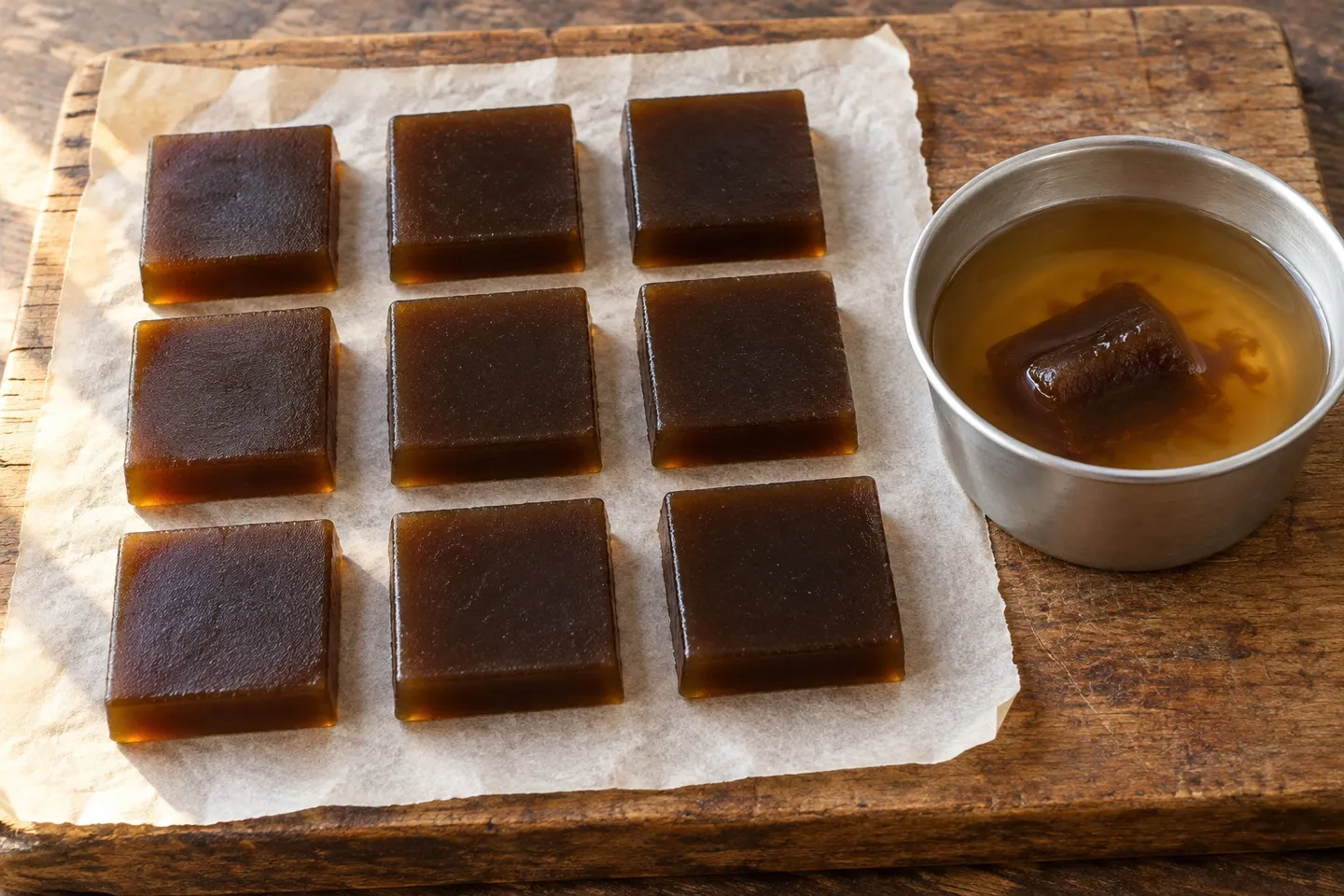
Reader ratingsBeef shin boiled with anchovies, mace and herbs, then reduced to a firm glaze that melts back into broth: Hannah Glasse’s portable soup of 1747.
- Recipe makes
- About 1½ cups glaze, about 24 pieces
- Prep
- Cook
- Total
Spread it over two days. The broth simmers for about 6 hours and chills overnight so the fat can be lifted off; the next day it reduces for 1 to 2 hours and sets in the refrigerator for about 2 hours.
Squares of portable soup and a cup of the broth made from one.
The story behind the recipe
Two legs of beef go into Hannah Glasse’s pot and come out as hard brown cakes, stored in stone pots, that melt back into broth in a pint of boiling water. Her portable soup, printed in The Art of Cookery in 1747, was the stock cube of its century. James Cook named portable soup among the three stores that kept the Endeavour’s crew healthy in 1769, and on his second voyage, in the Resolution, his men had an ounce each boiled with their pease three days a week, as What Did Captain Cook Feed His Crew to Keep Them Well? tells.
What was portable soup?
A meat broth with nearly all its water taken out. Glasse boils the beef “softly for eight or nine Hours” with anchovies, mace, cloves, pepper, onions, thyme, marjoram, winter savory and a dry crust of bread, until a spoonful sets firm when it cools. The jelly is strained, freed of fat and boiled again, stirred so it can’t catch, until it is so thick it gathers in lumps. The last stage happens in china cups set in boiling water, where the jelly thickens without burning. Then it is turned out on new flannel and dried in a warm place until quite hard. “A Piece as big as a large Walnut, will make a Pint of Water very rich,” she says.
Read more about this recipe
Was it the navy’s recipe?
No. The navy’s was made for its Victualling Office from the bones and scraps, feet and shins among them, of cattle killed for salt beef. Glasse’s is the household way of doing the same thing.
Making it today
Beef shin is rich in gelatin, and its sinews help the jelly set. Glasse’s anchovies and spices were measured for fifty pounds of beef on the bone; this is about a sixth of her batch, with everything in proportion. We follow her method to the glue stage and stop before the flannel. Drying meat jelly for days at room temperature is not safe in a home kitchen, so the glaze sets in the refrigerator and keeps there or in the freezer. It is softer than her dried cakes, so we melt a piece in a cup of water where she used a pint. A piece of it finishes the Pease Soup for Sea (1747), as Glasse suggests.
TAKE two Legs of Beef, about fifty Pounds Weight, take off all the Skin and Fat as well as you can, then take all the Meat and Sinews clean from the Bones, which Meat put into a large Pot, and put to it eight or nine Gallons of soft Water; first make it boil, then put in twelve Anchovies, an Ounce of Mace, a Quarter of an Ounce of Cloves, an Ounce of whole Pepper black and white together, six large Onions peeled, and cut in two, a little Bundle of Thyme, Sweet Margoram, and Winter-savory, the dry hard Crust of a Two-penny Loaf, stir it all together, and cover it close, lay a Weight on the Cover to keep it close down, and let it boil softly for eight or nine Hours, then uncover it, and stir it together. Cover it close again, and let it boil till it is a very rich good Jelly, which you will know by taking a little out now and then, and let it cool. When you find it is a thick Jelly, take it off and strain it through a coarse Hair-bag, and press it hard; then strain it through a Hair-sieve into a large Earthen Pan, when it is quite cold, take off all the Skim and Fat, and take the fine Jelly clear from the Settlings at Bottom, and put the Jelly into a large deep well-tinned Stew-pan. Set it over a Stove with a slow Fire, keep stirring it often, take great Care it neither sticks to the Pan, or burns; and when you find the Jelly is very stiff and thick, as it will be in Lumps about the Pan, take it out, and put it into large deep China-Cups, or well-glazed Earthen Ware. Fill the Pan two Thirds full with Water, when the Water boils, set in your Cups, be sure no Water gets into the Cups, keep the Water boiling softly all the time, till you find the Jelly is like a stiff Glew; then take out the Cups, and when they are cool, turn out the Glew into coarse new Flannel. Let it lay eight or nine Hours, keeping it in a dry warm Place, and turn it on fresh Flannel till it is quite dry, and the Glew will be quite hard; then put it into clean new Stone-pots, keep it close coloured from Dust and Dirt, and in a dry Place, where no Damp can come to it.
When you use it, pour boiling Water on it, and stir it all the time till it is melted. Season it with Salt to your Palate; a Piece as big as a large Walnut, will make a Pint of Water very rich; but as to that you are to make it as good as you please; if for Soop, fry a French Role and lay in the Middle of the Dish, when the Glew is dissolved in the Water, give it a boil, and pour it into the Dish; if you chuse it for Change, you may boil either Rice, Barley, or Vermecilly, Salary cut small, Truffles or Morels; but let them be very tenderly boiled in the Water before you stir in the Glew, and then give it a boil all together. ...
Recipe makes: About 1½ cups glaze, about 24 pieces
Ingredients
For about 1½ cups glaze, about 24 pieces. Quantities are shown as written.
Quantities as written here, for about 1½ cups glaze, about 24 pieces.
- Boneless beef shin5 lb
- Cold water5 quart
- Anchovy fillets in oil, drained4
- Blade mace1 tbsp
- Cloves12
- Black peppercorns1 tsp
- White peppercorns1/2 tsp
- Large onion, peeled and halved1
- Fresh thyme4 sprigs
- Fresh marjoram2 sprigs
- Winter or summer savory2 sprigs
- Dry bread crust30 g
- Salt, to taste when serving
- Boiling water, about 1 cup per piece, for serving
Measurement notes
Ingredients as written here
- 5 lb boneless beef shin
- 5 quarts cold water
- 4 anchovy fillets in oil, drained
- 1 tbsp blade mace
- 12 whole cloves
- 1 tsp black peppercorns
- ½ tsp white peppercorns
- 1 large onion, peeled and halved
- 4 sprigs fresh thyme
- 2 sprigs fresh marjoram
- 2 sprigs winter or summer savory
- 30 g dry bread crust
- Salt, to taste when serving
- Boiling water, about 1 cup per piece, for serving
Equipment
- Stockpot of at least 8 quarts, with a lid
- Colander and fine sieve
- Cheesecloth
 Large heatproof bowl
- Wide, heavy saucepan
- Heatproof bowl that sits over a saucepan of water
- Small shallow dish, about 6 inches square, lined with parchment paper, or a silicone ice-cube tray
- Cold saucer, for testing
Instructions
Trim any skin and outer fat from the beef shin and cut the meat into large chunks, keeping the sinews.
Put the beef in the stockpot with the water and bring it to a boil over medium-high heat, skimming off the gray scum as it rises.
Add the anchovies, mace, cloves, black and white peppercorns, onion, thyme, marjoram, savory and bread crust. Stir, cover the pot and turn the heat down until the liquid barely trembles. Simmer for 6 hours, stirring once or twice.
Spoon a little broth onto the cold saucer and chill it for 5 minutes. It should set into a soft jelly. If it stays liquid, simmer uncovered for another 30 to 60 minutes and test again.
Strain the broth through the colander into the large bowl, pressing hard on the meat, then strain it again through the sieve lined with cheesecloth. Set the bowl in a sink of ice water and stir until the broth is cool, then cover and refrigerate overnight.
Lift the hard layer of fat off the top. Scoop the clear jelly into the wide saucepan, leaving the cloudy sediment at the bottom of the bowl behind.
Boil the jelly uncovered over medium heat, skimming off any scum. As it thickens, lower the heat and stir often, scraping the bottom and sides of the pan, so it doesn’t catch. It is ready for the next stage when it is thick and syrupy, bubbles slowly in large bubbles, and a drop on the cold saucer sets firm within a minute.
Pour it into the heatproof bowl and set the bowl over a saucepan of gently simmering water, taking care that no water gets in. Cook, stirring now and then, for 30 to 60 minutes, until it is like stiff glue and hardly runs off the spoon.
Scrape the glaze into the lined dish or the ice-cube tray, about ½ inch deep. Let it cool for 20 minutes, then cover and refrigerate for about 2 hours, until firm.
Turn the glaze out and cut it into small squares, each about the size of a walnut. Wrap them and keep them in the refrigerator, or freeze them.
To make broth, pour the boiling water over a piece and stir until it melts. Season with salt to taste. Use two pieces for a stronger broth or for gravy.
Nutrition
35calories per serving
- Recipe makes
- About 1½ cups glaze, about 24 pieces
- Servings
- 24
Estimated per walnut-sized piece, from USDA FoodData Central values for beef broth reduced to glaze.
Recipe notes
When adjusting quantities
Glasse’s batch is two legs of beef, about fifty pounds with the bone. This uses about a sixth of the meat she would have cut from them, with her water and spice in the same proportion.
Notes
Quantities mentioned in these notes don’t change when you adjust the servings.
Glasse dried her glue on flannel in a warm room for many hours, turning it until it was hard, and kept it in stone pots. We set it in the refrigerator instead. The glaze keeps for 3 to 4 days in the refrigerator and 3 months in the freezer, and a frozen piece melts straight into hot water. Don’t dry it at room temperature or keep it in the cupboard. Our amounts are a sixth of hers: 5 pounds of boneless shin where she took the meat from about 50 pounds of beef on the bone, 5 quarts of water to her 8 or 9 gallons, and her anchovies, mace, cloves, pepper and onions cut in proportion; the herb sprigs and bread crust are our measures for her “little Bundle” and “Crust of a Two-penny Loaf.” The simmer is 6 hours to her 8 or 9, a cheesecloth-lined sieve stands in for her hair-bag, a piece melts in about a cup of water where she uses a pint, and we added the overnight chill, ice bath and saucer test. The yield depends on how far you reduce it. Contains fish (anchovies) and wheat (bread crust).
Scaling changes the ingredients only; pan sizes and cooking times need their own judgment. To adapt this recipe further, try the recipe tool at TuneMyRecipe (opens in a new tab), our sister site.
Sources and attribution
After Hannah Glasse, The Art of Cookery Made Plain and Easy (London, 1747), To make Portable Soop
See the original pages (scan at Internet Archive) (opens in a new tab)
Recipe details
- Course
- Soup
- Dish family
- Soups & Broths
- Region
- British
- Era
- 18th century
- Difficulty
- Advanced
- Season
- Winter