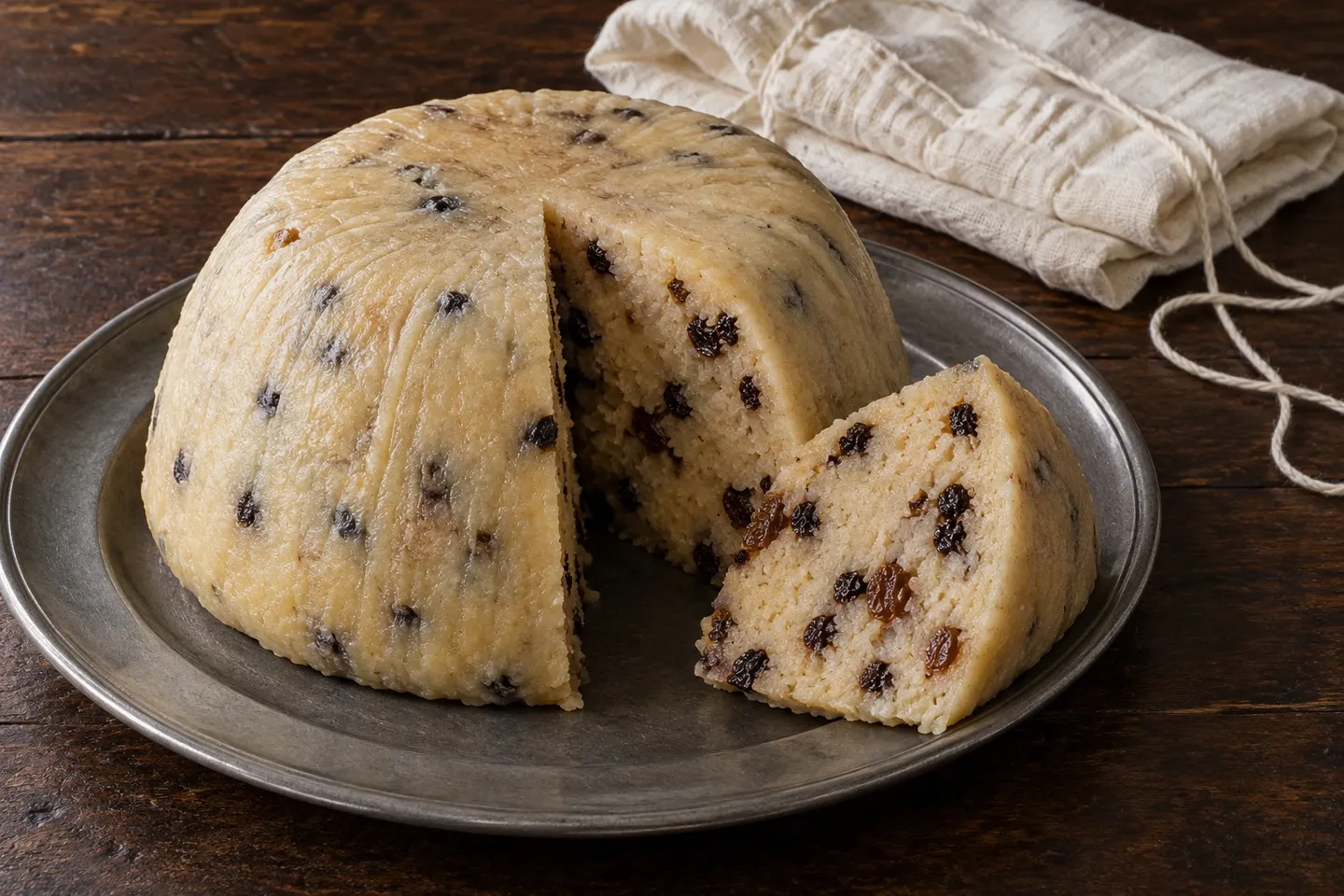
Suet Pudding for Sea (1747)
Reader ratingsHannah Glasse’s suet pudding for sea, 1747: flour, suet, currants and raisins with ginger and saffron, mixed stiff with salted water and boiled in a cloth for ships.
- Recipe makes
- 1 pudding, 8 servings
- Prep
- Cook
- Total
The pudding boils for 3 hours; keep a kettle hot for topping up the pot.
A boiled suet pudding with currants and raisins.
The story behind the recipe
Hannah Glasse’s suet pudding for sea is sweetened by its fruit alone and bound with salt water, so a ship’s cook could make it from stores. Hannah Glasse put it in the chapter of her 1747 Art of Cookery written “For Captains of Ships”: a pound each of suet, flour and currants, half a pound of raisins, ginger and saffron, “mix all together with salt Water very thick; then either boil or bake it.”
What made it a pudding for sea?
What it leaves out: eggs, milk and sugar. Flour, suet, dried fruit, ginger and saffron could all be stowed with a ship’s stores. The water that binds it is salt. Currants and raisins give it all its sweetness. The same page has a plainer oatmeal pudding of suet, currants and raisins tied in a cloth, “leaving room for the Swelling,” close to the salt-pork pie and the pease soup.
Read more about this recipe
What was tincture of saffron?
Saffron steeped in spirit. Glasse names it without a recipe. A pinch of saffron soaked in a spoonful of brandy does the same work here, coloring the pudding and carrying the flavor.
Making it today
Glasse says to boil or bake it, for no stated time. We boil it in a cloth, as she does most of the chapter’s puddings, for 3 hours. Shredded beef suet is sold in boxes; fresh suet from a butcher can be chilled and grated in its place. The pudding belongs with the ship’s stores in What Did Captain Cook Feed His Crew to Keep Them Well?, though no source says it was served on the Endeavour. The navy did issue its makings: the Admiralty’s Regulations and Instructions of 1808 allowed “flour, raisins, or suet, in lieu of half the beef” on beef days, and sent canvas for pudding bags.
TAKE a Pound of Suet shread fine, a Pound of Flour, a Pound of Currans picked clean, and half a Pound of Raisins stoned, two Tea Spoonfuls of beaten Ginger, and a Spoonful of Tincture of Saffron; mix all together with salt Water very thick; then either boil or bake it.
Recipe makes: 1 pudding, 8 servings
Ingredients
For 1 pudding, 8 servings. Quantities are shown as written.
Quantities as written here, for 1 pudding, 8 servings.
- Saffron threads1 pinch
- Brandy1/2 tbsp
- All-purpose flour, plus more for the cloth0.5 lb
- Shredded beef suet0.5 lb
- Dried currants0.5 lb
- Seedless raisins0.25 lb
- Ground ginger1 tsp
- Salt1 tsp
- Cold water, or as needed1/2 cup
Measurement notes
Ingredients as written here
- 1 pinch saffron threads
- ½ tbsp brandy
- ½ lb all-purpose flour, plus more for the cloth
- ½ lb shredded beef suet
- ½ lb dried currants
- ¼ lb seedless raisins
- 1 tsp ground ginger
- 1 tsp salt
- ½ cup cold water, or as needed
Equipment
- Large mixing bowl
- Small cup
- Pudding cloth or a clean, thin unbleached cotton cloth, about 24 inches square
- Kitchen string
- Large pot, deep enough to cover the pudding, with an upturned saucer or trivet in the bottom
 Kettle
Instructions
Crumble the saffron into the cup, pour over the brandy and leave for 15 minutes.
In the large bowl, mix the flour, suet, currants, raisins, ginger and salt.
Stir the saffron brandy into the water. Pour it into the bowl a little at a time, mixing with your hand, until everything holds together in a stiff dough. Add a little more water only if dry flour remains.
Bring a large pot of water to a boil, with the saucer in the bottom.
Wet the cloth in hot water, wring it out and spread it flat. Sift a thick layer of flour over the middle, about a foot across.
Shape the dough into a ball and set it on the floured part of the cloth. Gather the cloth up around it, leaving about an inch of slack above the pudding so it can swell, and tie it tightly with string.
Lower the pudding into the boiling water. It should be covered. Keep the water at a steady boil for 3 hours, topping it up with boiling water from the kettle whenever it drops.
Lift the pudding out by the string and dip it into a bowl of cold water for a few seconds. Untie the cloth, peel it back and turn the pudding onto a warm plate. Serve hot, in slices.
Nutrition
460calories per serving
- Recipe makes
- 1 pudding, 8 servings
- Servings
- 8
Estimated per serving from USDA FoodData Central values for flour, beef suet, currants and raisins.
Recipe notes
When adjusting quantities
This is half of Glasse’s pudding, which took a pound each of suet, flour and currants. A full one needs about 4 hours.
Notes
Quantities mentioned in these notes don’t change when you adjust the servings.
This is half of Glasse’s quantities. The brandy is our stand-in for her tincture of saffron, and salted tap water stands in for her salt water, with the salt measured by us. Seedless raisins replace her stoned ones. Of her two choices we boil it, for a time of our own. You can also steam it in a 1½-quart pudding basin, buttered, covered with pleated parchment and foil, for the same 3 hours. Leftover pudding keeps, wrapped, in the refrigerator for 3 days; reheat slices in a steamer or fry them in a little butter. Contains wheat; beef suet is not vegetarian.
Scaling changes the ingredients only; pan sizes and cooking times need their own judgment. To adapt this recipe further, try the recipe tool at TuneMyRecipe (opens in a new tab), our sister site.

Sources and attribution
After Hannah Glasse, The Art of Cookery Made Plain and Easy (London, 1747), For Captains of Ships, A Suet Pudding
See the original pages (scan at Internet Archive) (opens in a new tab)
Recipe details
- Course
- Dessert
- Dish family
- Desserts & Sweets
- Region
- British
- Era
- 18th century
- Difficulty
- Intermediate
- Season
- Winter