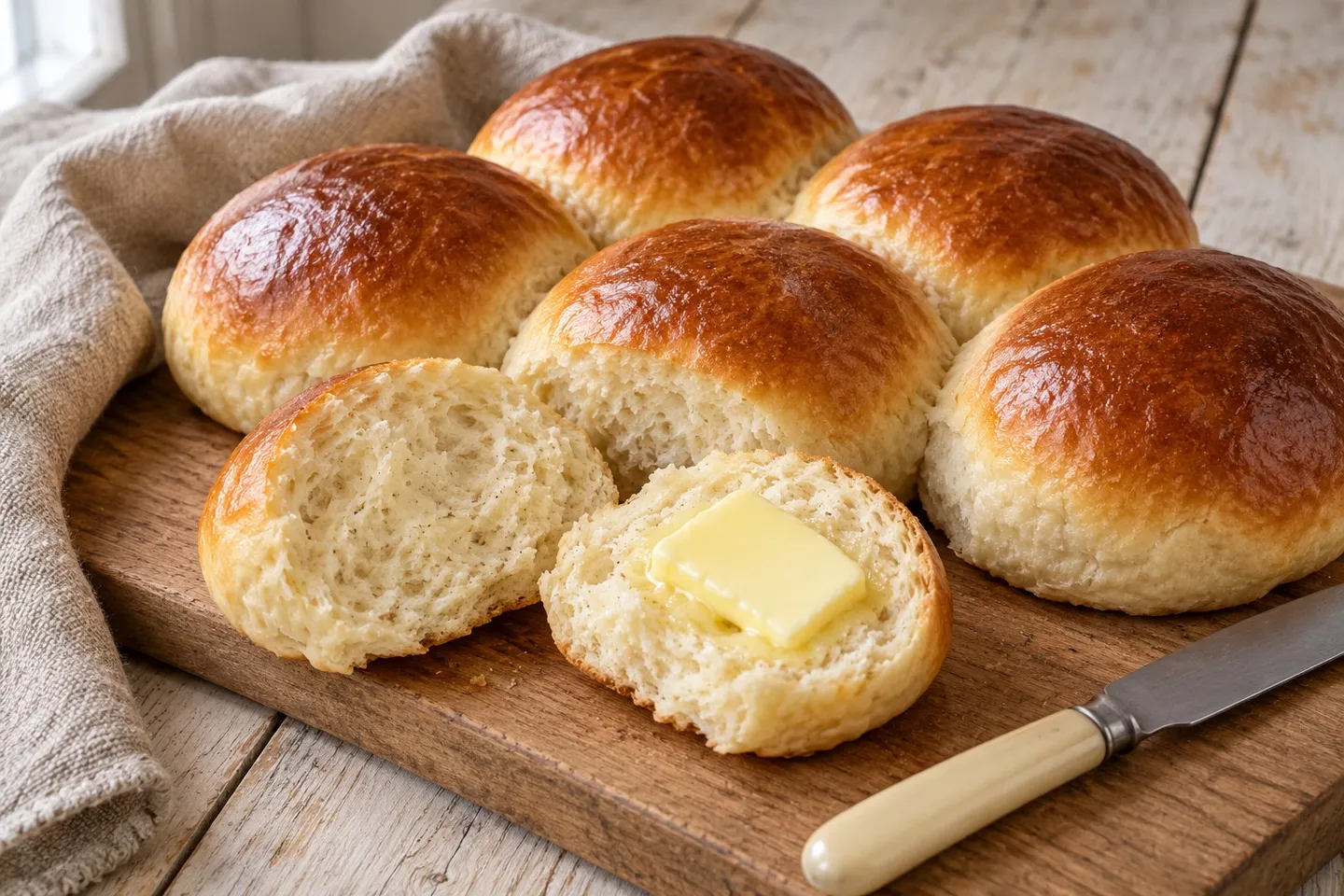
Very Good Wigs (1747)
Reader ratingsVery good wigs from Hannah Glasse’s The Art of Cookery Made Plain and Easy of 1747: rich yeast buns of flour rubbed with butter, sweetened and spiced with nutmeg and ginger, wetted with eggs, sherry and warm milk.
- Recipe makes
- 9 large buns
- Prep
- Cook
- Total
The dough rises for 1 to 1½ hours, and the shaped buns for about 30 minutes more. They are best the day they are baked, split and buttered.
Wigs, glossy yeast buns, one split and buttered.
The story behind the recipe
A wig was a bun: a rich yeast dough, sweetened, spiced and baked in small rounds. Hannah Glasse’s The Art of Cookery Made Plain and Easy gives two kinds in 1747, and this is the richer, “very good” one, with three quarters of a pound of butter rubbed into a quarter of a peck of flour.
A recipe that traveled
The wigs in Glasse’s book are older than the book. Eliza Smith’s The Compleat Housewife printed “To make very good Wigs” in its 1739 edition, and Glasse’s version follows it almost word for word, down to the “half a Race of Ginger grated” and the “Dozen and half of Wigs.” Both books crossed the Atlantic: Smith’s was reprinted in Williamsburg in 1742, and Glasse’s sold well in the colonies; George Washington owned a copy. No Boston diary or letter names wigs at a tea table; this is the recipe from a book the colonies bought.
The method is a plain one for a rich dough. The butter is rubbed into the flour “till it is like grated Bread,” the sugar and spice go in, and thick ale-yeast, beaten eggs and sack are poured into a hole in the middle with “as much Milk just warm, as will make into a light Paste.” The dough stands before the fire for half an hour, the buns are washed with egg, and “a quick Oven and half an Hour will bake them.”
Read more about this recipe
Making it today
Glasse’s thick ale-yeast came from brewing and isn’t sold, so instant yeast does its work; it needs longer than her half hour, so the dough rises until doubled. Sack was a Spanish wine, and dry sherry is the usual stand-in. A peck of flour was often understood as a weight, 12 or 14 pounds, and Smith’s plainer wigs, a few pages on in her book, use three and a half pounds of flour with the same butter and ale-yeast, so we read Glasse’s quarter peck as about that weight; our half batch uses 1¾ pounds and makes nine large buns, about the size of hers. Glasse doesn’t say what shape a wig is, and we bake them as round buns.
The wigs share the table with Glasse’s Portugal Cakes (1747) in What Was on the American Tea Table Before the Boston Tea Party?.
TAKE a quarter of a Peck of the finest Flour, rub it into three quarters of a Pound of fresh Butter, till it is like grated Bread, something more then half a Pound of Sugar, half a Nutmeg, and half a Race of Ginger grated, three Eggs Yolks and Whites beat very well, and put to them half a Pint of thick Ale-yeast, and three or four Spoonfuls of Sack, make a Hole in the Flour, and pour in your Yeast and Eggs, as much Milk just warm, as will make into a light Paste. Let it stand before the Fire to rise half an Hour, then make it into a Dozen and half of Wigs, wash them over with Egg just as they go into the Oven; a quick Oven and half an Hour will bake them.
Recipe makes: 9 large buns
Ingredients
For 9 large buns. Quantities are shown as written.
Quantities as written here, for 9 large buns.
Dough
- All-purpose flour, plus a little for shaping1.75 lb
- Unsalted butter, cold, cut in small pieces6 oz
- Granulated sugar4.5 oz
- Freshly grated nutmeg1/2 tsp
- Ground ginger3/4 tsp
- Salt1/2 tsp
- Instant yeast1 tbsp
- Large egg1
- Large egg yolk1
- Dry oloroso or amontillado sherry2 tbsp
- Whole milk, lukewarm, or as needed1 3/4 cups
Glaze
- Large egg, beaten1
Measurement notes
Ingredients as written here
- 1¾ lb all-purpose flour, plus a little for shaping
- 6 oz unsalted butter, cold, cut in small pieces
- 4½ oz granulated sugar
- ½ tsp freshly grated nutmeg
- ¾ tsp ground ginger
- ½ tsp salt
- 1 tbsp instant yeast
- 1 large egg
- 1 large egg yolk
- 2 tbsp dry oloroso or amontillado sherry
- 1¾ cups whole milk, lukewarm, or as needed
- 1 large egg, beaten
Equipment
- Large mixing bowl
 Small saucepan
 Whisk
- Two baking sheets lined with parchment paper
- Pastry brush
 Instant-read thermometer
Instructions
Put the flour in the large bowl and rub in the butter with your fingertips until the mixture looks like fine breadcrumbs. Stir in the sugar, nutmeg, ginger, salt and yeast.
In a small bowl, beat the egg and egg yolk with the sherry. Make a well in the flour, pour in the egg mixture and about three quarters of the milk, and mix to a soft dough, adding more milk a spoonful at a time if it is dry. It should be soft and slightly sticky.
Knead on a lightly floured surface for 8 to 10 minutes, until smooth and springy. Return it to the bowl, cover and leave in a warm place for 1 to 1½ hours, until doubled.
Turn the dough out and divide it into equal pieces, one for each bun. Shape each into a smooth ball, flatten it slightly and set it on the baking sheets with room to spread. Cover loosely and leave for about 30 minutes, until puffy. Heat the oven to 375°F (190°C).
Brush the buns with the beaten egg just before they go into the oven. Bake for 20 to 25 minutes, swapping the sheets halfway, until deep golden and the center of a bun reads 190°F (88°C).
Cool on a rack for at least 15 minutes. Serve warm or at room temperature, split and buttered.
Nutrition
565calories per serving
- Recipe makes
- 9 large buns
- Servings
- 9
Estimated per bun from USDA FoodData Central values for the listed ingredients.
Recipe notes
When adjusting quantities
This is half of Glasse’s batch, which made a dozen and a half.
Notes
Quantities mentioned in these notes don’t change when you adjust the servings.
Glasse’s lighter wigs, on the same page, use only half a pint of warm milk, half a pound each of sugar and butter and a pound and a half of flour, with “a quarter of a Pint of good Ale-Yeast.” The buns keep for a day in a tin, and reheat in a low oven or split and toasted. Contains wheat, milk and egg.
Scaling changes the ingredients only; pan sizes and cooking times need their own judgment. To adapt this recipe further, try the recipe tool at TuneMyRecipe (opens in a new tab), our sister site.
Sources and attribution
After Hannah Glasse, The Art of Cookery Made Plain and Easy (London, 1747), To make very good Wigs
Recipe details
- Course
- Bread & baking
- Dish family
- Breads & Cakes
- Region
- British
- Era
- 18th century
- Main ingredient
- Spices
- Difficulty
- Intermediate
- Occasion
- Everyday meal
- Season
- Winter