HMS Endeavour’s voyage around the world under James Cook · Plymouth to the Pacific
What Did Captain Cook Feed His Crew to Keep Them Well?
Cook credited sauerkraut, portable soup and malt for a healthy crew. The soup was dried beef glue for the pease pot, and Hannah Glasse printed how to make it.
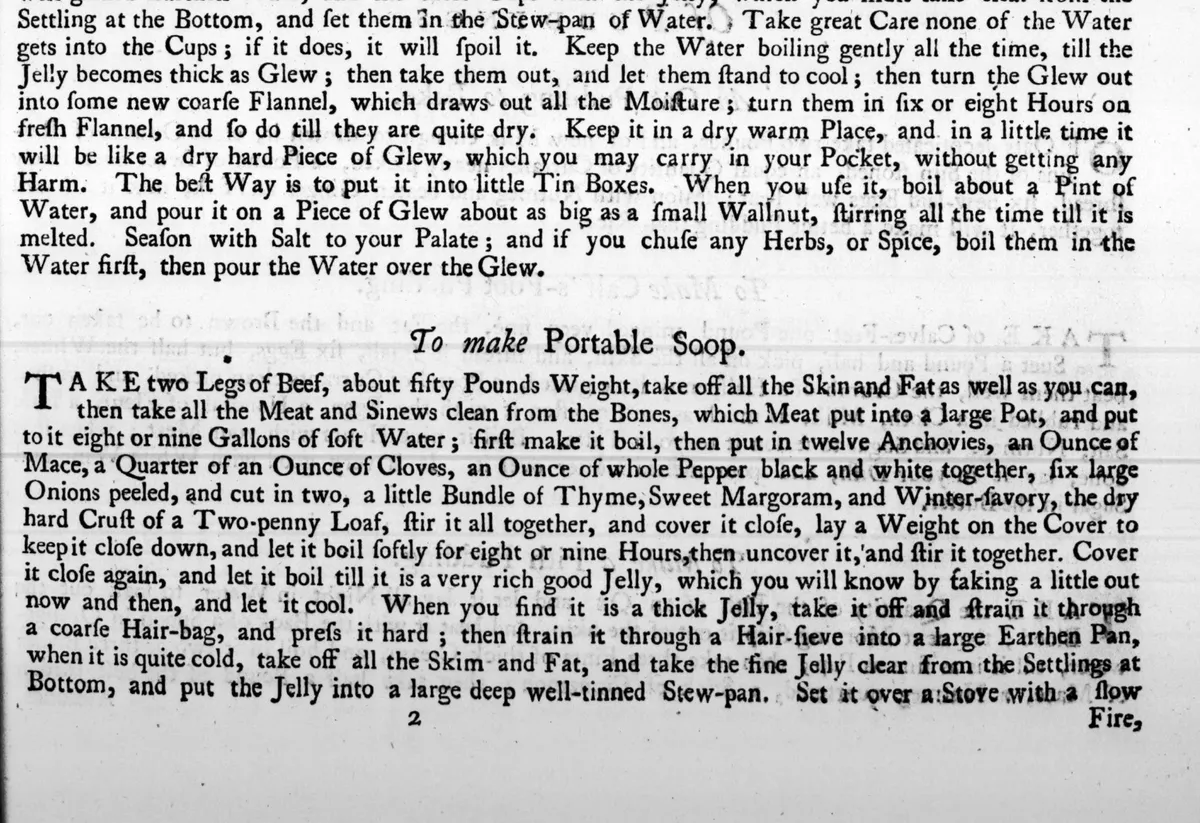
Sauerkraut, portable soup and malt. Seven and a half months out from Plymouth, at anchor off Tahiti in April 1769, James Cook wrote in his journal that the Endeavour’s company “had in general been very healthy owing in a great measure to the Sour krout, Portable Soup and Malt.” The first two went to the men in turn, the sauerkraut “on Beef Days” and the soup on banyan days, the days without meat. The soup was beef boiled down until it set like glue and dried into cakes. Hannah Glasse’s The Art of Cookery, first printed in 1747, shows how a household made it, and how a ship’s cook could put it into a pot of pease.
Three things in the hold
The Endeavour sailed from Plymouth in August 1768, and the April entry credits three stores. The malt was boiled into a sweet wort and given out by the surgeon, Monkhouse, “to every man that had the least symptoms of Scurvy upon him.” The other two were food.
The sauerkraut took persuading. “[T]he Men at first would not eate it,” Cook wrote, until he tried a method he had never known to fail with seamen: he had some dressed every day for the cabin table and let every officer eat it. “The Moment they see their Superiors set a vallue upon it, it becomes the finest stuff in the World.”
He kept the same order of things on his second voyage, in the Resolution. In a paper read to the Royal Society in 1776 he listed what had kept that crew well: malt, sauerkraut, “Portable Soup or Broth, … of which we had likewise a liberal supply,” a rob of lemons and oranges, and sugar in place of oil. An ounce of the soup to each man was boiled with their pease three days a week, he wrote, and when greens could be had on shore it went into the pot with them and with wheat or oatmeal for breakfast.
Beef boiled down to glue
Glasse printed portable soup for the household. She gives two recipes for it, one after the other. The small one, “Pocket Soop,” is a leg of veal boiled until it sets into a jelly and dried until “you may carry in your Pocket” a piece as hard as glue, best kept “in little Tin Boxes.”
The large one is the one her sea chapter points back to, “to carry abroad.” It starts with “two Legs of Beef, about fifty Pounds Weight,” stripped of skin and fat, the meat and sinews put into eight or nine gallons of soft water with anchovies, mace, cloves, whole pepper, six onions, thyme, marjoram, winter savory and the hard crust of a loaf. It boils softly for eight or nine hours, until “a very rich good Jelly.” The jelly is strained, cleared of fat and boiled down again, stirred so it can’t burn, until it lies “in Lumps about the Pan.” Set in china cups in a pan of boiling water, it thickens “like a stiff Glew,” and is turned out onto new flannel and dried in a warm place until quite hard.
“A Piece as big as a large Walnut, will make a Pint of Water very rich,” Glasse writes. Fifty pounds of beef became a crock of brown cakes that would keep, could be counted out by the ounce, and made a hot soup wherever there was water and a fire.
A chapter for captains
Glasse’s book also has a chapter “For Captains of Ships.” It assumes a ship’s stores, salt pork and beef soaked overnight, dried peas, suet, flour, currants, and a cook who must make them into dinner.
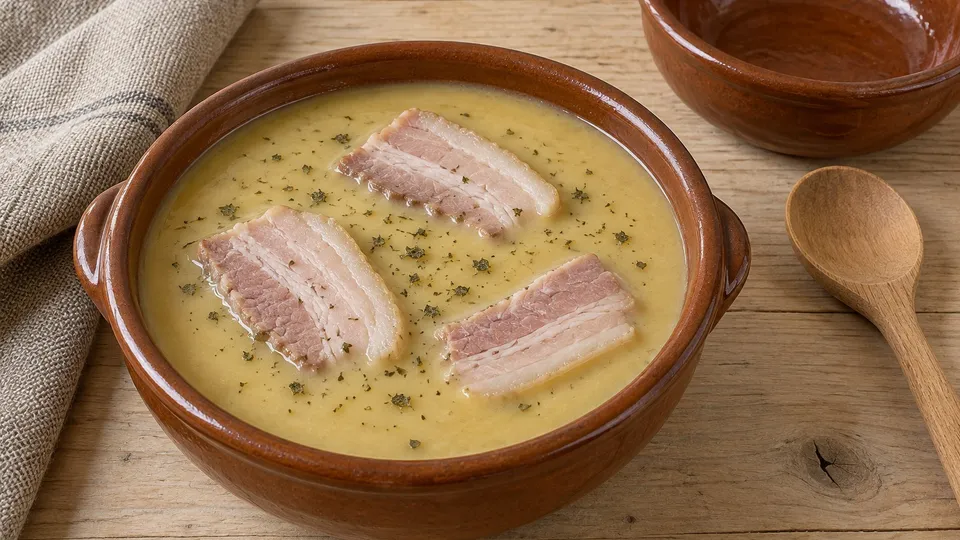
Its pease soup matches the pot Cook described on his second voyage. Peas and soaked salt meat boil together with onions and herbs, and “a good deal of dry Mint” goes in at the end. “If you add a Piece of the portable Soop, it will be very good.” The same pages give a suet pudding of flour, suet, currants, raisins and ginger mixed “with salt Water very thick,” a pie of salt pork and potatoes “for Sea,” dumplings “very pretty either at Land or Sea,” and a pointer back to “The Portable Soop to carry abroad.”
The navy’s soup was made for its Victualling Office, and the block now at Greenwich, stamped with the government’s broad arrow to mark it as government property, was boiled from bones and meat scraps, unsalted feet and shins among them, of cattle killed for salt beef. Glasse’s pages are what an English cook was told to do with the same kind of thing.
She also shows how far a little of it went. Earlier in the same chapter, a ragoo of artichoke bottoms takes “a Piece of the strong Soop as big as a small Wallnut” in half a pint of water, baked fish has its pan juices mixed with “Strong Soop,” and her gravy soup is nothing more than boiling water with as much of the strong soup “as will make it to your Palate.” A ship that carried the cakes could make a sauce or a soup out of water.
What it did and didn’t do
At Tahiti Cook’s company was healthy, with very few men on the sick list. Royal Museums Greenwich, which holds the navy’s tablet, notes that the Victualling Office began having it made after James Lind suggested in 1754 that it might work against scurvy, and that the stock had no significant antiscorbutic effect. Lind even proposed adding mutton to make it more nourishing. What it gave a crew was a hot, meaty soup from almost nothing: sailors softened their hard biscuit in it, thickened it with dried peas, celery or oatmeal, and valued it in bad or cold weather and on banyan days, often with sauerkraut beside it.
Cook’s own lists are long. The journal credits “the Care and Vigilanc[e]” of Monkhouse the surgeon as well as the stores, and the 1776 paper adds water and fresh greens taken in wherever they could be had, and a ship and crew kept “constantly clean and dry.”
Nearly a century and a half later, Robert Falcon Scott’s expedition kept its feast day at Cape Evans on the tinned and preserved stores of its own age, as Scott’s midwinter dinner of 1911 shows.
The recipes
The three recipes are Glasse’s, from the first edition of 1747, two decades before the Endeavour sailed. The modern amounts, scaling and times are ours.
- Portable Soup (1747): beef and spices boiled to a jelly and reduced to firm cakes that melt back into broth.
- Pease Soup for Sea (1747): split peas and salt pork with onions and mint, enriched with a piece of portable soup.
- Suet Pudding for Sea (1747): flour, suet, currants, raisins and ginger, boiled in a cloth.
Cooking it
Start with the pease soup. It needs salt pork, split peas and an afternoon, and it is the pot Cook’s ounce of soup went into. Make the portable soup first if you want to add a piece of it as Glasse does; it takes two days and keeps in the freezer for months, so one batch flavors many pots. Glasse’s three dishes for the sea are among our 18th-century recipes. For what a later navy poured into the cup, Forgotten Drink, our sister site, follows the daily ration of beer, grog and tea in Half the Grog and a Pint of Tea: The Navy in 1824 (opens in a new tab).
 Cook it todayPease Soup for Sea (1747)
Sources
- James Cook, journal of HMS Endeavour, April 13, 1769, National Library of Australia MS 1, p. 48; transcription by Paul Turnbull, South Seas project, https://paulturnbull.org/project/southseas/journals/cook/17690413.html (opens in a new tab).
- James Cook, “The Method taken for preserving the Health of the Crew of His Majesty’s Ship the Resolution during her late Voyage round the World,” Philosophical Transactions of the Royal Society of London 66 (1776), pp. 402–406; read in the JSTOR OCR text, JSTOR 106286.
- Hannah Glasse, The Art of Cookery, Made Plain and Easy (London, 1747), pp. 65 and 68 (the numbering skips 66 and 67) and 122–125; British Library copy, Internet Archive, PDF 80–81 and 135–138.
- Royal Museums Greenwich, “‘Portable soup’ (dried soup block),” object AAB0012, https://www.rmg.co.uk/collections/objects/rmgc-object-6061 (opens in a new tab).