Midwinter Day at Cape Evans, British Antarctic Expedition · Cape Evans, Ross Island, Antarctica
What Did Scott’s Men Eat for Midwinter at Cape Evans?
Scott’s men at Cape Evans ate seal soup, roast beef, Yorkshire pudding, plum pudding and mince pies for Midwinter 1911, and pemmican hoosh on the march.
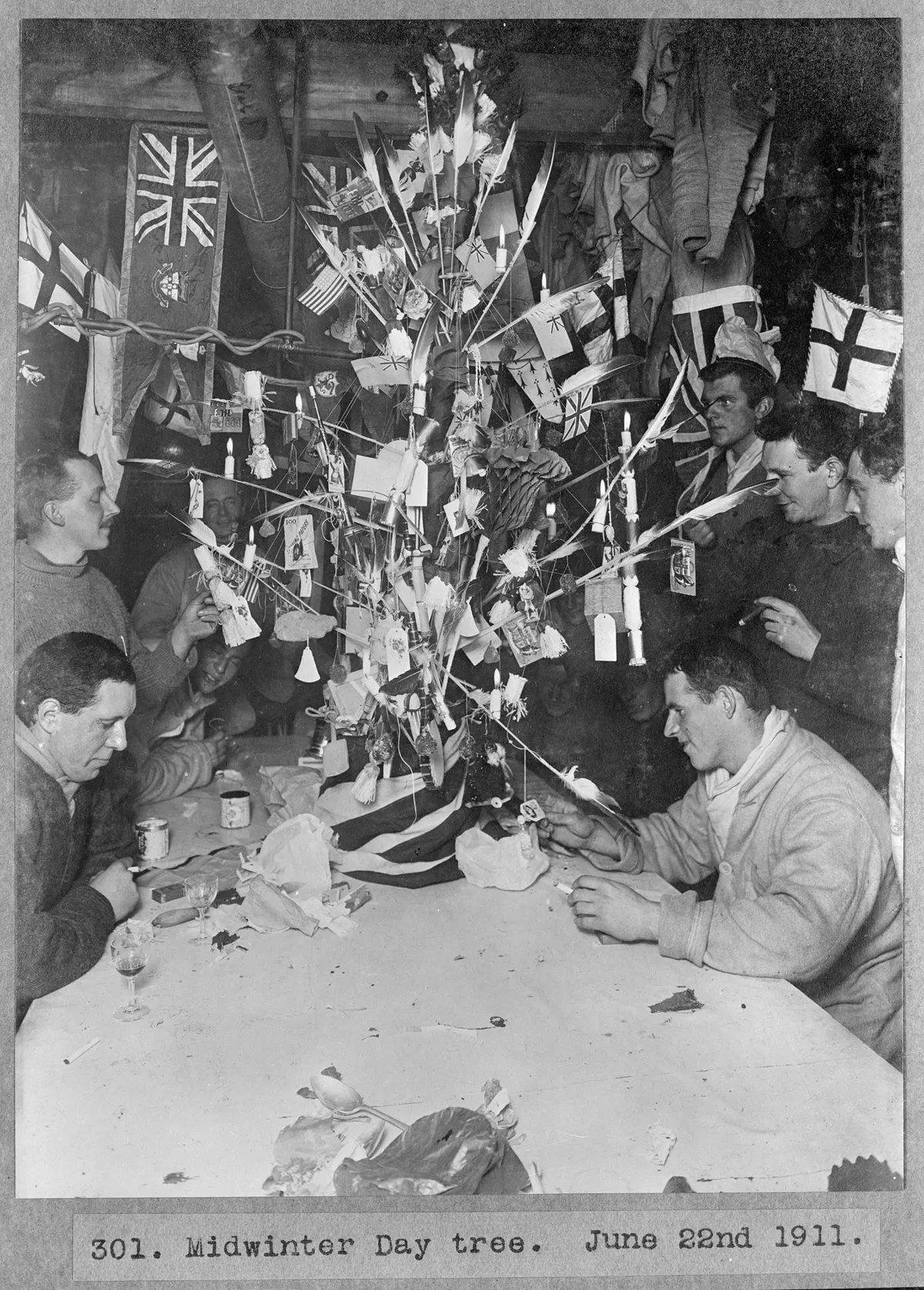
Seal soup, then roast beef with Yorkshire pudding, fried potatoes and Brussels sprouts, then a flaming plum pudding and mince pies, and last a savory of anchovy and cod’s roe, with champagne all the way through. That was the dinner Robert Falcon Scott and the men of the British Antarctic Expedition sat down to in their hut at Cape Evans on June 22, 1911, the middle of the polar winter. Out on the ice, the same men lived on something much plainer: pemmican and biscuit boiled together into a thick soup they called hoosh.
The shortest day
Scott kept a journal through the winter, and his entry for Thursday, June 22, begins with the astronomy: “The sun reached its maximum depression at about 2.30 P.M. on the 22nd.” From then on the light would return.
“In preparation for the evening our ‘Union Jacks’ and sledge flags were hung about the large table,” Scott wrote, and the table carried a “plentiful supply of champagne bottles instead of the customary mugs and enamel limejuice jugs.”
Seal soup to savory
Scott set down the menu in a single sentence:
Beginning on seal soup, by common consent the best decoction that our cook produces, we went on to roast beef with Yorkshire pudding, fried potatoes and Brussels sprouts. Then followed a flaming plum-pudding and excellent mince pies, and thereafter a dainty savoury of anchovy and cod’s roe.
The savory came last, after the puddings, as at an English dinner table; Mrs Beeton’s household book of the period files cod’s roe on fried bread under “Savouries and Hors d’Oeuvres.” Dishes of burnt almonds, candied fruits and chocolates stood about the table all evening, and when the champagne was done there were liqueurs for the toasts. Only the soup was Antarctic.
The cook
The man who made it was Thomas Clissold, listed among the members as “Cook, late R.N.,” a former Royal Navy cook. Early in the winter Scott wrote that “Clissold the cook has started splendidly, has served seal, penguin, and skua now,” and the journal notes the seal dishes that followed: “to-night we had galantine of seal,” and on another evening “excellent thick seal soup, very much like thick hare soup.”
A tree and a speech
In the course of the evening Scott made what he called “a little speech which drew attention to the nature of the celebration as a half-way mark.” Then Henry Bowers “suddenly appeared, followed by some satellites bearing an enormous Christmas Tree whose branches bore flaming candles, gaudy crackers, and little presents for all.” Through the noise, Scott noticed, “Clissold sat with a constant expansive smile.”
The tree, the crackers and the pudding brought Christmas forward six months, because the real one would find Scott and the men going south with him out on the ice. Scott’s verdict on the night was dry: “Thus, except for a few bad heads in the morning, ended the High Festival of Midwinter.”
Hoosh on the march
The sledges had a dish of their own. The glossary printed with Scott’s journal defines it in one line: “Hoosh, a thick camp-soup with a basis of pemmican.” Pemmican was dried meat pounded and mixed with melted fat, and the Royal Navy had provisioned several Arctic expeditions with beef pemmican made in England. A photograph in the journal shows the polar party’s sledging ration: “Pemmican, biscuits, butter, cocoa, sugar and tea.”
How much of each was argued over. On a journey in the dead of that same winter, Edward Wilson, Bowers and Apsley Cherry-Garrard took pemmican, butter, biscuit and tea and nothing else, and tried them in different proportions; Wilson’s share had more fat than the others could eat, Cherry-Garrard’s more biscuit. “We both therefore had 12 oz. pemmican, 16 oz. biscuit and 4 oz. butter a day,” Cherry-Garrard wrote. Scott recorded, when the three came back, that after a short trial “A middle course was struck which gave a general proportion agreeable to all,” and that cocoa was suggested for the evening meal. In the tent, the biscuit was broken up and the day’s pemmican went into the cooker with water, and the result was hoosh.
On Cherry-Garrard’s figures, pemmican, biscuit and butter alone came to two pounds a day on the winter journey. Men pulling sledges needed more than that: in November 1911 Scott wrote that “a ration amply sufficient for the needs of men leading ponies is quite insufficient for men doing hard pulling work,” and he gave that as the reason for a larger ration on the plateau. The ponies’ meat went into the pot. “It is great luck having the horsemeat to add to our ration,” Scott wrote on the way back, and one night’s “stew fry of pemmican and horseflesh” was the best hoosh of the journey.
After midwinter
The polar party left Cape Evans on October 24, 1911. Christmas Day found them on the march, eating horsemeat, a sweetened hoosh of arrowroot, cocoa and biscuit, and a plum pudding. Scott, Wilson, Bowers, Lawrence Oates and Edgar Evans reached the South Pole on January 17, 1912, and found that Roald Amundsen had been there about a month before them. Evans died on February 17, Oates walked out of the tent into a blizzard on March 16 or 17 (Scott, who had lost track of the days, dated the entry both ways), and Scott’s last entry is dated March 29. A search party found the tent and the bodies on November 12, 1912.
The recipes
Scott recorded the dishes but not how Clissold cooked them. The first three recipes here come from Mrs Beeton’s Book of Household Management in its 1906 edition, an English household book of the years before the expedition (we read the same edition against the Titanic’s first-class dinner card of the following April), and the fourth rebuilds the ration in a home kitchen.
- Roast Beef and Yorkshire Pudding (1906): a rib of beef roasted by Beeton’s rule of fifteen minutes to the pound, with the batter pudding baked in its dripping, for the roast at the center of the dinner.
- Mince Pies (1906): Beeton’s suet, fruit and brandy mincemeat in puff pastry, for the “excellent mince pies” that followed the pudding.
- Croûtes of Cod’s Roe (1906): slices of smoked cod’s roe on fried bread with anchovy butter, for the “dainty savoury of anchovy and cod’s roe” that ended the meal.
- Sledging Hoosh (1911): home-made pemmican boiled with broken biscuit, for the food on the march.
The flaming plum pudding isn’t remade here; TuneMyRecipe has a plum pudding with sweet sauce from the Titanic’s third-class menu of 1912 (opens in a new tab), from the same years. The seal soup isn’t remade either; Scott recorded no recipe for it.
A midwinter dinner at home
Cook the Sledging Hoosh (1911) the night before the roast. It takes half an hour, and after a bowl of beef fat and broken biscuit, a roast beef dinner on June 22 makes sense as a festival. The hoosh and the midwinter dinner are part of our Edwardian recipes.
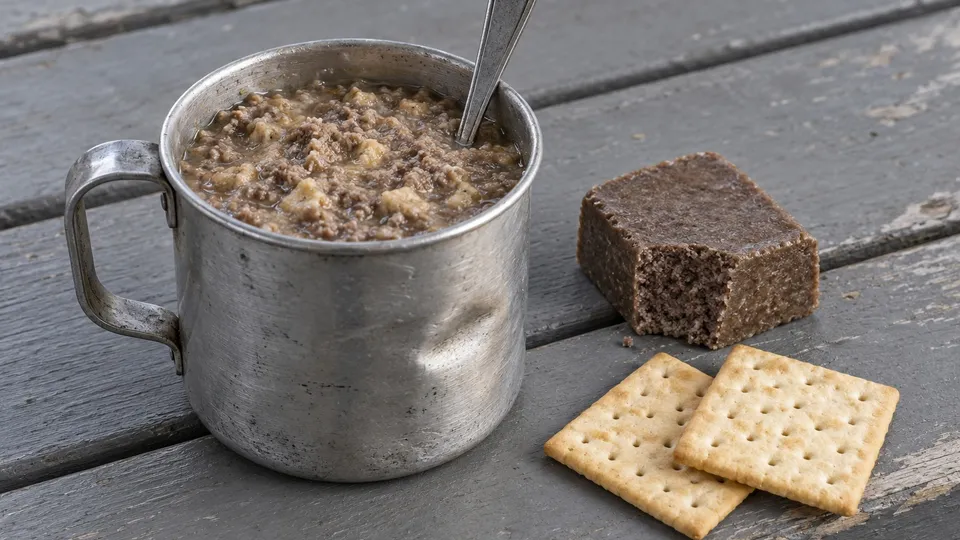 Cook it todaySledging Hoosh (1911)
Sources
- Robert Falcon Scott, Scott’s Last Expedition (opens in a new tab), vol. 1, arranged by Leonard Huxley (London: Smith, Elder, 1913), Internet Archive.
- Apsley Cherry-Garrard, The Worst Journey in the World (opens in a new tab), vol. 1 (London: Constable, 1922), Internet Archive.
- “Robert Falcon Scott (opens in a new tab),” Encyclopaedia Britannica.
- “Pemmican (opens in a new tab),” Encyclopaedia Britannica.
- Herbert Ponting, “Midwinter Day tree,” 1911, Alexander Turnbull Library, National Library of New Zealand (opens in a new tab).
- Isabella Beeton, Mrs Beeton’s Book of Household Management, new edition (London: Ward, Lock, 1906).