RMS Titanic, first-class dinner · First-class dining saloon, D deck, North Atlantic
What Was the Last First-Class Dinner on the Titanic?
On April 14, 1912, the first-class dinner card offered salmon with mousseline sauce, roast duckling and punch romaine. The menu and four recipes.
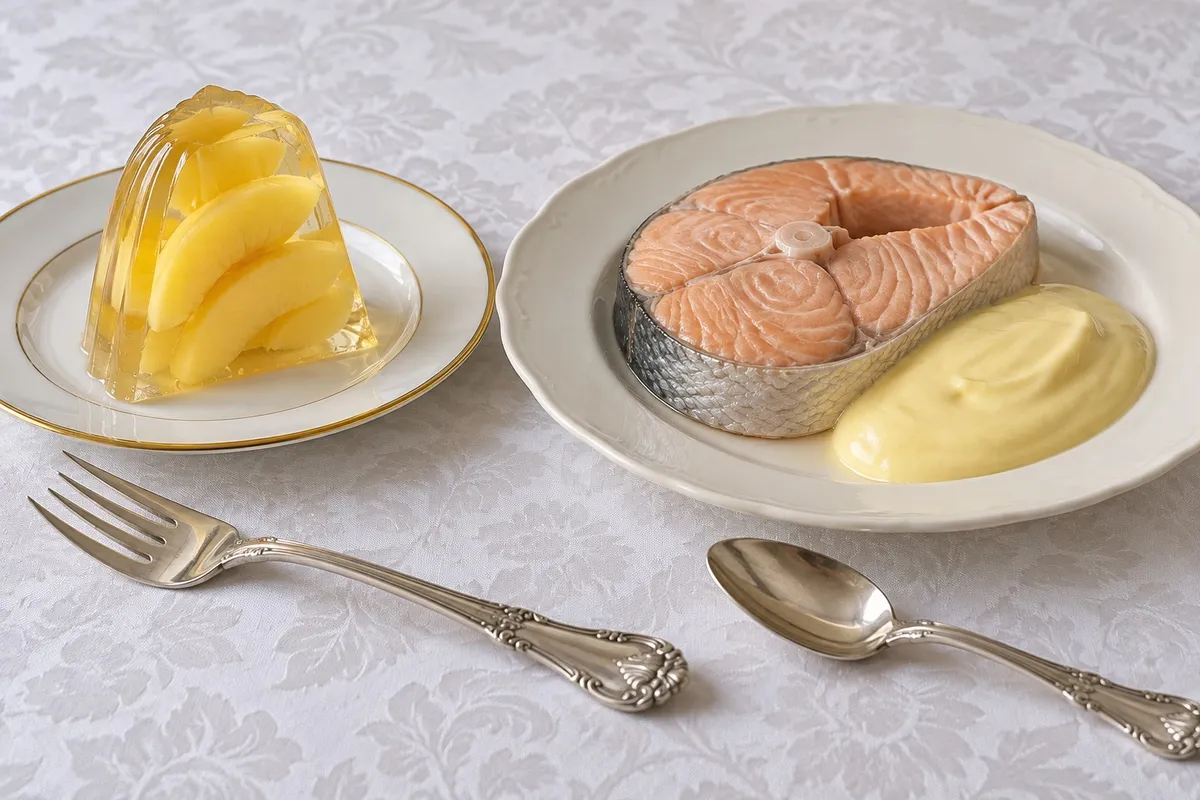
The last first-class dinner on the Titanic, served on the evening of Sunday, April 14, 1912, offered oysters, consommé Olga, salmon with mousseline sauce, filet mignon, roast duckling with apple sauce, sirloin of beef, an iced punch romaine, roast squab, asparagus, pâté de foie gras and a run of desserts from Waldorf pudding to peaches in Chartreuse jelly. It is a menu for a grand London hotel, served on a ship in the North Atlantic. A little before 11:40 that night, a lookout in the crow’s nest struck three blows on the gong.
The card and what it proves
Passengers kept menu cards as souvenirs, and that habit is why we know anything at all. The first-class dinner card for April 14 is known from reproductions: Robert Ballard printed it in The Discovery of the Titanic in 1987, and Rick Archbold and Dana McCauley built their 1997 book Last Dinner on the Titanic around it. Who kept the original is less certain. Researchers on Encyclopedia Titanica credit survivor John Irwin Flynn on the strength of a newspaper story from 1938, while others point out that no record traces the card from his hands to the copies we read today.
Other cards from that Sunday are on firmer ground. The National Maritime Museum in Greenwich holds the second-class dinner menu, printed as a postcard and kept by survivor Bertha Watt. The first-class luncheon card from the same day was kept by Abraham Lincoln Salomon, who left the ship in lifeboat No. 1, and it sold at auction in 2015 for $88,000 (about $120,000 today, by the US consumer price index, BLS CPI-U). Its buffet included potted shrimps, soused herrings, brawn and corned ox tongue.
A menu proves what was offered. It doesn’t say who chose what, how much was eaten, or how the kitchen made it. No recipe from the ship’s kitchen survives, and no source tells us which cookbooks its chefs used. What we can do is read each dish against the books a London kitchen would have known in 1912, and that is how the recipes here were built.
The room
First class ate in the dining saloon on D deck. The British inquiry’s report describes it with an engineer’s economy: “The dining saloon occupied 112 ft., and was between the second and third funnels.” Second class dined on the same deck, in a saloon of 70 feet. B deck held a separate restaurant for first-class passengers, with its own pantry and galley.
What was on the Titanic’s first-class menu?
The card reads in the French-and-English mix of an Edwardian hotel. Read in order, it runs like this:
- Hors d’oeuvre variés; oysters
- Consommé Olga; cream of barley
- Salmon, mousseline sauce, cucumbers
- Filet mignons Lili; sauté of chicken, Lyonnaise; vegetable marrow farci
- Lamb, mint sauce; roast duckling, apple sauce; sirloin of beef, château potatoes
- Green peas; creamed carrots; boiled rice; Parmentier and boiled new potatoes
- Punch romaine
- Roast squab and cress
- Cold asparagus vinaigrette
- Pâté de foie gras; celery
- Waldorf pudding; peaches in Chartreuse jelly; chocolate and vanilla éclairs; French ice cream
Popular retellings call this a ten-course dinner that every diner ate in full. The card itself offers choices: two soups, three entrées, three meat dishes on the next line. A passenger who took one dish from each line still faced a long evening, but not the whole list.
The order follows the rules of the period. Escoffier, whose A Guide to Modern Cookery came out in English in London in 1907, explains why the punch sits where it does. Sherbets, he writes, are “served after the Entrées,” and serve “in freshening the stomach; preparing it to properly receive the roast.” On this card the punch comes after the lamb, duckling and sirloin and just before the roast squab.
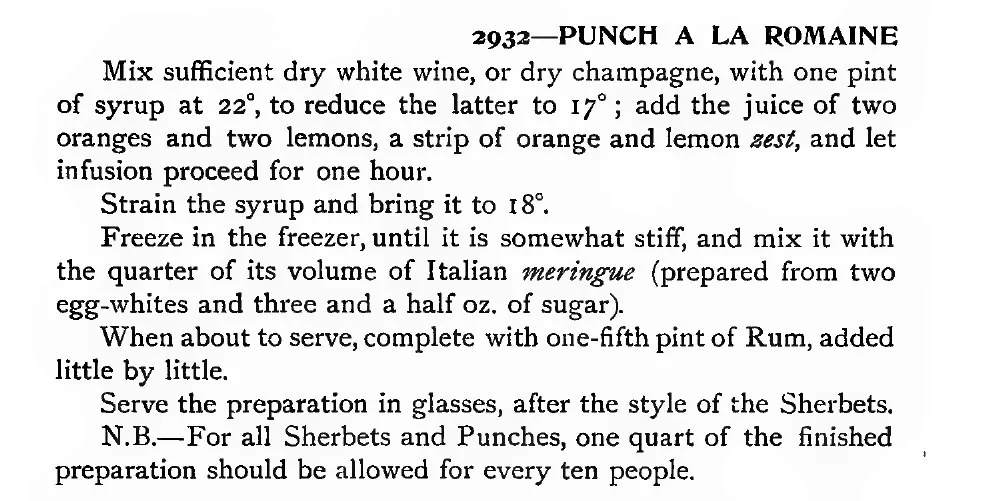 Punch à la romaine in Escoffier’s A Guide to Modern Cookery (London, 1907), p. 815.
What the dishes say
Some lines are pure London hotel French. Consommé Olga, filet mignons Lili and Waldorf pudding have no recipe under those names in Escoffier’s 1907 guide, Beeton’s 1906 edition or Agnes Marshall’s 1890 Cookery Book, so anything written for them from these books would be a guess.
The roasts are English cooking, listed in English. Mrs. Beeton’s Book of Household Management, in its 1906 Ward, Lock edition, stuffs the ducks with sage and onion and tells the cook to roast them “in front of a clear fire or in a moderately hot oven for about 1 hour, basting frequently,” with the gravy served “in a sauce-boat” and apple sauce beside it. Lamb with mint sauce and sirloin of beef with château potatoes sit beside it on the same line.
The salmon is the clearest match between card and cookbook. The card lists “Salmon, Mousseline Sauce, Cucumbers.” Escoffier says of salmon that “whatever be the method of preparation, it is always accompanied by cucumber salad,” and names mousseline sauce among the sauces “more especially” suited to boiled salmon. His mousseline is hollandaise with whipped cream folded in just before serving. The ship’s kitchen may never have opened his book, but its salmon course follows his rule to the letter.
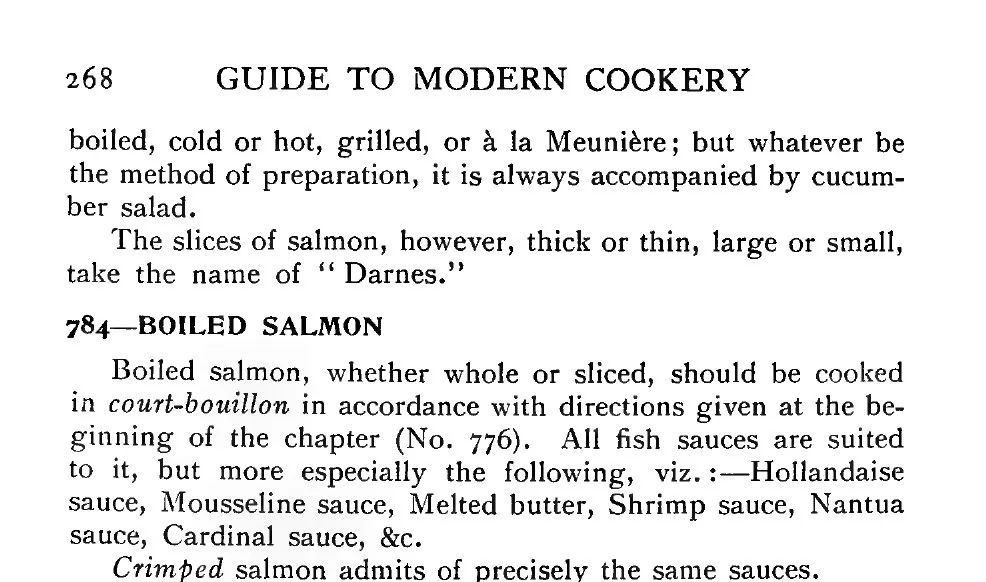 Escoffier’s salmon rule and his boiled salmon, from A Guide to Modern Cookery (London, 1907), p. 268.
The desserts end the evening on a note of display. Peaches in Chartreuse jelly needed a mold, clear jelly and patience. Agnes Marshall’s Cookery Book of 1890 describes lemon jelly tinted “a pale tint like green Chartreuse” and flavored with the liqueur, and a mold lined with peach slices set in liqueur jelly. Together those two recipes give a dessert that fits the card’s name; none of the three books gives a recipe under that exact title.
The other tables that night
Second and third class dined from their own, simpler cards that night. The second-class menu that Bertha Watt kept is a document in its own right. TuneMyRecipe tells that story in What They Ate on the Titanic: Three Classes, Three Tables (opens in a new tab), with recipes for salmon mayonnaise, curried chicken and plum pudding. Here we stay at the first-class table.
The recipes
Four dishes from the card, in the order they were served. Each page says which book it comes from and where we filled a gap.
- Poached Salmon with Mousseline Sauce (1912): the fish course, with Escoffier’s mousseline and his cucumber salad.
- Roast Duckling with Apple Sauce (1912): one of three meat dishes on its line, from Beeton’s 1906 edition with sage and onion stuffing.
- Punch à la Romaine (1912): the iced course before the squab, a soft wine and citrus ice with meringue and rum.
- Peaches in Chartreuse Jelly (1912): a dessert we rebuilt from two of Agnes Marshall’s 1890 jellies.
We left out the consommé Olga and the Waldorf pudding, because none of the three books gives a recipe under either name.
What the menu tells us
Read against the books of its day, the card is a London hotel kitchen at sea. Its French lines keep Escoffier’s order, with the iced punch set between the meat dishes and the roast squab. Its roasts and their sauces are Beeton’s English table (we read the same 1906 edition for the roast beef of Scott’s midwinter dinner in the Antarctic, ten months earlier), and its desserts need the molds and clear jellies of Agnes Marshall’s kitchen. What it can’t show is the eating: the card is a list of offers that passengers kept as souvenirs, and no one has traced the original.
Start with the salmon. Poach it in court-bouillon, serve the cucumbers beside it as the card does, and the mousseline sauce needs only whipped cream once the hollandaise is made. The four dishes join Scott’s midwinter roast and the paper-bag cooking of 1911 in our Edwardian recipes. The wine and coffee of a grand dinner that same spring are on Forgotten Drink, our sister site, in a coffee row at a 1912 diplomatic dinner (opens in a new tab) at the Waldorf Astoria.
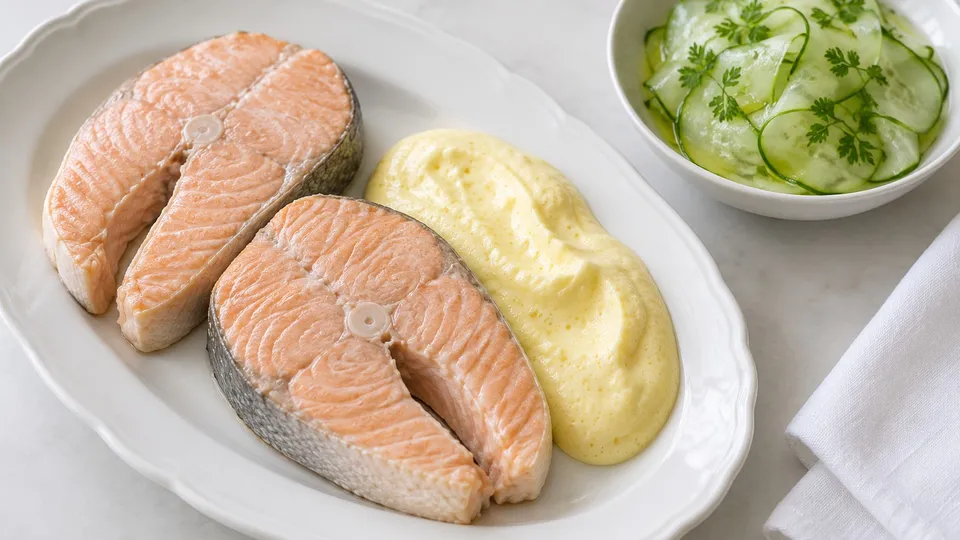 Cook it todayPoached Salmon with Mousseline Sauce (1912)
Sources
- British Wreck Commissioner’s Inquiry, Report on the Loss of the “Titanic” (s.s.), 1912: “Accommodation” and “The Collision,” transcribed at Titanic Inquiry Project (opens in a new tab).
- Royal Museums Greenwich, Second Class dinner menu from the last night on TITANIC (opens in a new tab), object LMQ/1/12/2.
- Discussion on the Encyclopedia Titanica forum: Titanic Menus (opens in a new tab) and Provenance of Titanic menus (opens in a new tab).
- CNN, Titanic’s last lunch menu sells for $88,000 (opens in a new tab) (October 2015), on the Lion Heart Autographs sale.
- Robert D. Ballard, The Discovery of the Titanic (Toronto: Madison Press, 1987).
- Rick Archbold and Dana McCauley, Last Dinner on the Titanic (Toronto: Madison Press, 1997).
- A. Escoffier, A Guide to Modern Cookery (London: William Heinemann, 1907), pp. 40, 268, 617, 813–815.
- Mrs. Beeton’s Book of Household Management, new edition (London: Ward, Lock, 1906), pp. 261, 697.
- Agnes B. Marshall, Mrs. A. B. Marshall’s Cookery Book (London: Simpkin, Marshall, 1890), pp. 351–353.