Poached Salmon with Mousseline Sauce (1912)
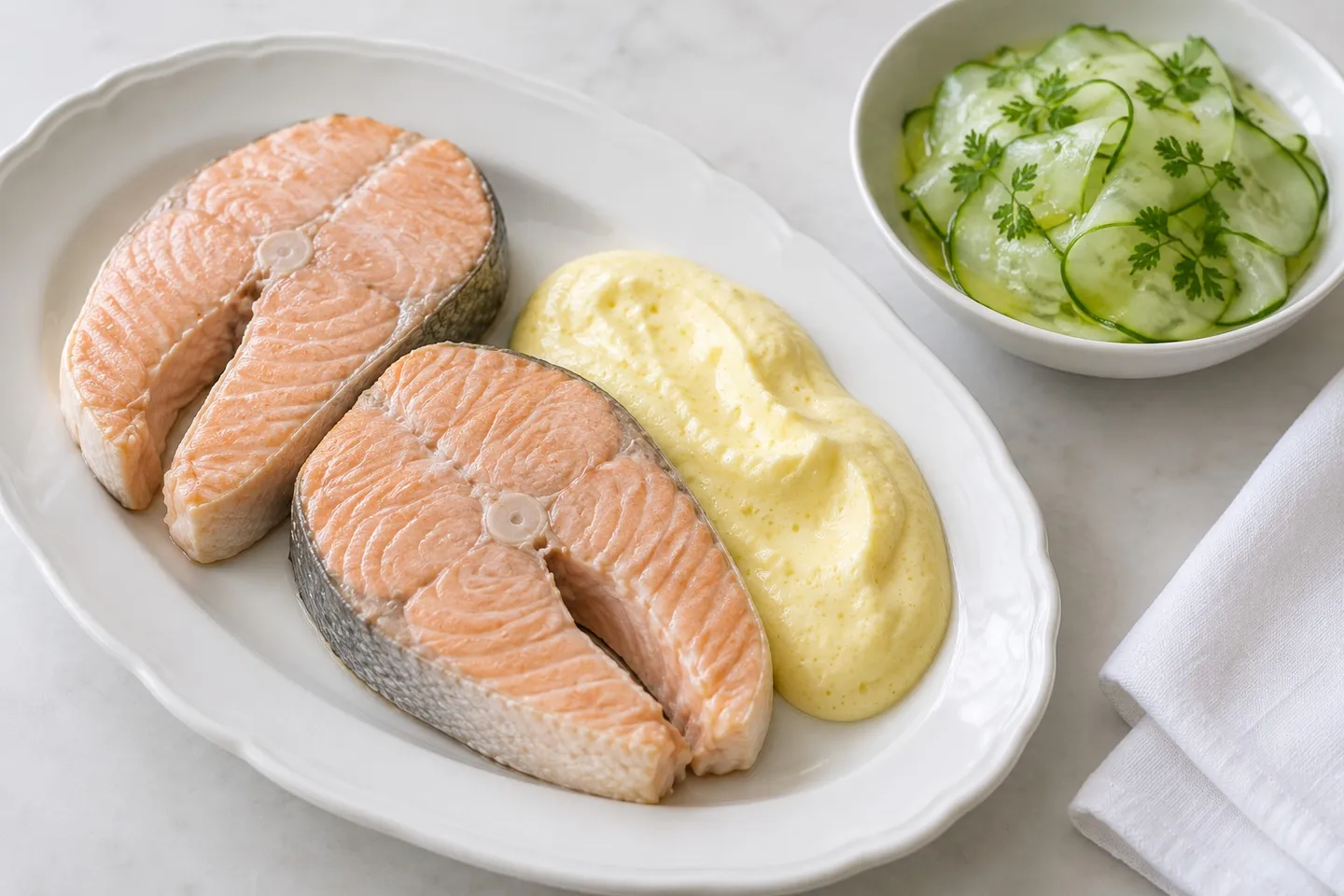
Reader ratingsPoached salmon with mousseline sauce, the fish course of the Titanic’s first-class dinner on April 14, 1912: salmon in court-bouillon, with Escoffier’s sauce and cucumber salad.
- Recipe makes
- 4 servings
- Prep
- Cook
- Total
The court-bouillon simmers for an hour while the cucumbers stand in salt for two, as Escoffier directs. Make the hollandaise while the salmon cooks and fold in the cream at the last moment.
Poached salmon steaks with mousseline sauce and cucumber salad on white china.
The story behind the recipe
Poached salmon with a mousseline sauce and a cucumber salad is the fish course from the last first-class dinner on the Titanic, offered on April 14, 1912, after the soups and before the entrées. Escoffier’s 1907 guide pairs the three exactly as the card does.
Why is salmon served with cucumber?
The menu lists “Salmon, Mousseline Sauce, Cucumbers”; this recipe comes from Escoffier’s A Guide to Modern Cookery, published in English in London in 1907. Escoffier is firm about salmon: “whatever be the method of preparation, it is always accompanied by cucumber salad.” He cooks it in a court-bouillon of water, vinegar, salt, vegetables and herbs, a liquid he says is “principally used for cooking trout and salmon,” and lists the sauces “more especially” suited to it, with mousseline among them.
Read more about this recipe
What is mousseline sauce?
His mousseline is a quick idea built on a hard one. Make a hollandaise, then, “just before dishing up,” fold in stiffly whipped cream, half as much whipped cream as sauce. The cream makes the hollandaise paler and lighter, and it is why the sauce must go to the table at once.
No source tells us how the Titanic’s kitchen made its salmon, so this is a period recipe for the dish on the card, not the ship’s own. The card names neither the cut nor the method. Escoffier’s boiled salmon works for whole fish or slices, which he calls “darnes.”
Making it today
Escoffier’s way with slices is to plunge them into the boiling liquid, then pull the pan to the side of the fire so they finish cooking without boiling. That gentle finish is the whole technique. We use steaks about an inch thick, our choice of cut, and a heat low enough that the liquid only trembles. His court-bouillon is made in batches of five quarts; we make three fifths of it, enough to cover four steaks.
He salts his cucumbers for two hours before dressing them with oil, vinegar and chervil, and leaves the dressing unmeasured, so we set those amounts. For the hollandaise we make a quarter of his quart, rounded up to two yolks, with his reduction of vinegar and pepper, his bain-marie and his drop of lemon at the end.
For the card itself, and what it does and doesn’t prove, read What Was the Last First-Class Dinner on the Titanic? The roast that followed on our menu is Roast Duckling with Apple Sauce (1912).
92—MOUSSELINE SAUCE
To a Hollandaise Sauce, prepared as explained (No. 30), add, just before dishing up, one-half pint of stiffly-whipped cream per pint of sauce.
784—BOILED SALMON
Boiled salmon, whether whole or sliced, should be cooked in court-bouillon in accordance with directions given at the beginning of the chapter (No. 776). ...
Recipe makes: 4 servings
Ingredients
For 4 servings. Quantities are shown as written.
Quantities as written here, for 4 servings.
Cucumber salad
- Cucumber1
- Salt for the cucumber1 tsp
- Olive oil1 tbsp
- White wine vinegar for the cucumber2 tsp
- Chopped chervil1 tbsp
- White pepper for the cucumber1 pinch
Court-bouillon
- Water3 UK quart
- White wine vinegar for the court-bouillon6 fl oz
- Coarse gray sea salt1.25 oz
- Carrots7 oz
- Onions10 oz
- Parsley stalks1.25 oz
- Thyme2 sprigs
- Bay leaf1
- Black peppercorns1 tbsp
Salmon
- Salmon steaks, about 1 inch thick4
Hollandaise
- White wine vinegar for the sauce1 tbsp
- Water for the reduction1 tbsp
- Coarsely crushed white pepper for the sauce1 pinch
- Salt for the sauce1 pinch
- Cold water1 tbsp
- Egg yolks2
- Unsalted butter, melted and warm6 oz
- Lemon juice1 tsp
Mousseline finish
- Heavy cream2 fl oz
Measurement notes
Ingredients as written here
- 1 cucumber
- 1 tsp salt for the cucumber
- 1 tbsp olive oil
- 2 tsp white wine vinegar for the cucumber
- 1 tbsp chopped chervil
- 1 pinch white pepper for the cucumber
- 3 quarts water
- 6 fl oz white wine vinegar for the court-bouillon
- 1.25 oz coarse gray sea salt
- 7 oz carrots
- 10 oz onions
- 1.25 oz parsley stalks
- 2 sprigs thyme
- 1 bay leaf
- 1 tbsp black peppercorns
- 4 salmon steaks, about 1 inch thick
- 1 tbsp white wine vinegar for the sauce
- 1 tbsp water for the reduction
- 1 pinch coarsely crushed white pepper for the sauce
- 1 pinch salt for the sauce
- 1 tbsp cold water
- 2 egg yolks
- 6 oz unsalted butter, melted and warm
- 1 tsp lemon juice
- 2 fl oz heavy cream
Equipment
- Large saucepan for the court-bouillon
- Wide shallow pan or fish kettle with a lid
- Fish spatula
- Heatproof bowl set over a pan of barely simmering water
- Balloon whisk
 Fine sieve
- Clean dish towel
Instructions
Peel the cucumber, slice it thinly and toss the slices with the salt for the cucumber in a bowl. Leave for two hours, then tip them into a clean dish towel and press out the liquid.
Season the cucumber with the olive oil, white wine vinegar for the cucumber, chervil and white pepper for the cucumber. Set aside in a cool place.
For the court-bouillon, put the water, white wine vinegar for the court-bouillon and coarse gray sea salt in a large saucepan. Slice the carrots and onions thinly and add them, with the parsley stalks, thyme and bay leaf tied in a bunch. Bring to a boil and simmer for 1 hour, adding the black peppercorns for the last 12 minutes only. Strain into a wide shallow pan.
Bring the court-bouillon back to a boil. Lower in the salmon steaks, bring back just to a simmer, then turn the heat down so the liquid barely trembles. Cook for 8 to 12 minutes, until the flesh is opaque and flakes at the bone and the center reaches 145°F (63°C).
While the salmon cooks, put the white wine vinegar for the sauce, the water for the reduction, the white pepper for the sauce and the salt for the sauce in a small pan and boil until reduced by about half. With so little liquid, take it off the heat as soon as it gets there, before it can scorch. Tip it into a heatproof bowl set over barely simmering water.
Add the cold water and the egg yolks to the reduction and whisk until the yolks thicken to the consistency of cream. Take the bowl off the heat.
Pour in the warm melted butter in a thin stream, whisking all the time, until the sauce is thick and glossy. Add the lemon juice, then pass the sauce through a fine sieve into a warm bowl.
Whip the heavy cream to stiff peaks. Just before serving, fold it into the hollandaise.
Lift the salmon out with a fish spatula, drain it well and peel off the skin if you like. Serve at once with the mousseline sauce and the cucumber salad on the side.
Nutrition
840calories per serving
- Recipe makes
- 4 servings
- Servings
- 4
Estimated per serving (4) from USDA FoodData Central values for the listed ingredients, for a 7 oz salmon steak with its share of sauce and cucumbers; the court-bouillon is left out.
Recipe notes
When adjusting quantities
Scales by the number of salmon steaks. The sauce scales cleanly; keep at least one yolk.
Notes
Quantities mentioned in these notes don’t change when you adjust the servings.
Escoffier’s quantities are for one quart of hollandaise (six yolks to one and a half pounds of butter). We have cut them to a quarter and rounded up to two yolks, so our sauce has a little less butter per yolk than his. Keep the finished hollandaise over warm, not hot, water until you fold in the cream.
The yolks in a hollandaise are warmed but not fully cooked. For anyone pregnant, very young, elderly or with a weakened immune system, use pasteurized eggs.
If the sauce splits, whisk a tablespoon of hot water into a clean bowl and add the split sauce a little at a time.
Scaling changes the ingredients only; pan sizes and cooking times need their own judgment. To adapt this recipe further, try the recipe tool at TuneMyRecipe (opens in a new tab), our sister site.
Sources and attribution
After A. Escoffier, A Guide to Modern Cookery (London: Heinemann, 1907), Nos. 30, 92, 163, 776, 784 and 1991; dish as printed on the Titanic’s first-class dinner card of April 14, 1912
Recipe details
- Course
- Fish course
- Dish family
- Fish & Seafood
- Region
- French
- Era
- Edwardian
- Source decade
- 1900s
- Event
- Titanic, 1912
- Main ingredient
- Fish
- Difficulty
- Intermediate
- Occasion
- Dinner party