Peaches in Chartreuse Jelly (1912)
Reader ratingsPeaches in Chartreuse jelly, a dessert from the Titanic’s first-class dinner of April 14, 1912, rebuilt from two of Agnes Marshall’s 1890 jellies: peach slices set in a clear, liqueur-scented jelly.
- Recipe makes
- 1 mold, serving 8
- Prep
- Cook
- Total
Most of the time is setting: the jelly is built in layers, then needs about 6 hours in the fridge, or overnight, before it will turn out.
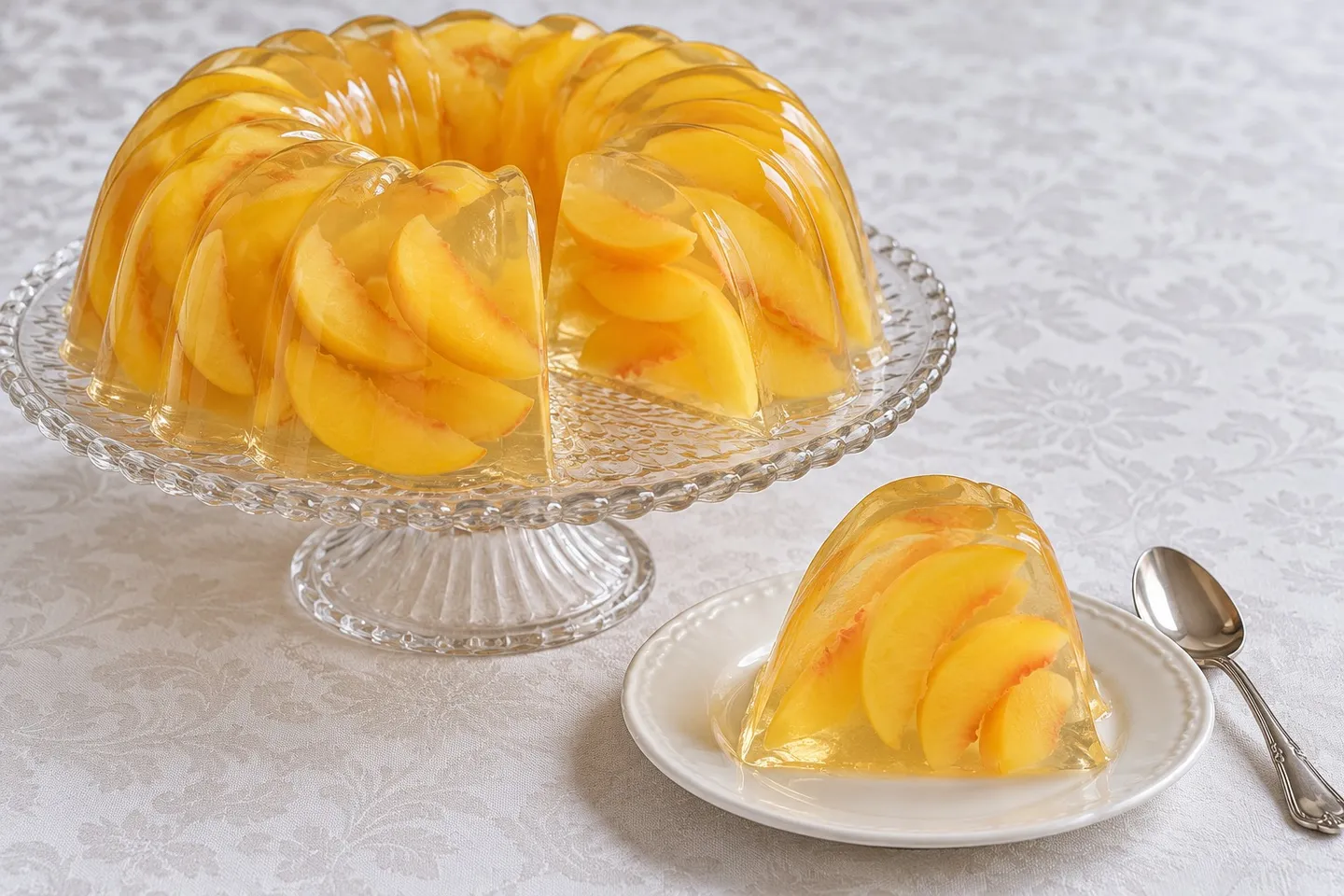
Peaches in Chartreuse jelly turned out on a clear glass cake stand, with a cut wedge on a small plate.
The story behind the recipe
A clear lemon jelly flavored with green Chartreuse, turned out of its mold with peach slices set inside: that is our reading of “Peaches in Chartreuse Jelly,” one of four desserts offered in first class on the Titanic on April 14, 1912, beside Waldorf pudding, éclairs and French ice cream.
Two recipes, one dessert
The menu lists “Peaches in Chartreuse Jelly,” and none of three London cookbooks published between 1890 and 1907, Escoffier’s 1907 guide, Beeton’s 1906 edition or Marshall’s own, gives a recipe under that name. This version is a reconstruction from two recipes in Mrs. A. B. Marshall’s Cookery Book, published in London in 1890 by Marshall’s School of Cookery.
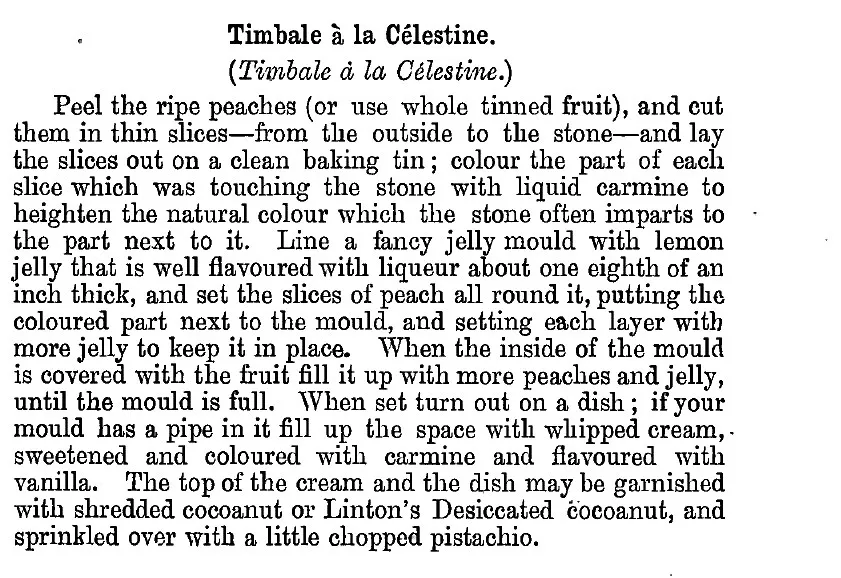
The first is her Jelly à la Française, in which a lemon jelly is tinted “a pale tint like green Chartreuse,” and flavored “with Chartreuse, noyeau, brandy, or other flavour.” The second is her Timbale à la Célestine: ripe peaches cut in thin slices “from the outside to the stone,” set around a mold lined with liqueur jelly, then filled up with more peaches and jelly. Put the two together and you have a dish that answers the card’s name.
Both rest on her lemon jelly, cleared the Victorian way. Lemon juice, sugar, spice, gelatin and hot water are whisked with egg whites and their crushed shells, brought to a boil and poured through a warmed jelly bag until the jelly runs clear. The egg catches the cloudiness, and the result is a jelly you can read a menu through.
Read more about this recipe
Making it today
Marshall used her own brand of leaf gelatin, an ounce and a half to the quart. Gelatins differ in strength, and for modern powdered gelatin we use one ounce for the whole batch, about 20 grams to each liter of liquid: our conversion, meant to set firm enough to turn out with fruit inside. We leave out her saffron coloring and her drops of green dye, and the carmine she brushed on the stone side of each slice, so the jelly keeps the pale gold of the lemon.
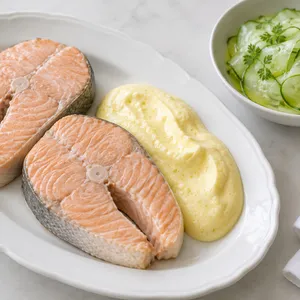
The jelly takes a night, so start it the day before. It closes our menu from the last first-class dinner on the Titanic, which opens with Poached Salmon with Mousseline Sauce (1912).
Timbale à la Célestine.
(Timbale à la Célestine.)
Peel the ripe peaches (or use whole tinned fruit), and cut them in thin slices—from the outside to the stone—and lay the slices out on a clean baking tin; colour the part of each slice which was touching the stone with liquid carmine to heighten the natural colour which the stone often imparts to the part next to it. Line a fancy jelly mould with lemon jelly that is well flavoured with liqueur about one eighth of an inch thick, and set the slices of peach all round it, putting the coloured part next to the mould, and setting each layer with more jelly to keep it in place. When the inside of the mould is covered with the fruit fill it up with more peaches and jelly, until the mould is full. When set turn out on a dish; if your mould has a pipe in it fill up the space with whipped cream, sweetened and coloured with carmine and flavoured with vanilla. The top of the cream and the dish may be garnished with shredded cocoanut or Linton’s Desiccated cocoanut, and sprinkled over with a little chopped pistachio.
Recipe makes: 1 mold, serving 8
Ingredients
For 1 mold, serving 8. Quantities are shown as written.
Quantities as written here, for 1 mold, serving 8.
Clear lemon jelly
- Lemons4
- Sugar8 oz
- Small piece cinnamon stick1
- Cloves4
- Egg whites, with their shells2
- Hot water40 fl oz
- Powdered gelatin1 oz
Flavoring
- Green Chartreuse2 fl oz
Fruit
- Ripe peaches4
Measurement notes
Ingredients as written here
- 4 lemons
- 8 oz sugar
- 1 small piece cinnamon stick
- 4 whole cloves
- 2 egg whites, with their shells
- 40 fl oz hot water
- 1 oz powdered gelatin
- 2 fl oz green Chartreuse
- 4 ripe peaches
Equipment
 Large saucepan
- Jelly bag, or a sieve lined with a doubled clean cloth
- 3-pint (about 1.75 L) jelly mold, ideally with a central tube
- Bowl of ice water
- Sharp knife
Instructions
Pare the zest thinly from the lemons, then halve them and squeeze the juice through a strainer into a large saucepan.
Add the zest, sugar, cinnamon and cloves. Whisk in the powdered gelatin while the mixture is still cold, and leave it for 5 minutes to soften. Separate the egg whites from the yolks (keep the yolks for another dish), crush the shells and add whites and shells to the pan. Whisk in the hot water. Bring slowly to a boil without stirring. A gray crust will rise and crack; take the pan off the heat and leave it for 5 minutes.
Pour boiling water through the jelly bag to warm it, discard that water, then ladle the jelly into the bag. If the first of the jelly is cloudy, pour it back through until it runs clear. Leave to cool until barely warm.
Stir the green Chartreuse into the jelly.
Pour a thin layer of jelly into the mold and swirl it around the sides, standing the mold in ice water so it sets on the walls. Repeat until the inside is coated about ⅛ inch thick.
Peel the peaches: dip them in boiling water for 30 seconds, then into cold water, and the skins slip off. Cut each peach into 10 to 12 thin slices from the outside to the stone.
Arrange a ring of peach slices against the jelly lining, spoon over a little cool jelly to hold them, and let it set. Repeat until the sides are covered.
Fill the mold with the rest of the peaches and jelly in layers, letting each set before the next. Chill for at least 6 hours, or overnight, until firm.
To serve, dip the mold in warm water for a few seconds, put the serving dish on top and turn it over.
Nutrition
180calories per serving
- Recipe makes
- 1 mold, serving 8
- Servings
- 8
Estimated per serving (8) from USDA FoodData Central values for the listed ingredients; the egg whites and shells used to clear the jelly are strained out.
Recipe notes
When adjusting quantities
Scales by the mold. Keep the ratio of gelatin to liquid the same.
Notes
Quantities mentioned in these notes don’t change when you adjust the servings.
The jelly contains uncooked liqueur. For a family version, leave out the Chartreuse. It is there for flavor only, so the jelly sets the same without it.
The egg whites and shells are boiled in the jelly and then strained out, so the jelly carries no raw egg.
Fresh pineapple, kiwi and papaya stop gelatin from setting; peaches are fine.
Scaling changes the ingredients only; pan sizes and cooking times need their own judgment. To adapt this recipe further, try the recipe tool at TuneMyRecipe (opens in a new tab), our sister site.
Sources and attribution
Reconstruction after Mrs. A. B. Marshall’s Cookery Book (London, 1890): Lemon Jelly, Jelly à la Française and Timbale à la Célestine; dish as printed on the Titanic’s first-class dinner card of April 14, 1912
Recipe details
- Course
- Dessert
- Dish family
- Desserts & Sweets
- Region
- British
- Era
- Edwardian
- Source decade
- 1890s
- Event
- Titanic, 1912
- Main ingredient
- FruitWine & spirits
- Difficulty
- Advanced
- Occasion
- Dinner party