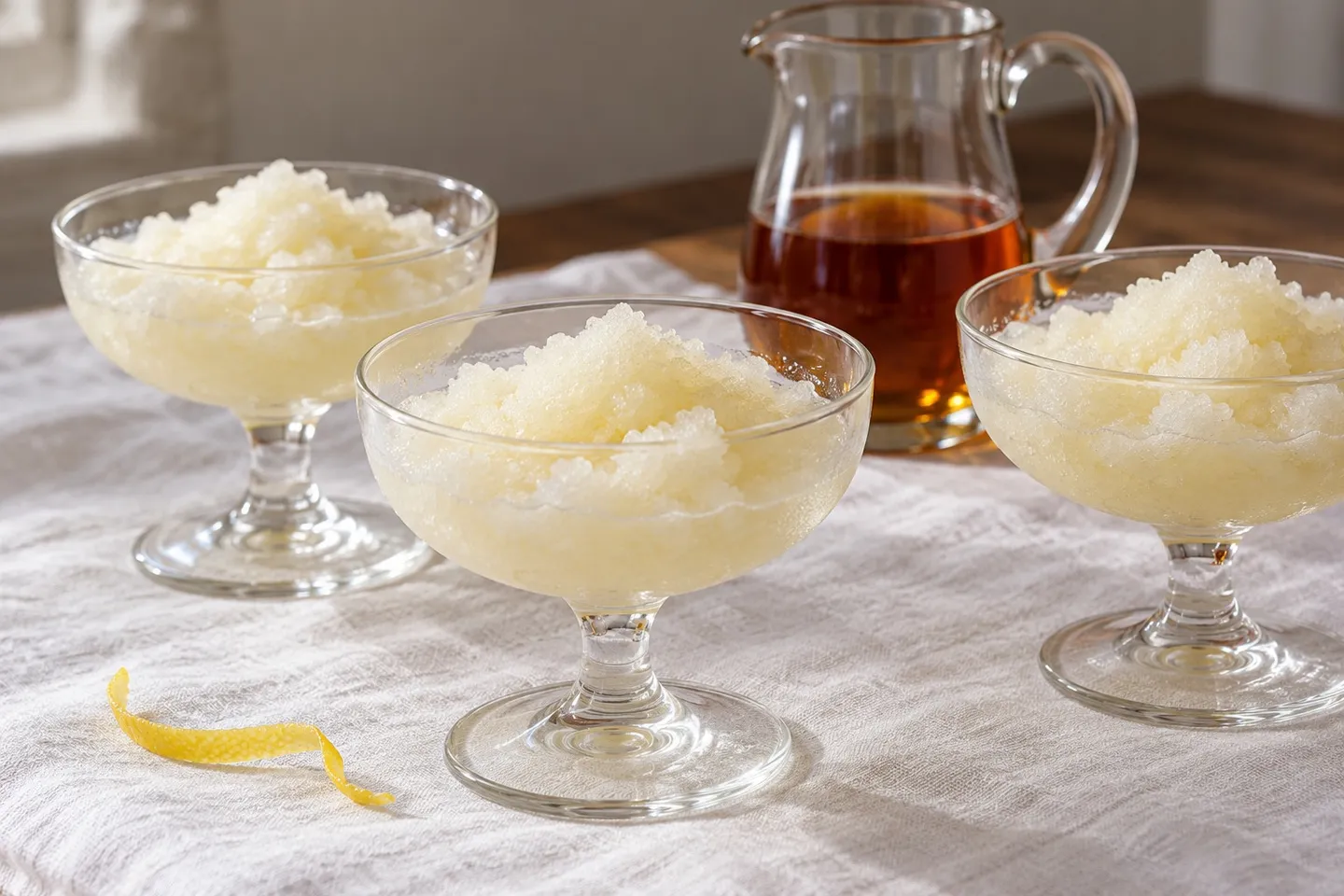
Punch à la Romaine (1912)
Reader ratingsPunch à la romaine, the iced course of the Titanic’s first-class dinner on April 14, 1912: Escoffier’s soft wine and citrus ice with Italian meringue and rum, served in glasses.
- Recipe makes
- about 12 small glasses
- Prep
- Cook
- Total
Includes an hour’s infusion, cooling, and about 3½ hours in the freezer (less in an ice-cream machine). The rum goes in just before serving.
Punch à la romaine in small glasses on a white cloth.
The story behind the recipe
Punch à la romaine is a soft, half-frozen ice of wine and citrus, lightened with meringue and finished with rum, and served in a glass. On the Titanic’s first-class card for April 14, 1912, it is the iced course that readied the table for the roast squab.
A pause before the roast
The menu lists “Punch Romaine”; this recipe comes from Escoffier’s A Guide to Modern Cookery, published in London in 1907. It shows what the name meant to a London kitchen of the time; the ship’s own version isn’t recorded. Forgotten Drink, our sister site, explains why it is so often called the ship’s last cocktail, and what else was poured on board, in what people drank on the Titanic (opens in a new tab).
Escoffier explains exactly where such a course belonged. Sherbets are “served after the Entrées,” and they serve “in freshening the stomach; preparing it to properly receive the roast.” Punch à la romaine is his sherbet made grander: syrup and dry white wine or Champagne infused with orange and lemon, frozen until “somewhat stiff,” then mixed with a quarter of its volume of Italian meringue. The rum goes in “little by little” just before serving.
He is precise about the texture too. “The consistence of a Sherbet, of what kind soever, should be such as to allow of its being drunk.” That is softer than a modern sorbet, closer to a frozen drink you eat with a spoon. His rule of thumb for quantities is generous: “one quart of the finished preparation should be allowed for every ten people.”
Read more about this recipe
Making it today
Escoffier measures his syrup by its density with a saccharometer, which few kitchens own. We worked his densities back into weights: his syrup “at 22°” is close to ten ounces of sugar in fourteen fluid ounces of water, and the wine brings it down toward his 17°. The freezing method is our choice too. He froze it in a freezer kept on the move, and an ice-cream machine is the closest modern match. Without one, still-freeze it in a shallow container and drag a fork through every half hour; the grain comes out coarser, closer to the “light, granulated mass” of his granites.
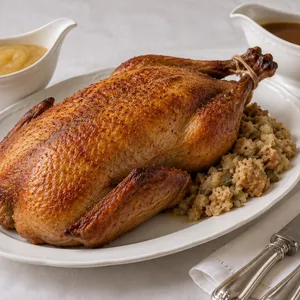
The meringue is made his way, with a hot sugar syrup whisked into the whites. In the order of that evening, it follows the Roast Duckling with Apple Sauce (1912); What Was the Last First-Class Dinner on the Titanic? has the whole card.
2932—PUNCH A LA ROMAINE
Mix sufficient dry white wine, or dry champagne, with one pint of syrup at 22°, to reduce the latter to 17°; add the juice of two oranges and two lemons, a strip of orange and lemon zest, and let infusion proceed for one hour. ...
Recipe makes: about 12 small glasses
Ingredients
For about 12 small glasses. Quantities are shown as written.
Quantities as written here, for about 12 small glasses.
Syrup
- Sugar for the syrup10 fl oz
- Water for the syrup14 fl oz
Ice
- Dry Champagne or dry white wine8 fl oz
- Oranges2
- Lemons2
Italian meringue
- Egg whites2
- Sugar for the meringue3.5 oz
- Water for the meringue2 tbsp
To finish
- Rum4 fl oz
Measurement notes
Ingredients as written here
- 10 oz sugar for the syrup
- 14 fl oz water for the syrup
- 8 fl oz dry Champagne or dry white wine
- 2 oranges
- 2 lemons
- 2 egg whites
- 3.5 oz sugar for the meringue
- 2 tbsp water for the meringue
- 4 fl oz rum
Equipment
 Saucepan
- Ice-cream machine, or a shallow freezer-proof container
 Fine sieve
- Sugar thermometer
- Electric whisk
- 12 small glasses, chilled
Instructions
Put the sugar for the syrup and water for the syrup in a saucepan and stir over low heat until the sugar dissolves. Bring to a boil, then take off the heat and leave to cool.
Pare a strip of zest from one of the oranges and one of the lemons, then squeeze the juice from both oranges and both lemons.
Stir the Champagne, the juices and the zest into the cool syrup and leave to infuse for an hour.
Strain through a fine sieve. Churn in an ice-cream machine until it is a soft, stiffish ice. Without a machine, pour it into a shallow freezer-proof container and freeze for about 3 hours, dragging a fork through it every 30 minutes and scraping in the crystals from the sides.
For the meringue, put the sugar for the meringue and water for the meringue in a small saucepan and boil to 245°F (118°C). Meanwhile, whisk the egg whites to soft peaks. With the whisk running, pour the hot syrup onto the whites in a thin stream and keep whisking until the meringue is thick, glossy and cool.
Fold the meringue into the ice, cover and return to the freezer for 30 minutes.
Just before serving, stir in the rum a little at a time, then spoon into chilled glasses.
Nutrition
175calories per serving
- Recipe makes
- about 12 small glasses
- Servings
- 12
Estimated per glass (12) from USDA FoodData Central values for the listed ingredients.
Recipe notes
When adjusting quantities
Escoffier allows one quart of finished punch for every ten people. Scale the ice and the meringue together.
Notes
Quantities mentioned in these notes don’t change when you adjust the servings.
After infusing, Escoffier strains the syrup and adjusts it to 18° on his saccharometer before freezing. We leave that step out, and without his instrument we can’t promise his exact density. If the ice freezes firmer than a sherbet you could drink, let it soften in the refrigerator for 15 to 20 minutes and stir before serving.
The rum and wine are not cooked, so this course contains alcohol. For a version without alcohol, Escoffier’s own sorbet base allows fruit juice in place of wine; leave out the rum.
Hot sugar syrup burns badly, so keep children away while you make the meringue. Italian meringue heats the whites in the syrup, but for anyone vulnerable to egg-borne illness use pasteurized egg whites.
Scaling changes the ingredients only; pan sizes and cooking times need their own judgment.
Sources and attribution
After A. Escoffier, A Guide to Modern Cookery (London: Heinemann, 1907), Nos. 2926, 2927 and 2932; dish as printed on the Titanic’s first-class dinner card of April 14, 1912
Recipe details
- Course
- Drink
- Dish family
- Drinks, Punches & Ices
- Region
- French
- Era
- Edwardian
- Source decade
- 1900s
- Event
- Titanic, 1912
- Main ingredient
- Wine & spiritsFruit
- Difficulty
- Intermediate
- Occasion
- Dinner party