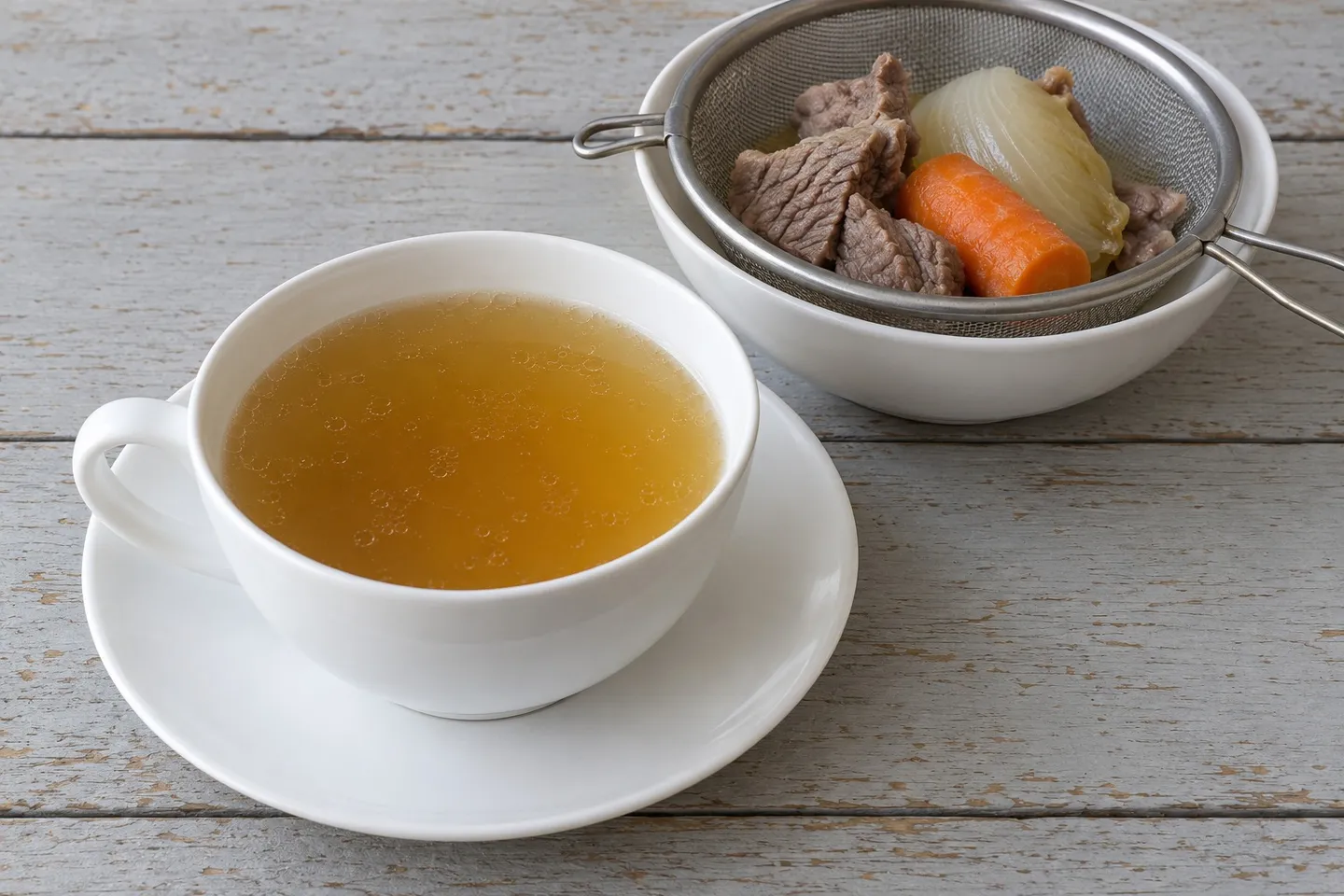
Beef Tea (1857)
Reader ratingsBeef cooked down with butter, onion and carrot to a pale gravy, then simmered an hour in water and strained: Alexis Soyer’s beef tea from the Scutari hospitals.
- Recipe makes
- About 7 cups, 6 servings
- Prep
- Cook
- Total
About 15 minutes to draw the gravy without browning it, 15 more to bring the water to a boil, an hour at a gentle simmer, and a few minutes to skim and strain.
A cup of strained beef tea beside a fine sieve.
The story behind the recipe
Beef tea was the first dish tasted on the day Alexis Soyer opened his kitchen at the Barrack Hospital in Scutari, in 1855. He set his sample beside the beef tea the soldier cooks made from the same allowance and asked Dr. Cumming to taste both. Cumming found Soyer’s good and the other “without taste or flavour,” and Soyer’s was adopted. Two years later Soyer printed his beef tea as No. 3 of his hospital diets, a receipt for six pints.
What made it different?
The difference is in the first ten minutes. Soyer starts the beef in a little butter and only half a pint of water with the vegetables and seasoning, on “a sharp fire,” stirring until the juices form “a rather thick gravy at bottom, but not brown.” Only then does the rest of the water go in, seven pints of it, “hot is preferable.”
It was one diet among many, and the doctors ordered which patient got what. His printed receipt is the formula he stood behind; nobody recorded how closely every cup in the wards matched it. Lord William Paulet’s note on that day’s samples, and the kitchen that made them, appear in What Did Soyer Cook for the Soldiers at Scutari?.
Read more about this recipe
Making it today
Beef chuck has enough connective tissue to give the tea body, and cutting it into walnut-size pieces, as Soyer asks, gives the gravy plenty of cut surface to draw from. He lists onions, leeks, celery, turnips and carrots, “or one or two of these”; we use onion and carrot, half his weight of vegetables. We leave out his chopped bones, which would need a butcher’s saw. The salt is a little under his. Soyer’s list also has a sweet side, and his Rich Rice Pudding (1857) sets rice and milk with eggs.
No. 3.—Beef Tea. Receipt for six Pints.
Cut 3lbs. of beef into pieces the size of walnuts, and chop up the bones, if any; put it into a convenient-sized kettle, with ½lb. of mixed vegetables, such as onions, leeks, celery, turnips, carrots (or one or two of these, if all are not to be obtained), 1oz. of salt, a little pepper, 1 teaspoonful of sugar, 2oz. of butter, half a pint of water. Set it on a sharp fire for ten minutes or a quarter of an hour, stirring now and then with a spoon, till it forms a rather thick gravy at bottom, but not brown: then add 7 pints of hot or cold water, but hot is preferable; when boiling, let it simmer gently for an hour; skim off all the fat, strain it through a sieve, and serve.
Recipe makes: About 7 cups, 6 servings
Ingredients
For about 7 cups, 6 servings. Quantities are shown as written.
Quantities as written here, for about 7 cups, 6 servings.
- Beef chuck, cut in walnut-size pieces1.5 lb
- Small onion, sliced1
- Small carrot, sliced1
- Salt2 tsp
- Ground black pepper1/8 tsp
- Sugar1/2 tsp
- Butter2 tbsp
- Water for the gravy2/3 cup
- Hot water2 quart
Measurement notes
Ingredients as written here
- 1½ lb beef chuck, cut in walnut-size pieces
- 1 small onion, sliced
- 1 small carrot, sliced
- 2 tsp salt
- ⅛ tsp ground black pepper
- ½ tsp sugar
- 2 tbsp butter
- ⅔ cup water for the gravy
- 2 quarts hot water
Equipment
- Heavy saucepan, about 4 quarts
 Kettle
 Wooden spoon
 Fine sieve
 Heatproof bowl or jug
 Instant-read thermometer
Instructions
Put the beef chuck, onion, carrot, salt, black pepper, sugar, butter and water for the gravy into the saucepan. Bring the hot water to a boil in the kettle.
Set the saucepan over medium-high heat for 10 to 15 minutes, stirring now and then, until the meat has turned gray and its juices have cooked down with the butter into a thick, pale gravy at the bottom of the pan. Turn the heat down at once if the gravy starts to brown.
Pour in the hot water and bring it to a boil. Turn the heat down and simmer gently, uncovered, for 1 hour, with the surface barely bubbling at about 200°F (93°C); the beef will be cooked far past the 145°F (63°C) safe minimum.
Skim off all the fat you can with a spoon.
Strain the tea through the fine sieve into the heatproof bowl or jug, pressing the meat lightly. Taste for salt and serve hot in cups.
Nutrition
45calories per serving
- Recipe makes
- About 7 cups, 6 servings
- Servings
- 6
Estimated per serving (6) from USDA FoodData Central values for home-prepared beef broth, with the butter counted and most of the fat skimmed; the strained beef is not included.
Recipe notes
When adjusting quantities
Half of Soyer’s receipt for six imperial pints. It doubles to his full amount in a pot of 8 quarts or more.
Notes
Quantities mentioned in these notes don’t change when you adjust the servings.
Our amounts are half of Soyer’s, with his half imperial pint of water for the gravy coming to about ⅔ cup and his 3½ imperial pints of water rounded to 2 US quarts. His six pints at full size come to about 7 US cups at half size; a small pot loses more to steam, so measure what you strain. We changed a few things: onion and carrot for his mixed vegetables, beef chuck for “beef,” no bones, a little less salt (2 teaspoons where half his ounce is about 2⅓), an uncovered pot and a thermometer reading. Soyer says nothing about the strained beef; it can go into a hash the same day. Chill leftover beef tea and beef in shallow containers within 2 hours, keep them up to 4 days and bring the tea back to a boil, at least 165°F (74°C), before serving. Keep the tea at a real simmer for the full hour: beef juices that are only warmed through are not safely cooked. Contains milk (butter).
Scaling changes the ingredients only; pan sizes and cooking times need their own judgment. To adapt this recipe further, try the recipe tool at TuneMyRecipe (opens in a new tab), our sister site.
Sources and attribution
After Alexis Soyer, Soyer’s Culinary Campaign (London, 1857), Hospital Diets No. 3
See the original pages (scan at Internet Archive) (opens in a new tab)
Recipe details
- Course
- Soup
- Dish family
- Soups & Broths
- Region
- British
- Era
- 19th century
- Source decade
- 1850s
- Main ingredient
- Beef
- Difficulty
- Easy
- Season
- Winter