Soyer’s Soup No. 1 (1857)
Reader ratingsSoyer’s Soup No. 1, his famine soup reprinted in 1857: a little beef fried with onion and vegetable trimmings, thickened with flour and pearl barley and simmered three hours.
- Recipe makes
- About 4.5 liters of soup, 8 bowls
- Prep
- Cook
- Total
About 15 minutes of frying and stirring, 20 minutes to bring the pot to the boil, then 3 hours at a bare simmer, stirring every 15 minutes because the flour sticks.
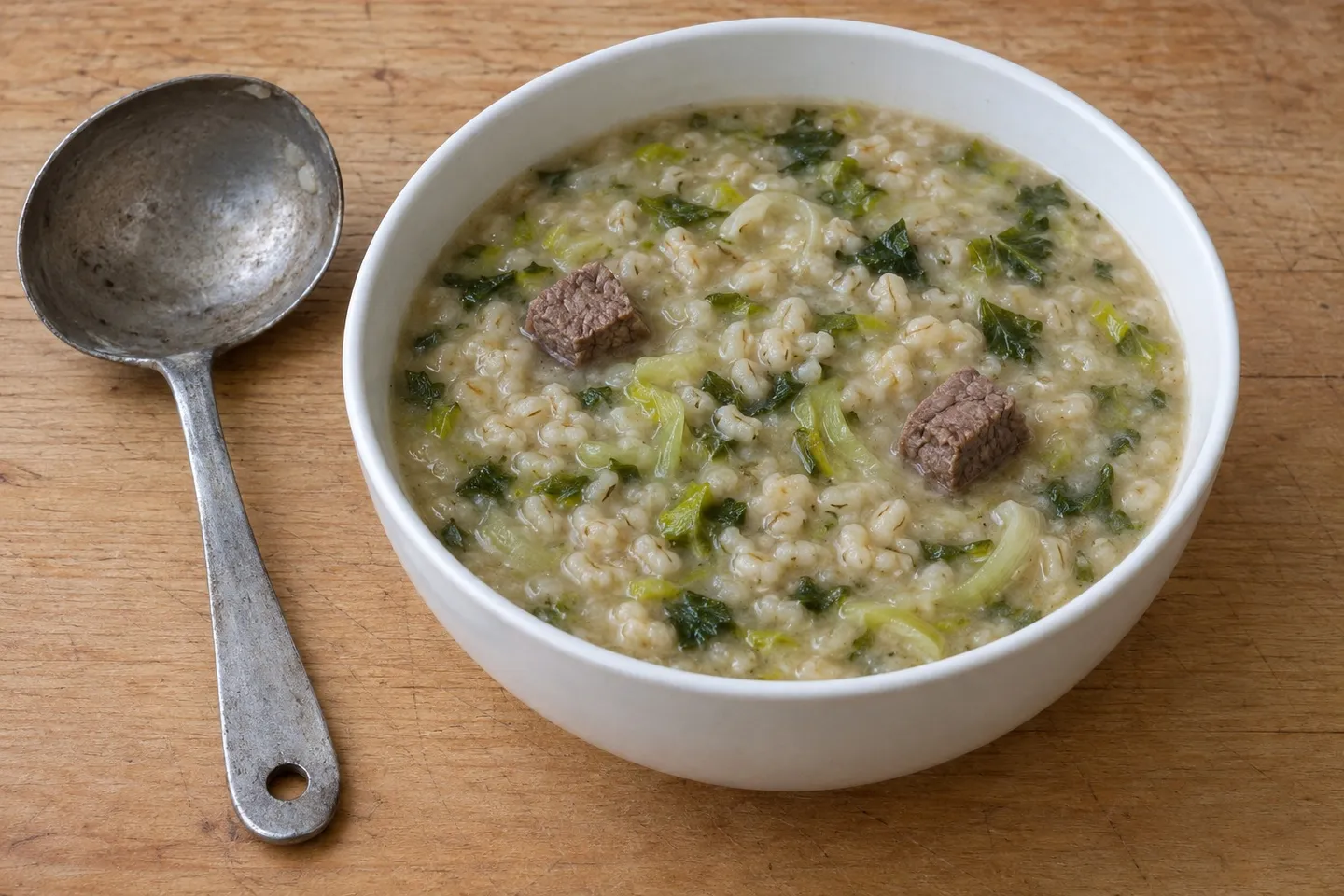
A bowl of thick barley and flour soup with a few cubes of beef.
The story behind the recipe
A quarter of a pound of beef and a few vegetable trimmings, browned in dripping, then thickened with flour and pearl barley in two gallons of water and simmered for three hours: Soyer’s Soup No. 1 is Alexis Soyer’s household size of his hundred-gallon famine soup. He printed it in 1857 as the first of his “Receipts for the Needy,” a section he says reprints some of his receipts of 1847. The hundred-gallon list that follows it on the page matches the one the Illustrated London News printed from his Dublin kitchen in April 1847, as a modern transcription of the paper gives it.
What did Soyer put in a famine soup?
Mostly the parts other cooks discarded. His table lists turnips, leeks and celery by weight, but his own account of making it names the peeling of two turnips, fifteen green celery tops and the green part of two leeks, “(the whole of which, I must observe, are always thrown away.)” Elsewhere in the same section he argued that the outside of a root holds more flavor than the inside. The beef was a small piece of leg, fried with the onions until lightly brown. The whole two gallons came to sixpence on his cost table, fuel included, about £4 today by UK consumer prices (Bank of England).
He wrote that the soup had been “tasted by numerous noblemen, members of parliament, and several ladies” who found it “very good and nourishing.” The critics who weighed his soups in 1847 thought otherwise, and What Did Soyer’s Dublin Soup Kitchen Serve in 1847? sets the two sides out.
Read more about this recipe
How was it kept?
In a flat pan, Soyer said, never a deep one, stirred now and then until nearly cold, “or otherwise the next day it will be in a state of fermentation.” The Recipe notes give the modern rule.
Making it today
This is half of his two-gallon pot, about four and a half liters. Beef shin stands in for leg of beef, and turnip peel can be swapped for a small diced turnip, as his table allows. Whisking the flour into the cold water before it goes in is our choice, to keep it from lumping, and so is cutting the salt to a little over half of his. His next receipt, Soyer’s Soup No. 2 (1857), keeps the quarter pound of beef and thickens the pot with maize flour in place of wheat flour and barley.
No. 1.—For Two Gallons.
Two ounces of dripping … 0½
Quarter of a pound of solid meat, at 4d. per lb. (cut into dice one inch square) … 1
Quarter pound of onions, sliced thin
Quarter pound of turnips; the peel will do, or one whole one cut into small dice … 1
Two ounces of leeks; the green tops will do, sliced thin
Three ounces of celery
Three quarters of a pound of common flour … 1
Half a pound of pure barley, or one pound of Scotch … 1½
Three ounces of salt
Quarter of an ounce of brown sugar … 0¼
Fuel … 0¾
Two gallons of water … 0
6
I first put two ounces of dripping into a saucepan (capable of holding two gallons of water), with a quarter of a pound of leg of beef without bones, cut into square pieces of about an inch; and two middling-sized onions, peeled and sliced; I then set the saucepan over a coal fire, and stirred the contents round for a few minutes with a wooden (or iron) spoon until fried lightly brown. I had then ready washed the peeling of two turnips, fifteen green leaves or tops of celery, and the green part of two leeks; (the whole of which, I must observe, are always thrown away.) Having cut the above vegetables into small pieces, I threw them into the saucepan with the other ingredients, stirring them occasionally over the fire for another ten minutes; then added one quart of cold water, and three quarters of a pound of common flour, and half a pound of pearl barley, mixing all well together; I then added seven quarts of hot water, seasoned with three ounces of salt, and a quarter of an ounce of brown sugar, stirred occasionally until boiling, and allowed it to simmer very gently for three hours; at the end of which time I found the barley perfectly tender. The above soup has been tasted by numerous noblemen, members of parliament, and several ladies who have lately visited my kitchen department, and who have considered it very good and nourishing.
This soup will keep several days when made as above described; but I must observe, not to keep it in a deep pan, but in rather a flat vessel, where the air could act freely upon it. Stir it now and then, until nearly cold: or otherwise the next day it will be in a state of fermentation: this does not denote the weakness of the soup, because the same evil exists with the very strongest of stock, or sauce, if not stirred, or if confined in a warm place—(a fact known to every first-rate cook).
The expenses make it come to three farthings per quart in London; but, as almost everything can be had at less cost in the country, the price of this soup will be still more reduced. In that case a little additional meat might be used, and by giving away a small portion of bread or biscuit, better support would be given to the poor at a trifling cost, and no one, it is to be hoped, hereafter, would hear of the dreadful calamity of starvation.
[Footnote] For the use of the bones, see Receipt No. 9.
Recipe makes: About 4.5 liters of soup, 8 bowls
Ingredients
For about 4.5 liters of soup, 8 bowls. Quantities are shown as written.
Quantities as written here, for about 4.5 liters of soup, 8 bowls.
- Beef dripping30 g
- Boneless beef shin, cut into 2.5 cm cubes55 g
- Onion, peeled and thinly sliced60 g
- Turnip peelings, washed and cut small60 g
- Leek greens, washed and thinly sliced30 g
- Celery leaves and tops, washed and chopped40 g
- Cold water570 ml
- Plain flour170 g
- Pearl barley115 g
- Hot water4 l
- Salt4 tsp
- Soft brown sugar1 tsp
Measurement notes
Ingredients as written here
- 30 g beef dripping
- 55 g boneless beef shin, cut into 2.5 cm cubes
- 60 g onion, peeled and thinly sliced
- 60 g turnip peelings, washed and cut small
- 30 g leek greens, washed and thinly sliced
- 40 g celery leaves and tops, washed and chopped
- 570 ml cold water
- 170 g plain flour
- 115 g pearl barley
- 4 l hot water
- 4 tsp salt
- 1 tsp soft brown sugar
Equipment
- Heavy soup pot, at least 6 liters
 Wooden spoon
- Mixing bowl and whisk
 Kettle
 Ladle
Instructions
Melt the beef dripping in the soup pot over medium heat. Add the beef shin and onion and stir for 4 to 5 minutes, until lightly browned.
Add the turnip peelings, leek greens and celery leaves and tops and cook for 10 minutes, stirring now and then, until they soften.
Whisk the plain flour into the cold water in the bowl until smooth. Pour it into the pot, add the pearl barley and stir everything well together.
Stir in the hot water from the kettle, then the salt and soft brown sugar. Bring to a boil over medium-high heat, stirring often so the flour doesn’t settle and catch.
Turn the heat down until the soup barely bubbles. Partly cover and simmer very gently for 3 hours, stirring right down to the bottom every 15 minutes or so. It is done when the barley is perfectly tender; the soup has been well above 165°F (74°C) for hours, far past the 145°F (63°C) safe minimum for the beef.
Taste and add a little more salt if it needs it. Serve hot in bowls; if it has grown thicker than you like, loosen it with a little more hot water.
Nutrition
185calories per serving
- Recipe makes
- About 4.5 liters of soup, 8 bowls
- Servings
- 8
Estimated per bowl (8) from USDA FoodData Central values for beef shank, beef tallow, wheat flour, pearl barley, onion, turnip, leek, celery and brown sugar.
Recipe notes
When adjusting quantities
Half of Soyer’s two-gallon receipt. Doubled, it is his full pot; keep the long, gentle simmer and stir more often in a bigger pot.
Notes
Quantities mentioned in these notes don’t change when you adjust the servings.
Our amounts are half of Soyer’s two-gallon receipt in grams, with his imperial quart of cold water and seven quarts of hot water coming to about 570 ml and 4 liters. We use the method’s pearl barley; his table also allows a pound of Scotch barley in place of half a pound of “pure” barley. The salt is a little over half of his three ounces, halved. We use beef shin for his leg of beef, choose the cut sizes, whisk the flour into the cold water first and partly cover the pot. Soyer suggested giving a little bread or biscuit with the soup, and his footnote sends the beef bones to his Receipt No. 9, a rice food made with bone stock. His flat-pan cooling is not safe practice today: divide leftovers into shallow containers and refrigerate within 2 hours, use them within 3 to 4 days and reheat to 165°F (74°C), as FoodSafety.gov advises for soups. Contains gluten (flour and barley).
Scaling changes the ingredients only; pan sizes and cooking times need their own judgment. To adapt this recipe further, try the recipe tool at TuneMyRecipe (opens in a new tab), our sister site.


Sources and attribution
After Alexis Soyer, Soyer’s Culinary Campaign (London, 1857), Receipts for the Needy, No. 1
See the original pages (scan at Internet Archive) (opens in a new tab)
Recipe details
- Course
- Soup
- Dish family
- Soups & Broths
- Region
- Irish
- Era
- 19th century
- Source decade
- 1850s
- Main ingredient
- Grains & riceBeef
- Difficulty
- Easy