Soyer’s Stock for Clear Soup (1854)
Reader ratingsAlexis Soyer’s first lesson in A Shilling Cookery for the People, 1854: veal, bacon and onion stirred down to a pale gravy, then simmered in water, skimmed and strained into a clear stock.
- Recipe makes
- About 1.2 liters of stock, plus the cooked veal
- Prep
- Cook
- Total
About 20 minutes to bring the pan to the boil and stir it down to a pale gravy, 10 minutes to return to the boil with the water, then 45 minutes at a gentle simmer.
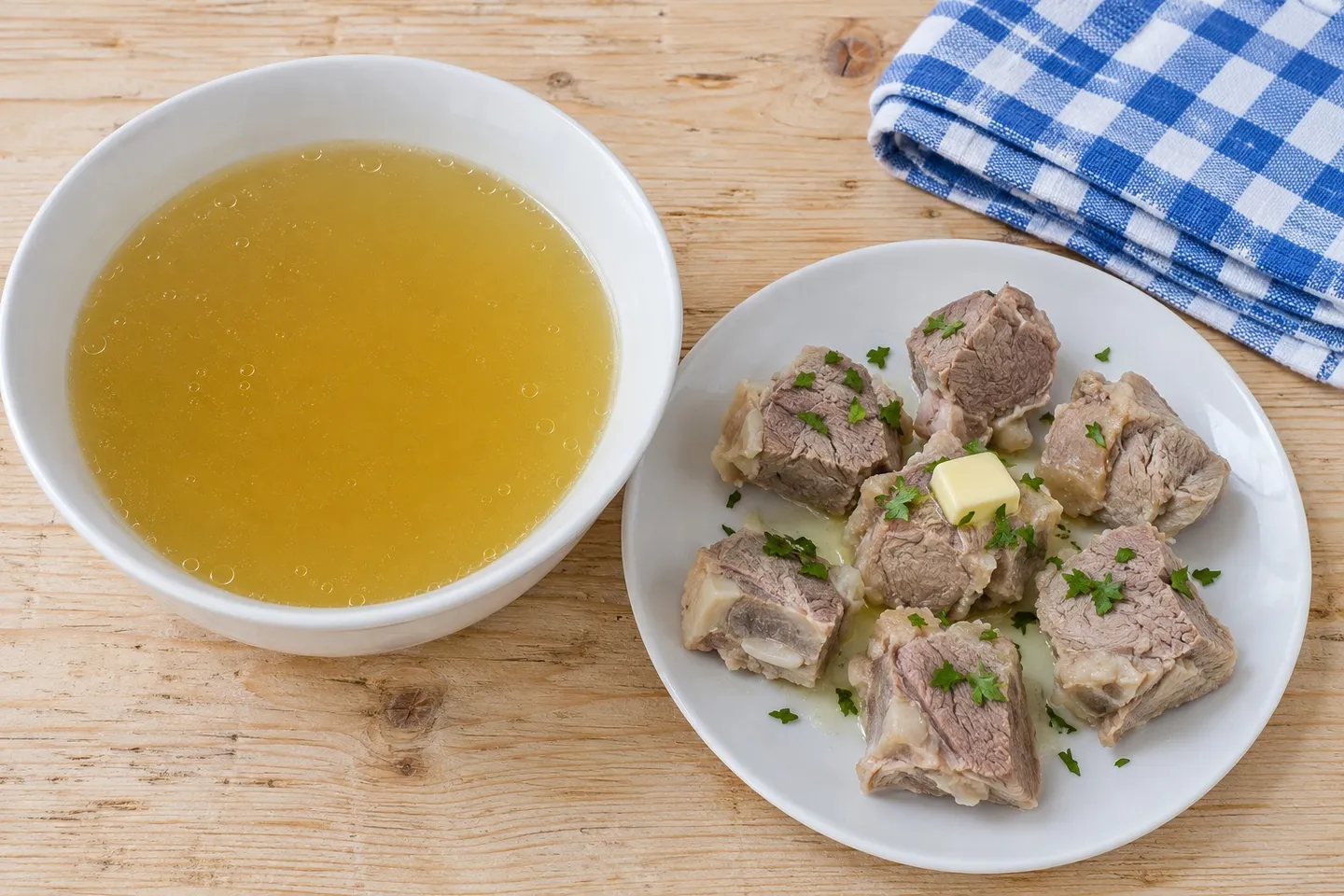
A bowl of clear veal stock with the boiled veal served beside it with parsley and butter.
The story behind the recipe
“Eloise,” Soyer begins his soups, writing the book as if to a correspondent, “Perhaps you are not aware of the reason why the great majority of people in this country are opposed to, and even accused of not liking, soup.” His answer is that every receipt in most cookery books is too complicated and expensive. A Shilling Cookery for the People sets out to simplify them, and it starts with one stock he asks the reader to pay particular attention to.
Why did Soyer call it the first lesson?
Because nearly everything after it depends on it. “Please pay particular attention to the following receipt,” he writes, “for when you are perfect in it, and can make it quick and well, almost every sort of soup can be made from it, and it will often be referred to in different sauces and dishes.” His second lesson begins “Proceed exactly as No. 1” and adds vegetables, cloves and herbs.
Read more about this recipe
Weights, and still a judgment
Nearly every amount is printed: two pounds of veal, two ounces each of butter and bacon, a gill of water to start and five pints after. Only the pepper, “half a spoonful,” is vague. He gives a time for the first stage, about ten minutes, and the signs to watch for as well: the pan forms “a whitish thick gravy at the bottom, or gets rather dry.” He also allows for a kitchen without bacon. Set beside two Babylonian recipes that give no amounts at all, in What Did a Babylonian Cook Need to Know?, his lesson shows how much a measured recipe still leaves to the cook’s eye.
Making it today
Soyer thought the veal good enough to eat on its own, plain or with parsley and butter, as long as it was not overstewed. His famine soups of 1847 also started with a little meat and onion in fat before the water went in: see Soyer’s Soup No. 1 (1857).
1. Stock for Clear Soup. First Lesson.—Cut two pounds of knuckle or scrag of veal into small pieces, place them in the iron pot or stewpan, with two ounces of salt butter or dripping, two ounces of lean bacon cut small, three teaspoonfuls of salt, half a spoonful of pepper, a gill of water, three middle-sized, or six ounces of, onions sliced. Put on the fire; when boiling, stir round with a spoon for about ten minutes, or until it forms a whitish thick gravy at the bottom, or gets rather dry, then add five pints of hot or cold water; when boiling, let it simmer gently for three quarters of an hour, skim it well, pass it through a sieve, and it will be found clear and ready for use for the following soups. Only one third of this quantity need be made.
In case bacon or ham cannot be obtained, use half a pound more meat and a little more salt.
The meat not being overstewed, will be found excellent eaten plain, or with parsley and butter, or any sauce.
Recipe makes: About 1.2 liters of stock, plus the cooked veal
Ingredients
For about 1.2 liters of stock, plus the cooked veal. Quantities are shown as written.
Quantities as written here, for about 1.2 liters of stock, plus the cooked veal.
- Veal knuckle or scrag, on the bone, cut small by the butcher450 g
- Salted butter30 g
- Lean bacon, cut small30 g
- Salt1/2 tsp
- Ground black pepper1/4 tsp
- Water for the first stage70 ml
- Onions, sliced85 g
- Hot or cold water1.4 l
Measurement notes
Ingredients as written here
- 450 g veal knuckle or scrag, on the bone, cut small by the butcher
- 30 g salted butter
- 30 g lean bacon, cut small
- 1/2 tsp salt
- 1/4 tsp ground black pepper
- 70 ml water for the first stage
- 85 g onions, sliced
- 1.4 l hot or cold water
Equipment
- Heavy saucepan, about 3 liters
 Wooden spoon
- Skimmer or large spoon
 Fine sieve
 Instant-read thermometer
Instructions
Put the veal, butter, bacon, salt, pepper, water for the first stage and onions into the saucepan and set it over medium heat.
When it boils, stir it round with the wooden spoon for about 10 minutes, until a whitish thick gravy forms on the bottom of the pan or the pan looks rather dry. Lower the heat if anything starts to catch.
Pour in the hot or cold water and bring it back to the boil. Lower the heat and simmer gently for 45 minutes, skimming off the scum as it rises. Check that the veal is cooked through, well past 145°F (63°C); simmer a little longer if it is not.
Pass the stock through the sieve. Taste it and add salt if it needs it.
Use the stock for soup, and serve the veal separately, plain or with chopped parsley and butter.
Nutrition
90calories per serving
- Recipe makes
- About 1.2 liters of stock, plus the cooked veal
- Servings
- 4
Estimated per bowl of strained stock (4) from USDA FoodData Central values for veal shank, butter, bacon and onion, with most of the meat served separately.
Recipe notes
When adjusting quantities
Half of Soyer’s quantity; he says a third is enough. Doubled, it is his full pot of five pints of water.
Notes
Quantities mentioned in these notes don’t change when you adjust the servings.
Ask the butcher to saw the knuckle into small pieces. We chose butter over Soyer’s alternative of dripping. We halved Soyer’s quantities: 1 lb of veal, 1 oz each of butter and bacon, 3 oz of onions, and half a gill and two and a half pints of water, taken as imperial measures since this is a London book (a gill is a quarter of an imperial pint, about 142 ml). Soyer’s salt would come to one and a half teaspoons for this half batch; we start with half a teaspoon and salt at the end, because modern bacon and salted butter are already salty. His “half a spoonful of pepper” is unclear in size, so we give a quarter teaspoon. Without bacon, use another 115 g of veal and a little more salt, as Soyer says. Contains milk (butter).
Scaling changes the ingredients only; pan sizes and cooking times need their own judgment. To adapt this recipe further, try the recipe tool at TuneMyRecipe (opens in a new tab), our sister site.
Sources and attribution
After Alexis Soyer, A Shilling Cookery for the People (London: Geo. Routledge & Co., 1854), No. 1, Stock for Clear Soup, First Lesson; half the quantity
See the original pages (scan at Internet Archive) (opens in a new tab)
Recipe details
- Course
- Soup
- Dish family
- Soups & Broths
- Region
- British
- Era
- 19th century
- Source decade
- 1850s
- Difficulty
- Easy