The Yale culinary tablet, YBC 4644 · Mesopotamia, findspot unknown · c. 1730 BC
What Did a Babylonian Cook Need to Know?
A clay tablet at Yale holds 25 stews from about 1730 BC and no amounts. What its three-line recipes tell a cook, and what they leave the cook to know.
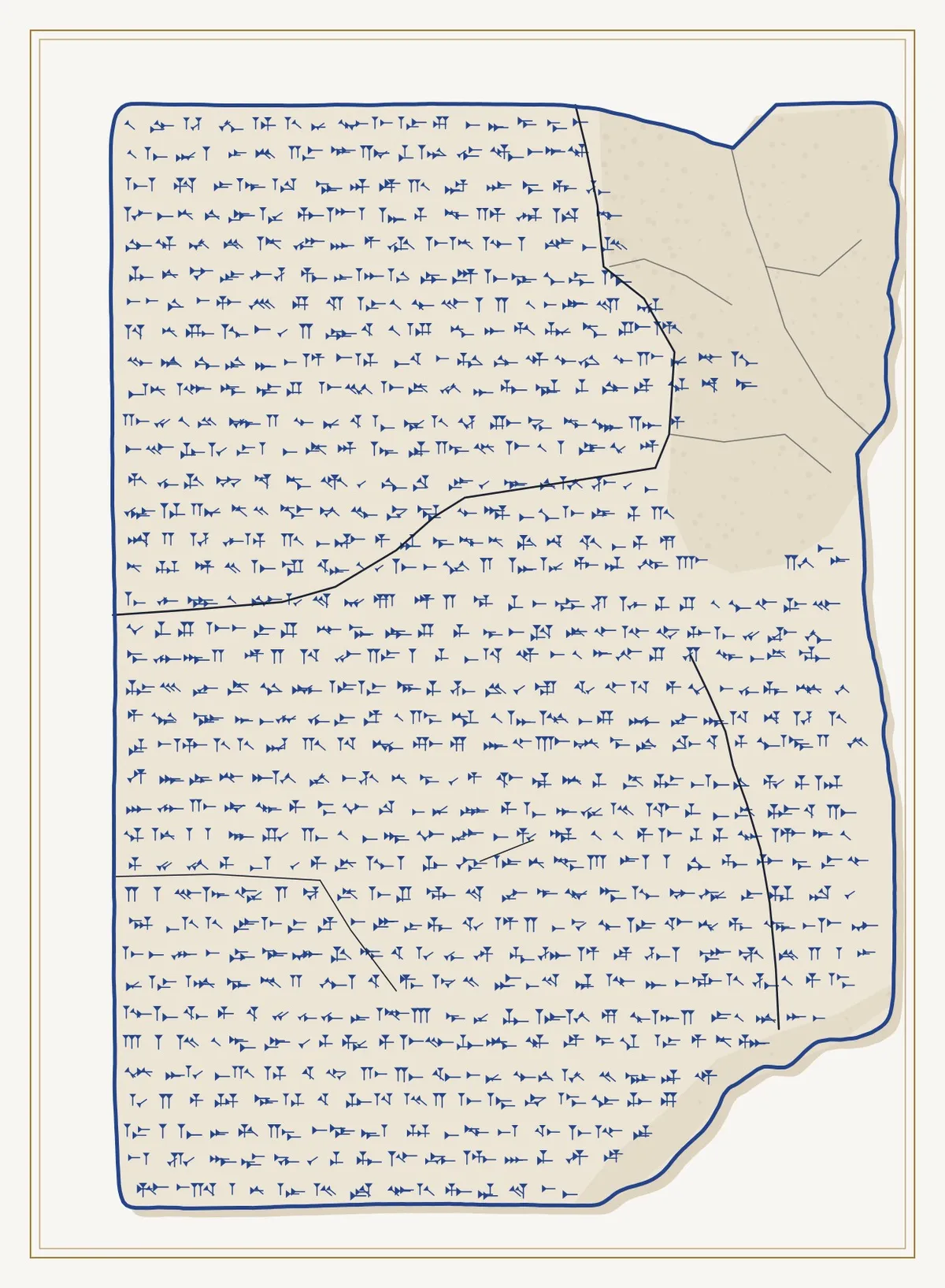
A Babylonian cook was expected to know the amounts, the heat and the timing, because the recipes leave them all out. One of the Yale culinary tablets, written around 1730 BC, holds twenty-five stews and broths in a few lines each. What the lines keep is how each ingredient is handled: bread dried, pounded and sifted, meat seared, leek and garlic crushed, herbs strewn over the top. Several recipes also say what goes in last. A cook today gets the character of each dish from them and has to supply the rest.
Twenty-five stews on one tablet
The tablet is YBC 4644 in the Yale Babylonian Collection, a clay slab about 16 by 12 centimeters, written in Akkadian. Of the three Old Babylonian recipe tablets at Yale it is the most complete, and twenty-one of its stews contain meat. The fat in most of them, according to the researchers who have cooked from it, was sheep’s tail fat, though sesame oil was also to hand. No date is written on it; the team places it around 1730 BC. Its findspot was never recorded, and nothing on it names a kitchen, a cook or a diner.
What the collections were for is unknown, and one modern catalogue files the tablet as a school text. A scribe copying out kitchen knowledge, a teacher or a working cook could each have held it.
Bread at the very end
Pašrūtum is one of the four broths without meat. The current English edition renders its name as “Unwinding,” and it is a short recipe: water and fat on the fire, kurrat, cilantro, leek and garlic, salt to the cook’s taste, and then bread. The bread gets the longest instruction on the tablet’s line: “You pound up dried sourdough, you sift (it) and you scatter (it) over the pot before removing it.”
The bread is worked three ways before it goes in, and it goes in last. A cook who simmered chunks of bread from the start would make a thick bread soup. The tablet asks for a fine crumb landing on the surface as the pot comes off the fire. The researchers who cooked it found it mild, and wonder whether the name describes the crumbs loosening and spreading as they land. Why a crumb added late changes a broth is still a kitchen question, and TuneMyRecipe’s Why Soup Gets Thick (opens in a new tab) follows it through crackers and flour.
Seared meat, a green finish
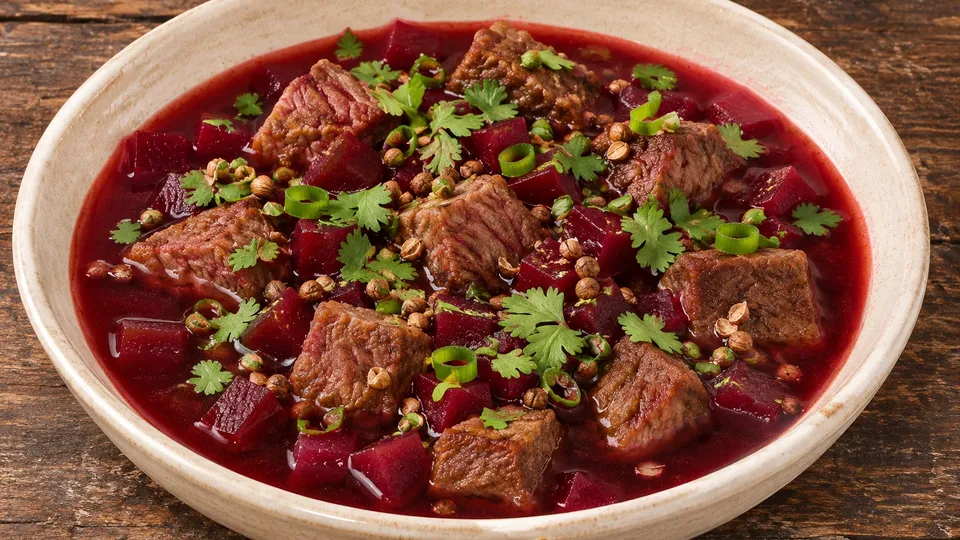
Tuh’u, on the back of the tablet, is a meat stew handled quite differently. A leg of meat is seared in fat before the liquid goes to work, and a long list of vegetables, herbs and seasonings goes in with it, beer, beet, arugula and cumin among them. Leek and garlic are crushed, coriander is strewn over the top, and fresh cilantro and kurrat finish it, so the same herb appears once in the pot and once raw. Where the clay is damaged two of the verbs are restored by the editors, and the researchers’ own slide puts a question mark beside the beet.
The team has cooked it many times. Their published version, from 2019, gives a pound of diced leg of mutton, half a cup of sheep fat, a cup of beer and half a cup of water, and about an hour’s simmer. Every one of those numbers is theirs.
Beer in the pot
Beer is one of the liquids these stews are cooked in, with water and sometimes milk, and tuh’u simply names it. Bread and beer were the staples of Mesopotamian eating, both made mostly from barley, and the kitchen borrowed from the brewery. Bappir, the dried barley cakes that beer writers call beer bread, also went into stews, where the Yale and Harvard team thinks they soaked up liquid and thickened the broth.
How that beer was made is a separate puzzle. The Sumerian Hymn to Ninkasi, which survives in copies of the same Old Babylonian centuries, praises the beer goddess through the work of brewing: bappir and dough, the oven, malt soaked and spread on mats, a vat over a collector, and the filtered beer poured out “like the onrush of the Tigris and the Euphrates.” Brewing trials in 2004 and 2005, built around vessels found at Tall Bazi in northern Syria, a site some five centuries younger than the tablet, produced a beer of 1.6 percent alcohol, but the brewers chose a dilute mash on purpose. What a Babylonian cook poured into tuh’u, and how strong it was, can’t now be recovered.
What the cook brought
Patricia Jurado Gonzalez, Gojko Barjamovic and Pia Sörensen, three of the six scholars and cooks behind the reconstructions, put the difficulty plainly in a lecture in 2020: “None of these recipes have quantities listed. Often, the order of steps are not quite clear. So clearly, there is some implied understanding that the person who is doing this has some knowledge.” Even a word that clearly means cilantro leaves open whether the leaf, flower, root or seed went in.
Their way through is to cook, and the results feed back into the reading. They first took one of tuh’u’s ingredients, samīdu, to be soapwort. The stew came out extremely bitter even with a little, and foamed as it boiled. Barjamovic went back to the books, and the team now reads Persian shallot, which sits better beside the onion, leek and arugula. The bitter pot weakened the old reading; the new one rests on the books.
A first lesson from 1854
A cookbook from thirty-six centuries later measures what the tablet leaves out and still leaves the cook a judgment. Alexis Soyer’s A Shilling Cookery for the People, which promises soups plain and cheap enough for every dinner table, opens with a stock he calls the “First Lesson” and asks the reader to pay particular attention to it:
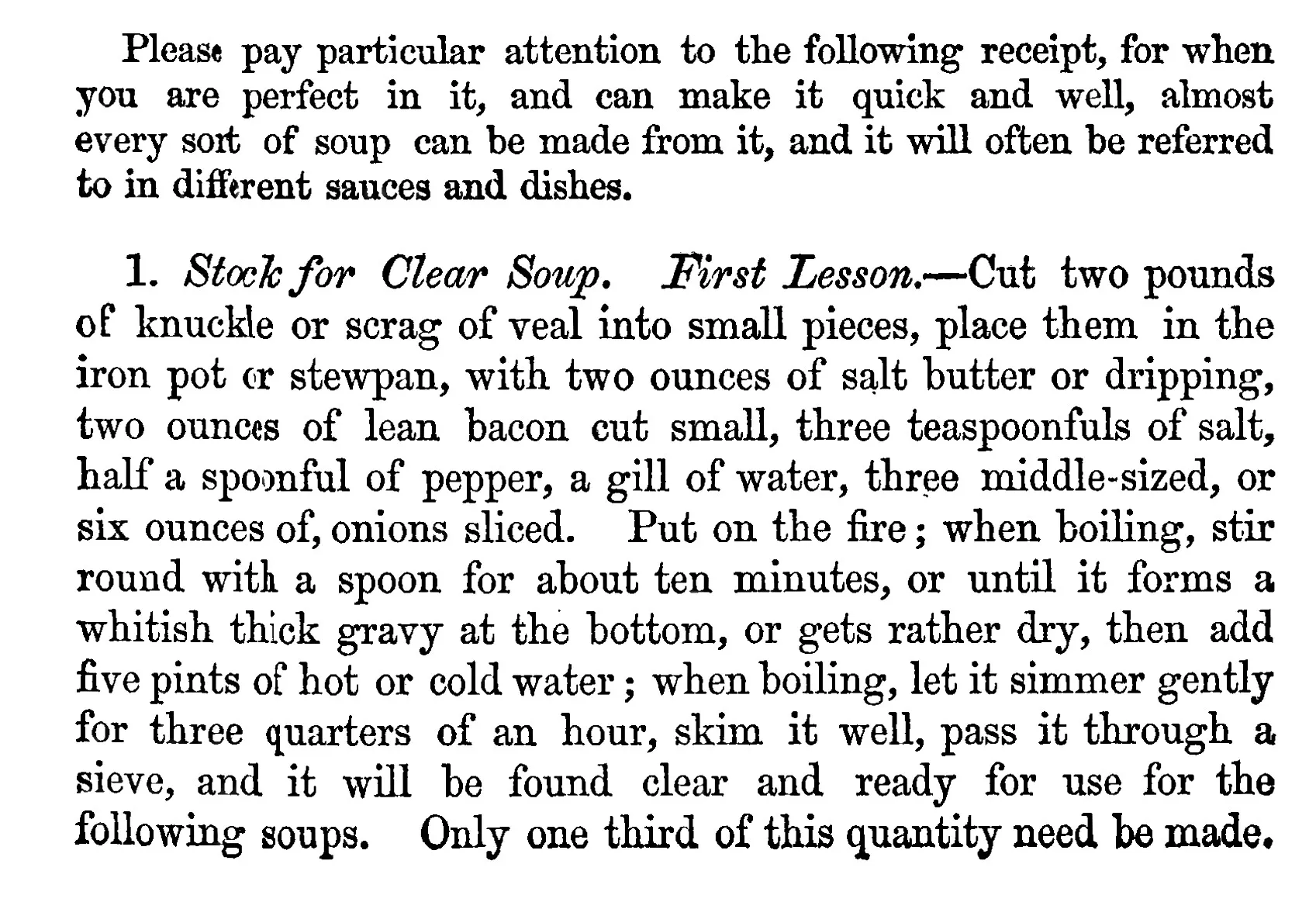
Soyer weighs the veal, butter, bacon and onions and measures the water, and he gives about ten minutes for the first stage and three quarters of an hour for the second. Even so, the cook decides when to add the water, by watching for “a whitish thick gravy at the bottom,” and makes up the bacon with more meat when there is none. Cato’s farm manual, written between the two, weighs some recipes and not others: its cheese bread is measured in pounds while its honeyed fritters come with no amounts at all, as What Did a Roman Farmhouse Bake? shows.
The recipes
The two Babylonian dishes keep the tablet’s handling of each ingredient, with amounts of our own. Soyer’s stock is his recipe, halved.
- Ancient Babylonian Leek Broth with Sourdough Crumbs (Pašrūtum): the meatless broth, with its bread finish.
- Ancient Babylonian Lamb and Beet Stew (Tuh’u): the seared meat stew, cooked in beer.
- Soyer’s Stock for Clear Soup (1854): Soyer’s first lesson, measured to the ounce.
Cooking it
For a Babylonian supper, start the lamb and beet stew two and a half hours ahead and make the leek broth while it simmers: crush the coriander seed in the same mortar you used for the bread.
 Cook it todayAncient Babylonian Lamb and Beet Stew (Tuh’u)
Sources
- YBC 4644 (YOS 11, 25; CDLI P291955), recipes 9 and 22, obverse lines 23–25 and reverse lines 26–28, English translation in the electronic Babylonian Library edition, ebl.lmu.de/library/YBC.4644 (opens in a new tab), read 2 November 2026; object record and description at CDLI (opens in a new tab) and CDLI’s highlight page (opens in a new tab).
- Patricia Jurado Gonzalez, Gojko Barjamovic and Pia Sörensen, “Spices in Mesopotamian Food,” (opens in a new tab) Fermentology, NC State University Libraries, 24 September 2020, pp. 5–11, CC BY 4.0 (opens in a new tab); quoted from p. 6, the rest summarized.
- Gojko Barjamovic, Patricia Jurado Gonzalez, Chelsea A. Graham, Agnete W. Lassen, Nawal Nasrallah and Pia M. Sörensen, “The Ancient Mesopotamian Tablet as Cookbook,” (opens in a new tab) Lapham’s Quarterly, 11 June 2019, from Ancient Mesopotamia Speaks (New Haven: Yale Peabody Museum, 2019).
- A hymn to Ninkasi, lines 45–48, translation in the Electronic Text Corpus of Sumerian Literature (opens in a new tab), 4.23.1 (Oxford); Miguel Civil, “A Hymn to the Beer Goddess and a Drinking Song,” in Studies Presented to A. Leo Oppenheim (Chicago: University of Chicago Press, 1964), pp. 67–89.
- Martin Zarnkow and others, “Cold mashing process: a technology possibly used in ancient times in the Orient,” Brauwelt International 24 (2006), pp. 306–310.
- Alexis Soyer, A Shilling Cookery for the People, tenth thousand (London: Geo. Routledge & Co., 1854), pp. [7]–8. Getty Research Institute, digitized by the Internet Archive.