Cato’s farm manual, De agri cultura · A Roman farm in central Italy · c. 160 BC
What Did a Roman Farmhouse Bake?
Cheese bread baked on leaves, honeyed cheese fritters, must cakes on bay leaves and an olive relish: the kitchen of Cato’s farm manual, second century BC.
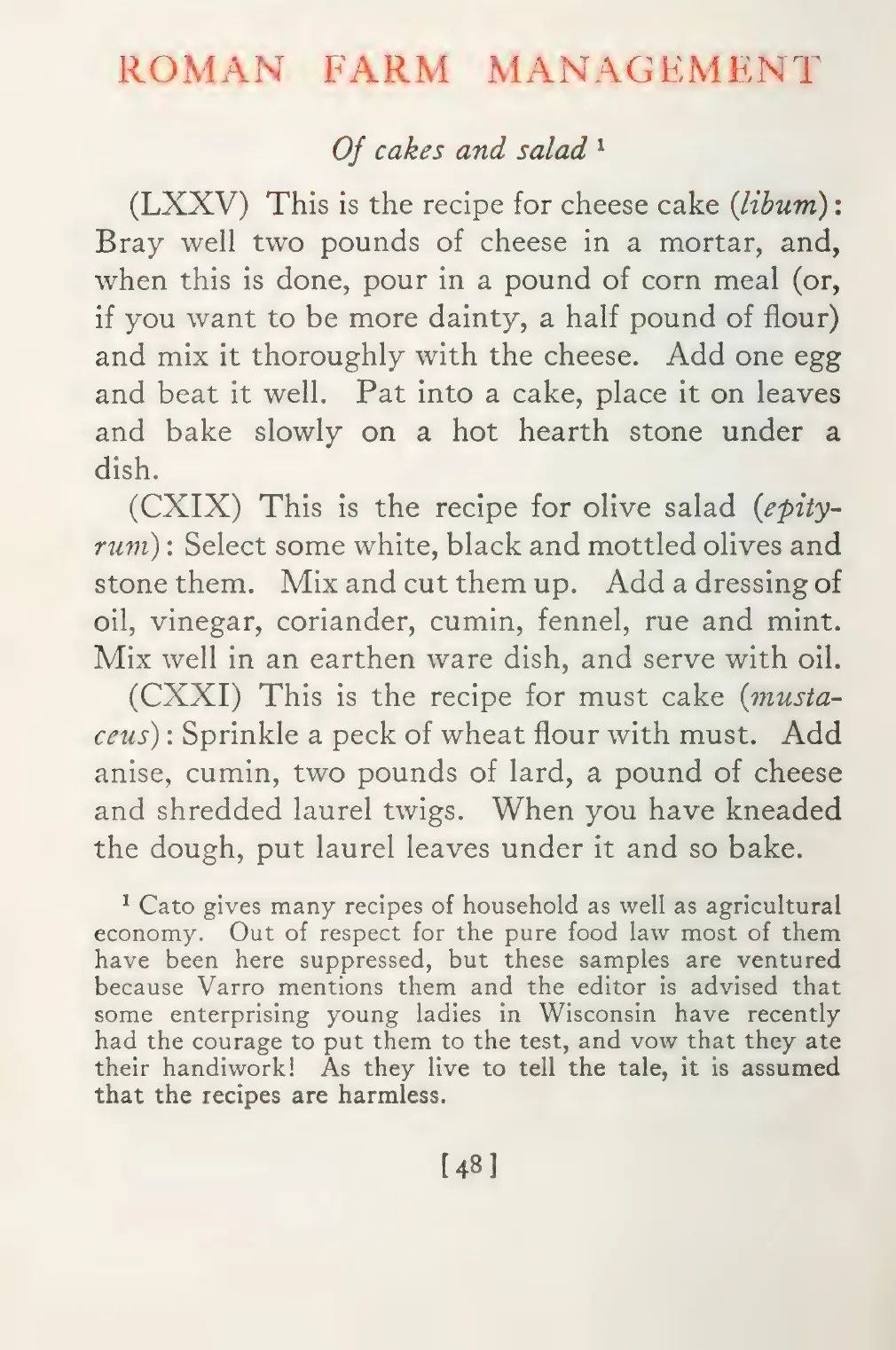
A Roman farmhouse baked with cheese, wheat flour and leaves. Cato’s farm manual, written in the middle of the second century BC, gives a run of recipes for its kitchen: a cheese bread called libum, set on leaves and baked under a dish on the hearth; honeyed cheese fritters called globi; must cakes baked on bay leaves; and an olive relish called epityrum, from one of the first books ever written in Latin.
Cato and his book
Marcus Porcius Cato lived from 234 to 149 BC. Fairfax Harrison, who put Cato and Varro into English, describes a peasant’s son from Tusculum who became a leader of the bar in Rome, commanded an army, held all the high offices of state and “ended a contentious life in the Senate denouncing Carthage and the degeneracy of the times.” He wrote his De agri cultura “in green old age,” and Harrison calls it “a mere collection of random notes” that still “sets forth more shrewd common sense and agricultural experience than it is possible to pack into the same number of English words.”
It was also, Harrison adds, the first book on farming in Latin, and “one of the very first books written in that vernacular at all.” Most of it is about vines, olives, oxen and the overseer. The recipes sit among instructions for curing hams, pressing oil and charming a dislocated hip.
The housekeeper’s hearth
The cooking on Cato’s farm fell to the vilica, the overseer’s wife and housekeeper. Cato’s list of her duties puts the hearth at the center. “Every night before she goes to bed she should see that the hearth is swept and clean.” On feast days she hangs a garland over it and prays to the household gods. “She should take care that she has food cooked for you and for the hands,” Cato goes on, and keep “plenty of chickens and an abundance of eggs.”
The hands drew grain, four pecks of meal in winter and four and a half in summer. The slaves who worked in chains got bread, four pounds in winter and five once the digging of the vines began. “Save the wind fall olives as much as possible as relishes for the hands,” he writes, and “when the olives are all eaten, give them fish pickles and vinegar.” Olives were the everyday relish.
Cheese, flour and leaves
Cato’s baking needs no oven. The libum is two pounds of cheese pounded in a mortar with a pound of fine wheat flour and one egg, shaped into a loaf and baked “slowly on a hot hearth stone under a dish,” with leaves beneath it. His must cake is flour wetted with grape must, worked with lard, cheese, anise and cumin, and baked on bay leaves. The globi are cheese mixed with alica, coarse groats, rolled into balls, fried in hot fat and finished with honey and poppy seed.
The cheese is not named in these recipes, but for his largest cake, the placenta, Cato asks for sheep’s cheese that is fresh and not sour.
Not every Roman admired the recipes. In his dialogue on farming, written more than a century later, Varro grumbles about authors who wander off the subject: “Does not the agricultural treatise of the great Cato himself fairly bristle with them, as for instance his instructions how to make must cake and cheese cake, and how to cure hams?” That is Harrison’s English. Varro’s Latin names the placenta and the libum, and Harrison turned the placenta into a must cake.
Harrison shared some of that doubt. He kept only three of the recipes, explaining in a footnote that “out of respect for the pure food law most of them have been here suppressed.” He printed three “because Varro mentions them,” and because “some enterprising young ladies in Wisconsin” had tried them “and vow that they ate their handiwork! As they live to tell the tale, it is assumed that the recipes are harmless.”
Cato’s honey cheesecake, the savillum, appears in What Did Pompeii Buy at the Street Counter?, beside the cakes found charred in the town’s shops.
The recipes
Four recipes come from Cato’s own chapters and one from Columella, the farm writer of the first century AD who credited Cato with teaching agriculture to speak Latin.
- Epityrum, Olive Relish (Cato): white, black and mottled olives, stoned and chopped with oil, vinegar, coriander, cumin, fennel, rue and mint.
- Moretum, Herb and Cheese Spread (Columella): green herbs and salted fresh cheese pounded in a mortar, with peppered vinegar and oil poured over.
- Libum, Cheese Bread (Cato): fresh cheese, flour and an egg, baked on bay leaves under an upturned dish.
- Globi, Honeyed Cheese Fritters (Cato): cheese and semolina balls fried in olive oil, brushed with honey and rolled in poppy seed.
- Mustaceus, Must Cake (Cato): flour wetted with grape must, with lard, cheese, anise and cumin, baked on bay leaves.
Cato’s placenta, the cake Varro actually named, is left out for its size: it takes fourteen pounds of cheese.
Cooking it
Fresh cheese does most of the work. Whole-milk ricotta, drained in a sieve, takes the place of Cato’s fresh sheep’s cheese in the bread and the fritters. The must cake takes grated pecorino, which works into its stiff dough, and feta replaces Columella’s salted cheese. Unsweetened red grape juice does for must, which is the fresh juice of crushed grapes before it ferments. An ovenproof bowl turned over the loaf does the job of Cato’s dish on the hearth.
The olive relish is the place to start. It takes fifteen minutes and an hour’s rest, keeps a few days in the refrigerator, and olives were the relish Cato set aside for his hands. The relish and the farm’s breads and cakes are among our Roman recipes, with Trimalchio’s far richer dinner. His hands also had a wine ration; for what Romans drank besides wine, posca among it, Forgotten Drink, our sister site, has What Did Romans Drink Besides Wine? (opens in a new tab)
Sources
- Cato and Varro, Roman Farm Management: The Treatises of Cato and Varro, trans. Fairfax Harrison (New York: Macmillan, 1918), pp. 4–5, 35–37, 48 and 71–72. University of Toronto, digitized by the Internet Archive (romanfarmmanagem02harruoft).
- Cato, De agri cultura, chapters 56, 75, 76, 79, 119 and 121, Latin text in Les agronomes latins, ed. Charles Nisard (Paris: Dubochet, 1844), pp. 22, 26, 27 and 34, with Varro’s Latin on p. 67.
- Columella, Of Husbandry (London: A. Millar, 1745), book 12, chapter 57, p. 569.