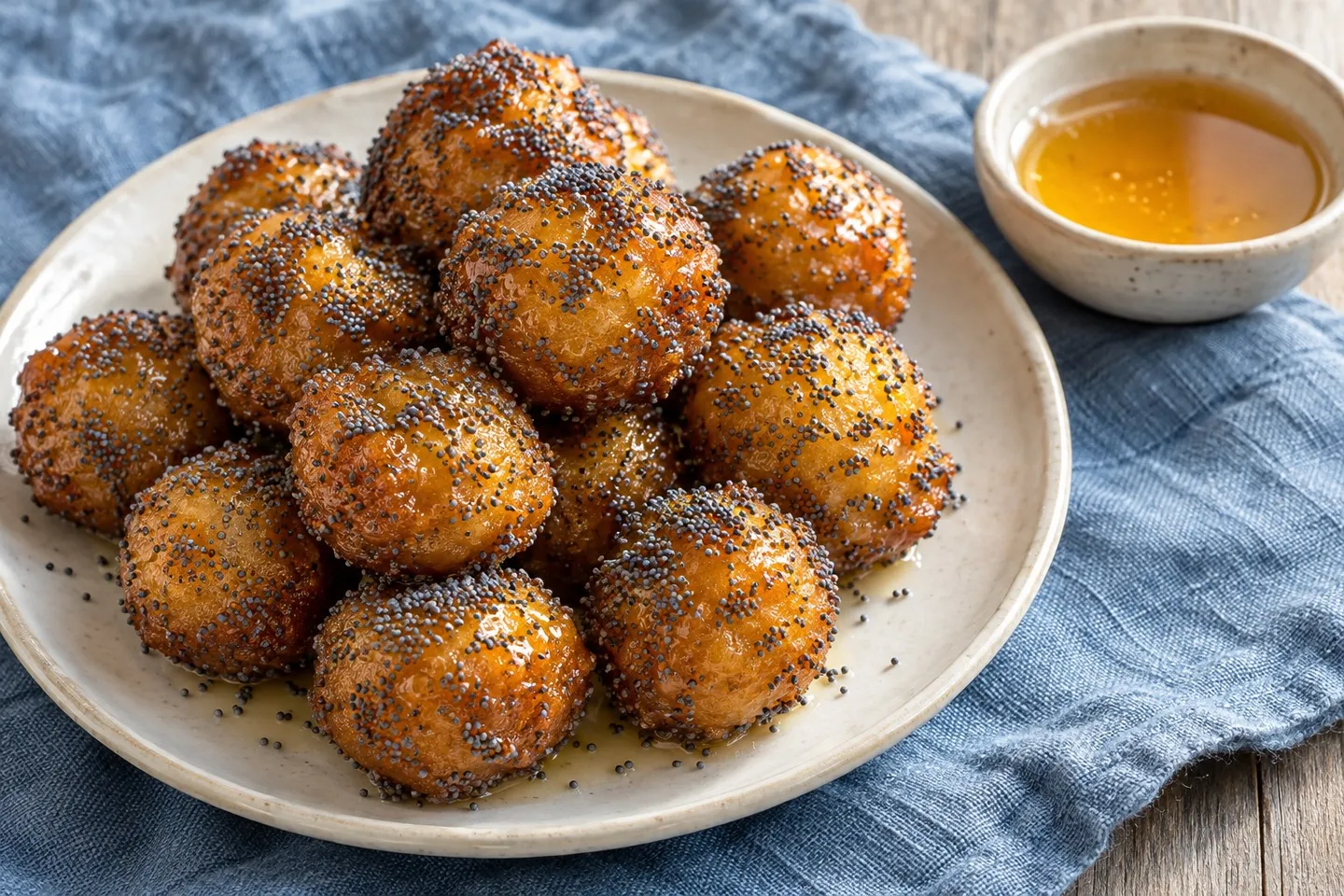
Globi, Honeyed Cheese Fritters (Cato)
Reader ratingsBalls of fresh cheese and semolina fried golden in olive oil, then spread with honey and sprinkled with poppy seed, after Cato’s globi of the second century BC.
- Recipe makes
- About 20 fritters, 6 servings
- Prep
- Cook
- Total
Drain the ricotta for 30 minutes, then let the mixture rest 30 minutes so the semolina softens and the balls hold their shape.
Globi, cheese fritters with honey and poppy seed.
The story behind the recipe
Fairfax Harrison left Cato’s fritters out of his English translation, along with most of the recipes, “out of respect for the pure food law.” Globi are cheese and grain rolled into balls, fried in hot fat, then spread with honey and sprinkled with poppy seed. The whole recipe is six short sentences in the Latin, and it gives no amounts.
Cheese, alica and two sticks
Cato mixes the cheese “with alica,” coarse groats, and lets the cook make as many as they like. The fat goes into a hot bronze pot, ahenum, and the balls fry one or two at a time, turned often with two sticks. Once cooked they are spread with honey, sprinkled with poppy seed, and served. The honey and poppy seed are the same finish he gives his savillum cheesecake.
The next chapter is a cousin, the encytum, made “the same way as the globi” except that the mixture is poured into the hot fat through a hollow vessel with a hole in it and shaped into a spiral, like a rope coiled on itself. It too is turned with two sticks, spread like the globi, and served, not too hot, with honey or honeyed wine. The translations here are ours, from the Latin.
Read more about this recipe
Making it today
Fine semolina stands in for the alica: it is a wheat meal, and it soaks up the whey from the cheese so the balls hold. Cato’s unguen is any fat or grease; olive oil, the farm’s own fat, is our choice. We set the amounts.
With Mustaceus, Must Cake (Cato), they are the sweet end of What Did a Roman Farmhouse Bake?
Globos sic facito. Caseum cum alica ad eundem modum misceto. Inde quantos voles facere facito. In ahenum caldum unguen indito. Singulos aut binos coquito, versatoque crebro duabus rudibus; coctos eximito. Eos melle unguito, papaver infriato, ita ponito.
Cato, De agri cultura, chapter 79, as printed in Charles Nisard’s Les agronomes latins (Paris, 1844). In our translation: “Make globi this way. Mix cheese with alica in the same way. Then make as many as you like. Put fat into a hot bronze pot. Cook them one or two at a time, turning them often with two sticks; take them out when cooked. Spread them with honey, sprinkle with poppy seed, and serve them so.”
Recipe makes: About 20 fritters, 6 servings
Ingredients
For about 20 fritters, 6 servings. Quantities are shown as written.
Quantities as written here, for about 20 fritters, 6 servings.
- Whole-milk ricotta600 g
- Fine semolina150 g
- Olive oil, about 4 cm deep in the pan, for frying
- Honey120 g
- Poppy seeds2 tbsp
Measurement notes
Ingredients as written here
- 600 g whole-milk ricotta
- 150 g fine semolina
- Olive oil, about 4 cm deep in the pan, for frying
- 120 g honey
- 2 tbsp poppy seeds
Equipment
 Fine sieve
- Mixing bowl
- Heavy saucepan or deep frying pan
- Deep-fry or instant-read thermometer
- Slotted spoon
 Small saucepan
Instructions
Set the ricotta in the sieve over a bowl and let it drain for 30 minutes.
Mix the drained ricotta and semolina in the bowl until smooth. Cover and leave for 30 minutes, until the mixture is firm enough to roll.
With wet hands, roll the mixture into balls the size of a walnut and set them on a plate.
Heat the olive oil in the heavy saucepan to 350°F (175°C). Fry the balls 4 or 5 at a time, turning them often with two wooden spoons, until deep golden all over, 3 to 4 minutes. Lift them out with the slotted spoon onto paper towels. Let the oil come back to 350°F (175°C) between batches.
Warm the honey in the small saucepan until runny. Roll the fritters in it, or brush it over them, and sprinkle with the poppy seeds.
Serve warm.
Nutrition
360calories per serving
- Recipe makes
- About 20 fritters, 6 servings
- Servings
- 6
Estimated per serving from USDA FoodData Central values for whole-milk ricotta, semolina, honey, poppy seed and the olive oil a fritter takes up.
Recipe notes
When adjusting quantities
Cato gives no amounts. Keep about three parts drained ricotta to one of semolina; fry in batches whatever the quantity.
Notes
Quantities mentioned in these notes don’t change when you adjust the servings.
If the first ball breaks up in the oil, work another tablespoon or two of semolina into the mixture and rest it 10 minutes more. Pat the balls dry before frying, since wet ricotta spits in hot oil. Keep the pan on a back burner, never fill it more than half full, and never leave it unattended. Keep a lid nearby to smother a flare, never use water on burning oil, and let the oil cool completely before you move it.
Scaling changes the ingredients only; pan sizes and cooking times need their own judgment. To adapt this recipe further, try the recipe tool at TuneMyRecipe (opens in a new tab), our sister site.
Sources and attribution
After Cato, De agri cultura 79, Globos sic facito; Latin text in Les agronomes latins, ed. Charles Nisard (Paris: Dubochet, 1844); our translation
Recipe details
- Course
- Dessert
- Dish family
- Desserts & Sweets
- Era
- Ancient Rome
- Main ingredient
- Milk & cream
- Difficulty
- Intermediate
- Occasion
- Everyday meal