Mustaceus, Must Cake (Cato)
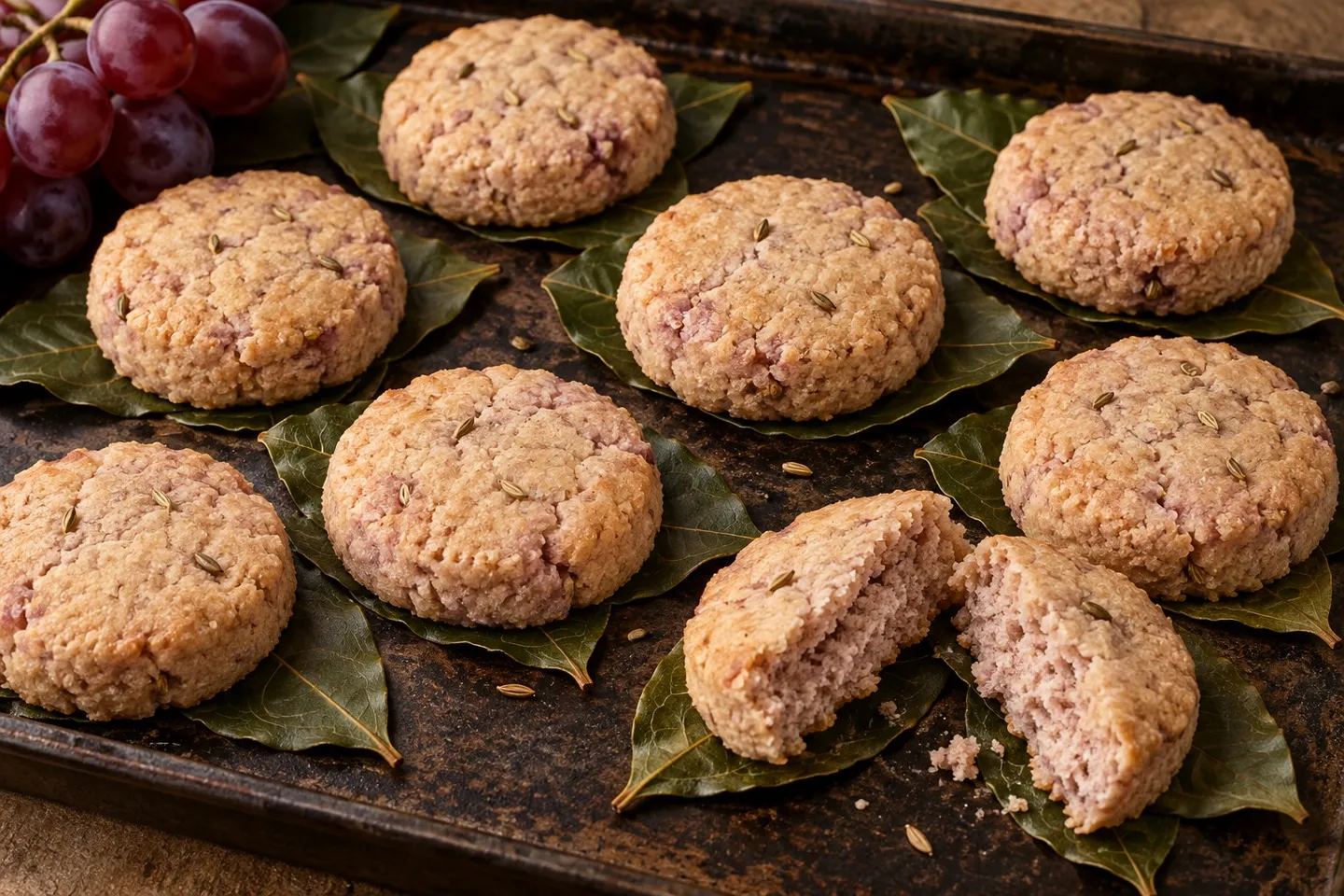
Reader ratingsMustaceus, the must cake of Cato’s farm manual: wheat flour wetted with grape must and worked with lard, cheese, anise and cumin, shaped into small cakes and baked on bay leaves.
- Recipe makes
- 8 small cakes
- Prep
- Cook
- Total
No rising time: Cato’s dough has no yeast, so the cakes go into the oven as soon as they are shaped.
Mustaceus, small must cakes baked on bay leaves.
The story behind the recipe
Must is the fresh juice of crushed grapes, before it ferments, and Cato’s farm, with its vineyards, made it every vintage. Cato’s must cake uses it in place of water: a peck of wheat flour wetted with must and worked with lard, cheese and spices, then baked on bay leaves. Fairfax Harrison printed it, he said, because Varro mentions it. Varro’s Latin actually names Cato’s placenta, a far grander cake, and Harrison’s English turned that into “must cake.”
A peck of flour and two pounds of lard
The recipe is written for a whole farm’s baking, and the Latin title is plural, mustaceos, so the batch made many cakes. A modius, Harrison’s “peck,” of fine wheat flour takes two pounds of lard and one of cheese, with anise and cumin. Cato also scrapes in bark from a bay twig, and sets bay leaves under the cakes as they bake. There is no honey and no yeast. The sweetness comes from the must alone.
Must did not have to wait for the vintage. The chapter just before it tells how to keep must sweet all year: fill an amphora, pitch the stopper, sink it in a pond, and take it out after thirty days.
Read more about this recipe
Making it today
A modius held about 8.7 liters, and its flour weighs roughly 4.5 kg; we keep Cato’s proportions for 500 g: 70 g of lard and 35 g of cheese. His cheese isn’t named; a hard sheep’s cheese grates finely enough to work into a stiff dough, so we use pecorino. Unsweetened red grape juice is the closest to must in a shop. Ground bay leaf replaces the scraped bark, and we add salt.
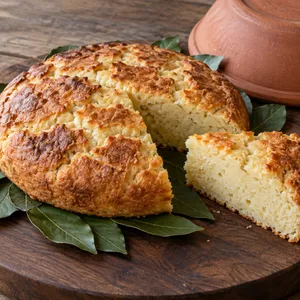
With no yeast or egg in the recipe, expect a firm cake. For the farm’s other baking, see Libum, Cheese Bread (Cato) and What Did a Roman Farmhouse Bake?
(CXXI) This is the recipe for must cake (mustaceus): Sprinkle a peck of wheat flour with must. Add anise, cumin, two pounds of lard, a pound of cheese and shredded laurel twigs. When you have kneaded the dough, put laurel leaves under it and so bake.
Recipe makes: 8 small cakes
Ingredients
For 8 small cakes. Quantities are shown as written.
Quantities as written here, for 8 small cakes.
- All-purpose flour500 g
- Anise seeds1 tsp
- Cumin seeds1 tsp
- Ground bay leaf1/4 tsp
- Lard, soft70 g
- Pecorino, finely grated35 g
- Salt1/2 tsp
- About 250 ml unsweetened red grape juice
- Bay leaves, fresh or dried16–24
Measurement notes
Ingredients as written here
- 500 g all-purpose flour
- 1 tsp anise seeds
- 1 tsp cumin seeds
- 1/4 tsp ground bay leaf
- 70 g lard, soft
- 35 g pecorino, finely grated
- 1/2 tsp salt
- About 250 ml unsweetened red grape juice
- 16 to 24 bay leaves, fresh or dried
Equipment
- Mixing bowl
 Grater
- Mortar and pestle or spice grinder
- Baking sheet
Instructions
Heat the oven to 350°F (180°C).
Crush the anise seeds and cumin seeds coarsely in the mortar. Mix them in the bowl with the flour, ground bay leaf and salt.
Rub the lard into the flour with your fingertips until it disappears. Stir in the pecorino.
Pour in most of the grape juice and mix with your hand, adding the rest a little at a time, until the dough comes together. Knead it on the counter for 3 to 4 minutes, until smooth.
Divide the dough into 8 pieces. Roll each into a ball and flatten it to a round about 1.5 cm thick.
Lay 2 or 3 bay leaves on the baking sheet for each cake and set a cake on each group.
Bake for 25 to 30 minutes, until firm and lightly browned underneath. Cool on a rack and peel off the bay leaves before eating.
Nutrition
320calories per serving
- Recipe makes
- 8 small cakes
- Servings
- 8
Estimated per cake from USDA FoodData Central values for all-purpose flour, lard, pecorino and grape juice.
Recipe notes
When adjusting quantities
Keep the lard at about one seventh of the flour’s weight and the cheese at half the lard. Add the grape juice by feel until the dough comes together.
Notes
Quantities mentioned in these notes don’t change when you adjust the servings.
If you can get fresh grape must from a winemaker at harvest time, use it in place of the juice. The cakes keep 3 days in a tin.
Scaling changes the ingredients only; pan sizes and cooking times need their own judgment. To adapt this recipe further, try the recipe tool at TuneMyRecipe (opens in a new tab), our sister site.
Sources and attribution
Cato, De agri cultura 121, in Fairfax Harrison’s translation, Roman Farm Management (New York, 1918)
Recipe details
- Course
- Bread & baking
- Dish family
- Breads & Cakes
- Era
- Ancient Rome
- Main ingredient
- Fruit
- Difficulty
- Intermediate
- Occasion
- Everyday meal