Libum, Cheese Bread (Cato)
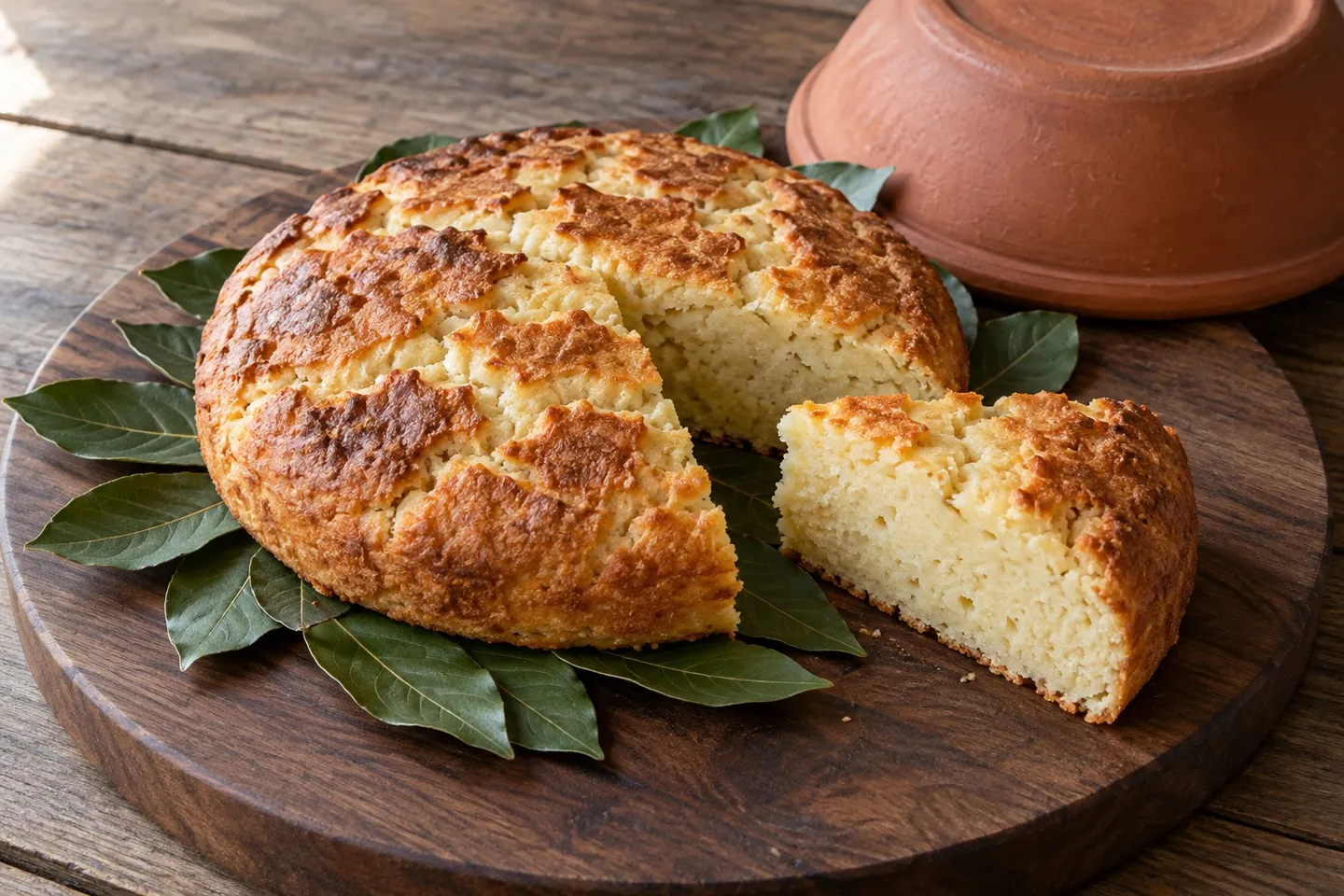
Reader ratingsLibum, the cheese bread of Cato’s farm manual: fresh cheese pounded with fine wheat flour and one egg, shaped into a round loaf and baked slowly on bay leaves under a covering dish.
- Recipe makes
- One 18 cm loaf, 8 servings
- Prep
- Cook
- Total
Drain the ricotta for 30 minutes while the oven heats. Let the loaf cool for 10 minutes before cutting.
Libum, a Roman cheese bread baked on bay leaves.
The story behind the recipe
Libum was the plainest of the cheese breads in Cato’s farm manual: cheese, flour and one egg, with no salt, honey or leavening. It heads his run of cakes, and his savillum, a few chapters on, is mixed the same way.
Two pounds of cheese
Cato wants the cheese pounded well in a mortar before anything else goes in. Then comes a pound of fine wheat flour, farina siliginea, or, “if you want to be more dainty,” half a pound of a finer flour still, and one egg. The dough is shaped into a loaf, set on leaves, and baked “slowly on a hot hearth stone under a dish.” The dish is a testum in the Latin, a cover set over the loaf on the hearth.
Fairfax Harrison’s English renders the flour as “corn meal,” but the Latin is farina siliginea, a wheat flour, and maize was unknown in Europe until after Columbus.
Read more about this recipe
Making it today
A Roman pound weighed about 327 grams, which gives 650 g of cheese to 325 g of flour; 750 g of ricotta drains to about that weight. Cato doesn’t name the cheese here, but for his placenta cake he asks for fresh sheep’s cheese, not sour, so we use whole-milk ricotta, drained. All-purpose flour stands in for his first choice. The oven stands in for the hearth, with an ovenproof bowl turned over the loaf for his dish. Bay leaves are our choice of leaf: Cato doesn’t name one here, but he bakes his must cake on bay.
Spread with Moretum, Herb and Cheese Spread (Columella), it makes a farm lunch. The other recipes from Cato’s kitchen are in What Did a Roman Farmhouse Bake?
(LXXV) This is the recipe for cheese cake (libum): Bray well two pounds of cheese in a mortar, and, when this is done, pour in a pound of corn meal (or, if you want to be more dainty, a half pound of flour) and mix it thoroughly with the cheese. Add one egg and beat it well. Pat into a cake, place it on leaves and bake slowly on a hot hearth stone under a dish.
Recipe makes: One 18 cm loaf, 8 servings
Ingredients
For One 18 cm loaf, 8 servings. Quantities are shown as written.
Quantities as written here, for One 18 cm loaf, 8 servings.
- Whole-milk ricotta750 g
- All-purpose flour325 g
- Egg1
- Bay leaves, fresh or dried10–12
Measurement notes
Ingredients as written here
- 750 g whole-milk ricotta
- 325 g all-purpose flour
- 1 egg
- 10 to 12 bay leaves, fresh or dried
Equipment
 Fine sieve
- Mixing bowl and wooden spoon, or a mortar and pestle
- Baking sheet
- Ovenproof bowl about 20 cm across, to cover the loaf
 Instant-read thermometer
Instructions
Set the ricotta in the sieve over a bowl and let it drain for 30 minutes. Heat the oven to 375°F (190°C).
Beat the drained ricotta in the bowl with the wooden spoon until smooth, or pound it in a mortar as Cato does.
Add the flour and work it in thoroughly. Add the egg and beat until the dough is smooth and holds together. It will be soft and sticky.
Lay the bay leaves in a circle on the baking sheet. Wet your hands and pat the dough into a round loaf about 18 cm across on the leaves.
Cover the loaf with the ovenproof bowl and bake for 40 minutes. Lift off the bowl, using oven gloves, and bake 10 to 15 minutes more, until the top is golden and cracked and the center reads at least 190°F (88°C).
Let the loaf cool for 10 minutes. Peel off the bay leaves, which are not eaten, and cut the loaf in wedges.
Nutrition
300calories per serving
- Recipe makes
- One 18 cm loaf, 8 servings
- Servings
- 8
Estimated per serving from USDA FoodData Central values for whole-milk ricotta, all-purpose flour and egg.
Recipe notes
When adjusting quantities
Half the recipe makes a 13 cm loaf; check it 10 minutes sooner. Keep the egg whole for the full loaf and use a small one for half.
Notes
Quantities mentioned in these notes don’t change when you adjust the servings.
Cato’s dainty version uses half a pound of a finer flour (use cake flour), for a finer loaf. Bake it the same way, with the bowl over it the whole time it sets. The libum is best warm on the day it is baked.
Scaling changes the ingredients only; pan sizes and cooking times need their own judgment. To adapt this recipe further, try the recipe tool at TuneMyRecipe (opens in a new tab), our sister site.
Sources and attribution
Cato, De agri cultura 75, in Fairfax Harrison’s translation, Roman Farm Management (New York, 1918)
Recipe details
- Course
- Bread & baking
- Dish family
- Breads & Cakes
- Era
- Ancient Rome
- Main ingredient
- Milk & cream
- Difficulty
- Easy
- Occasion
- Everyday meal