Pompeii and the eruption of Vesuvius, AD 79 · Pompeii, Italy
What Did Pompeii Buy at the Street Counter?
Hot wine, stews of duck, pork, goat, fish and snails, beans, and bread from the bakery next door. What Pompeii’s street counters sold, and four Roman recipes.
Hot food and drink, served from jars set into a counter open to the street. Pompeii had about eighty of these counters, and the one excavated in 2020 still held the remains of duck, pork, goat, fish and land snails, with ground fava beans at the bottom of a wine jar. Around them were bakeries, market stalls and shops selling figs, chestnuts, lentils, loaves and cakes.
A counter on the corner
The counter stood where two lanes met in Regio V, at the corner of the Vicolo delle Nozze d’Argento and the Vicolo dei Balconi. Part of it came to light in 2019, and archaeologists cleared the rest in 2020. The Italian news agency AGI, reporting the site’s announcement that December, counted about eighty such counters in Pompeii, “but none with the counter entirely painted” (our translation, as with the agency’s other quotes below).
This one was painted on every face. Across the front, a sea nymph rides a horse through the waves. Elsewhere on it hang two mallard ducks, head down, “ready to be prepared and eaten,” as the site’s archaeologists put it, beside a rooster and a dog on a leash. The excavators read the paintings as, at least in part, a picture of the food and drink sold over the counter.
Human bones were found in the room too, disturbed by treasure hunters in the seventeenth century; some belonged to a person at least fifty years old. Near them lay the complete skeleton of a very small dog.
What the jars held
Set into the top of the counter were deep earthenware jars, dolia, and in them the excavators found what was being sold. One held a fragment of duck bone, “together with pork, goat, fish and land snails,” AGI reported. Another, used for wine, had fava beans in the bottom, “intentionally fragmented or ground.” Specialists explained that the beans were used to change the taste and color of the wine, lightening it.
The counter left no recipes. The menu is what the jars and the wall paintings show: cooked meat, fish and snails, kept in the counter and served from it, and wine doctored with ground beans. How a Roman cook would have treated a duck or a pot of beans is in the cookbook that goes under the name of Apicius. It carries the name of a first-century gourmet but was likely not compiled until the fourth century, so its dishes show Roman cooking of the kind the counter sold, with no claim to be the counter’s own. (TuneMyRecipe has five more dishes from Apicius (opens in a new tab), from pork patties to spiced pears.)
Hot water and wine
The counters were known long before 2020. August Mau, the archaeologist who spent a quarter of a century on Pompeii, described one on Mercury Street in Pompeii: Its Life and Art, translated into English in 1899. It was built for guests who came in, he wrote, “but also for the sale of drinks over the counter to those who might stop a moment in passing.” Its long counter had marble shelves like steps “for the display of cups and glasses” at one end and a place for heating a vessel at the other. “Large jars are set in the counter, in which liquids and eatables could be kept.” From the provision for hot water he called it a thermopolium, “a wineshop which made a specialty of furnishing hot drinks.”
One of those hot drinks was calda, wine mixed with hot water. Forgotten Drink, our sister site, has a recipe for calda (opens in a new tab) to drink with the food here.
In the House of Sallust, Mau found a grand house turned into an inn with a shop at its entrance. There, “edibles and hot drinks were sold to those inside the house as well as to passers-by.”
The market by the forum
Not everyone ate at a counter. For raw food, Pompeians went to the Macellum, the market building on the forum. Mau’s plan shows a court ringed by a colonnade, with rows of stalls, and in the middle a roofed pavilion on twelve bases over a basin. “Under this roof the fish that had been sold were scaled,” he explained, “the scales being thrown into the basin.” In the southeast corner was a room for meat and fish, with a sloping counter on three sides and a gutter under the fish side to carry the water out to the street.
More shops lined the street along the market’s north side, and in them, or in those across the street (the report doesn’t say which), Mau wrote that “the excavators found charred figs, chestnuts, plums, grapes, fruit in glass vessels, lentils, grain, loaves of bread, and cakes.”
Bread from the oven next door
Pompeii baked its own bread. Mau described the bakeries with their stone mills for grinding grain, their kneading machines and their ovens “shaped like a low beehive.” When the oven was hot, the baker raked out the ashes, the loaves were “shoved in, and the mouth closed to retain the heat,” and a vessel of water stood in front “for moistening the surface of the loaves while baking.” Some bakeries had their own salesroom on the street. Others sold to stalls: Mau records the discovery of “charred nuts, fruits, and loaves of bread in the market stalls.”
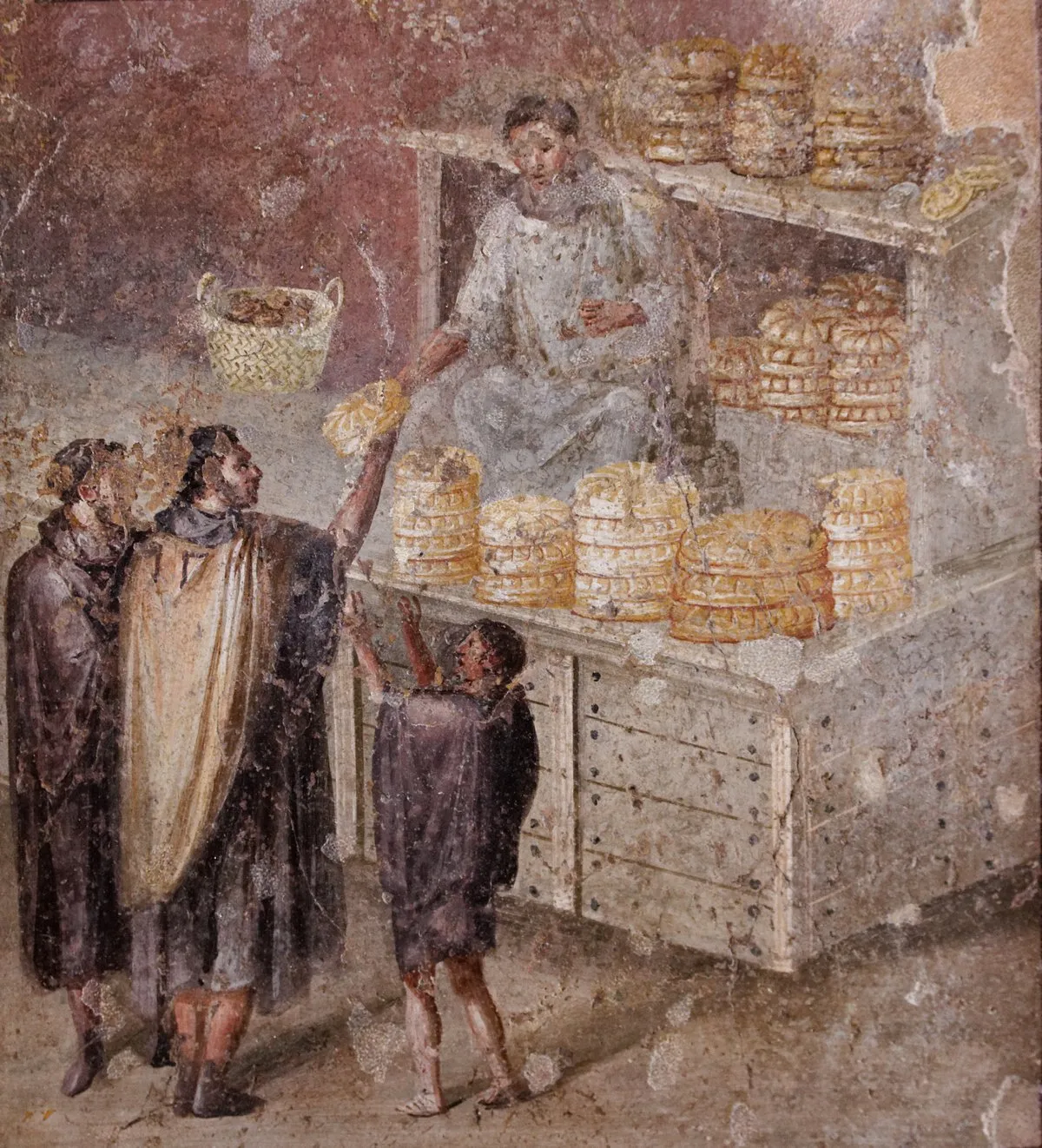
The painting at the top of this page, from a house in the city, shows a counter loaded with loaves of several shapes and a man in a white tunic handing one to a customer. Whether it shows a sale or a handout from a politician is still argued. Real loaves survive too, turned to charcoal. Several in the Naples Museum, Mau noted, carry a baker’s stamp: “(Made by) Celer, slave of Quintus Granius Verus.”
How that bread rose, Pliny the Elder explained in his Natural History. Pliny was the admiral at Misenum across the bay, and he died going to the rescue when Vesuvius erupted. Leavens were once made from millet and grape must or from soured barley cakes, he wrote, but now bakers “only make use of a little of the dough that has been kept from the day before.” Most of Pompeii’s bread, then, was probably sourdough.
What things cost
Pompeians scratched their accounts on the walls. In a bakery in Region I, Mau read one: “Oil, a pound, 4 asses; straw, 5 asses; hay, 16 asses; a day’s wages, 5 asses; bran, 6 asses.” The as was a small copper coin, and no price index reaches back to Rome, so the only honest yardstick is the one on the same wall. A pound of olive oil cost most of a day’s wages for the person paid there. The bran was probably for animals, perhaps the donkeys that turned the mills.
August or October?
For centuries the date of the eruption was given as August 24, AD 79. Mau used it in 1899; it comes from the account of Pliny’s nephew, Pliny the Younger, who watched from Misenum. In 2018 the Pompeii site announced a charcoal inscription, found in a house that was being renovated, with a date equivalent to October 17. Massimo Osanna, then the site’s director, told Reuters that “it is more than likely that it was written in October 79 AD,” and suggested October 24 as the date of the eruption. The question is still open.
The recipes
The four recipes follow what the shops and the counter sold: bread, a dish from the counter’s jars, a meat from its paintings and a cake from the shopkeepers’ shelves. None comes from Pompeii itself. The bread is our reconstruction from Cato, Pliny and the excavated loaves; the bean and duck dishes are from Apicius; the cake is Cato’s, and it also made our list of historic recipes worth cooking again.
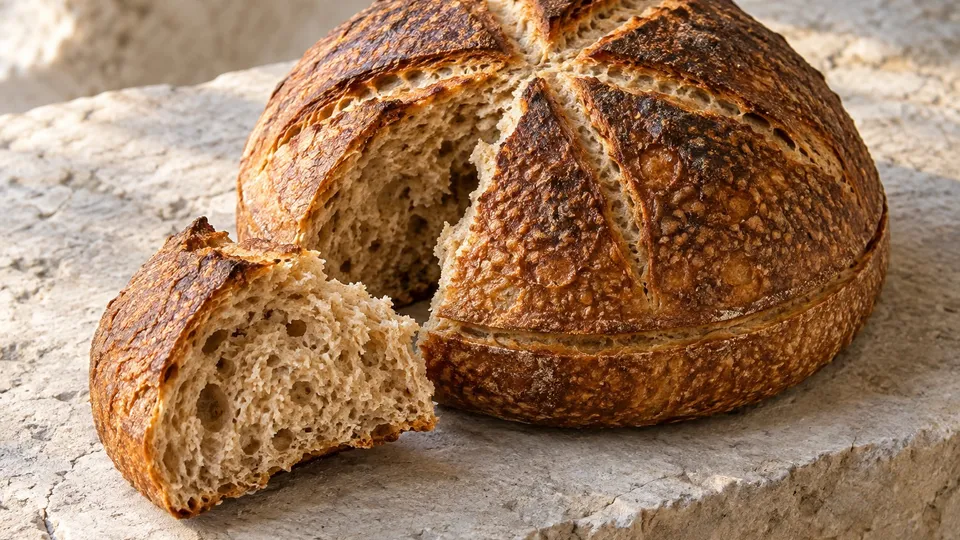
- Pompeii Sourdough Loaf (AD 79): a round wheat loaf raised with yesterday’s dough and scored into eight wedges, the bread the bakeries sold.
- Fava Beans Vitellian Style (Apicius): a pot of split favas with leek, herbs, fish sauce and green oil, a Roman way to eat the beans that the counter put in its wine.
- Duck with Turnips (Apicius): duck poached with dill and braised under turnips, for the mallards on the counter and the duck bone in its jar.
- Savillum, Honey Cheesecake (Cato): fresh cheese baked with honey and poppy seed, for the cakes found in the shops by the forum.
A meal from the counter
The bread is the one to start with, because it takes a night: mix the Pompeii Sourdough Loaf (AD 79) in the afternoon, shape it and leave it in the refrigerator, and bake it in the morning, so that by evening you can break it along its scored wedges into a bowl of beans. The loaf, the beans, the duck and Cato’s cheesecake are among our Roman recipes.
 Cook it todayPompeii Sourdough Loaf (AD 79)
Sources
- August Mau, Pompeii: Its Life and Art (opens in a new tab), translated by Francis W. Kelsey (New York: Macmillan, 1899), Internet Archive.
- “Pompei, riaffiora intatto il Termopolio della Regio V,” AGI Agenzia Italia (opens in a new tab), December 26, 2020.
- “Dig at Pompeii Fast-Food Place Reveals Tastes,” Associated Press, via Voice of America (opens in a new tab), December 26, 2020.
- “Charcoal inscription points to date change for Pompeii eruption,” Reuters, via the Oman Observer (opens in a new tab), October 17, 2018.
- Pliny the Elder, The Natural History (opens in a new tab), vol. 4, translated by John Bostock and H. T. Riley (London: Bohn, 1856), book 18, chapter 26, Internet Archive.
- “Fresco with the distribution of bread (opens in a new tab),” Homo Faber: Nature, Science and Technology at Pompeii, Museo Galileo, Florence.
- Apicius, De re coquinaria, edited by Cesare Giarratano and Friedrich Vollmer (Leipzig: Teubner, 1922).
- Cato, De agri cultura, in Les agronomes latins, edited by Charles Nisard (Paris: Dubochet, 1844).
- “Marcus Gavius Apicius (opens in a new tab),” Encyclopaedia Britannica.