Pompeii Sourdough Loaf (AD 79)
Reader ratingsA Pompeii sourdough loaf: a round wheat loaf raised with a piece of yesterday’s dough and scored into eight wedges before baking, built from Cato’s kneaded bread, Pliny’s leaven and the carbonized loaves of Pompeii and Herculaneum.
- Recipe makes
- 1 round loaf, 8 wedges
- Prep
- Cook
- Total
Most of the time is rising: about 5 hours for the dough and an overnight rest in the refrigerator for the shaped loaf, then an hour to cool. Feed your starter on the morning of the day you mix.
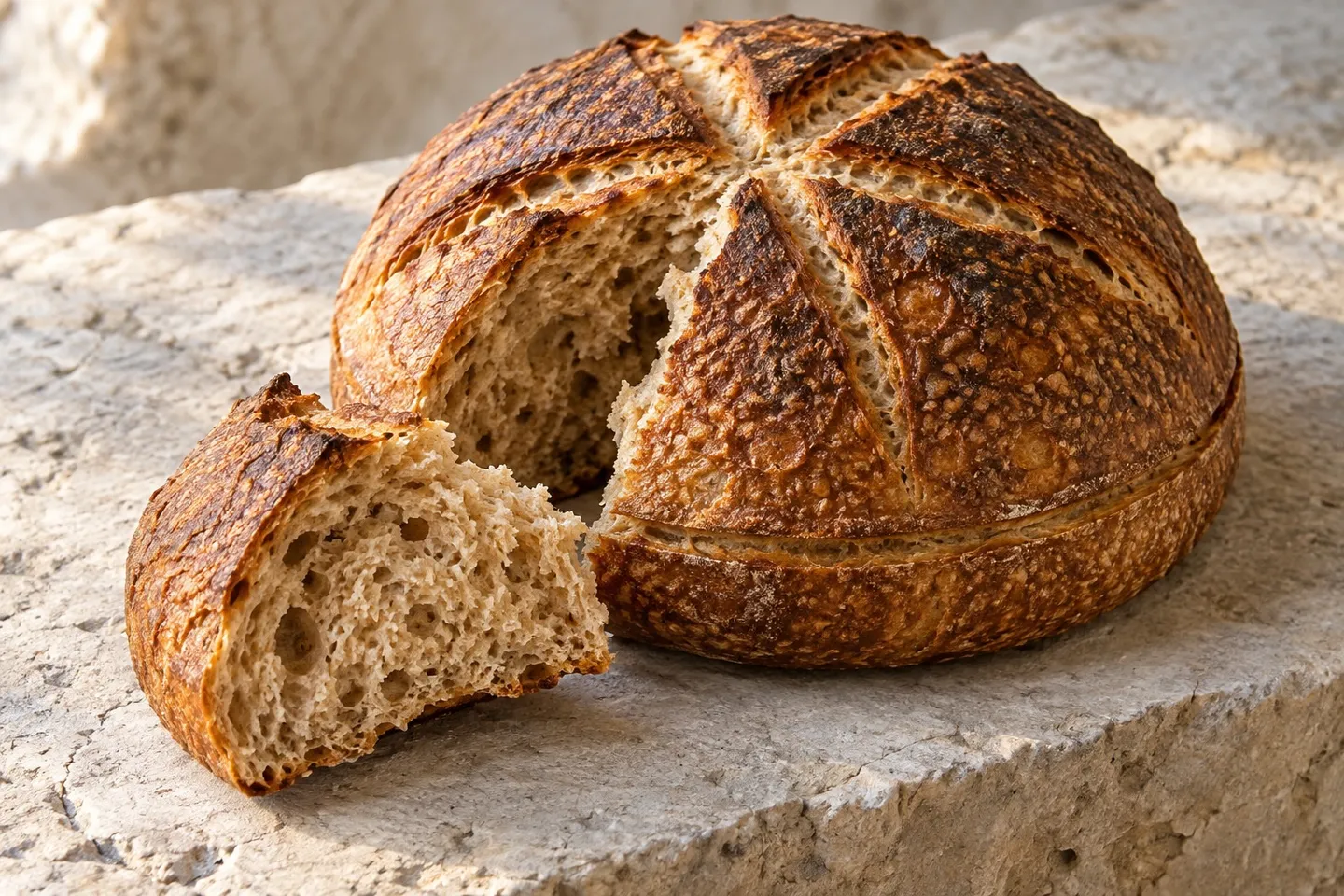
Pompeii-style sourdough loaf scored into wedges, on limestone.
The story behind the recipe
A Pompeian could buy bread from a bakery’s own salesroom, from a stall in the market, or across a counter piled with loaves, like the one in the wall painting at the top of What Did Pompeii Buy at the Street Counter?. How a Pompeii baker made his loaf isn’t recorded, so this one is put together from two Roman writers, Cato and Pliny, and the loaves themselves.
Yesterday’s dough
Cato’s farming manual of the second century BC gives a bread recipe in four short sentences. Wash your hands and the bowl, put in flour, add water little by little, knead it thoroughly, shape it and bake it under a cover. Pliny the Elder, who died in the eruption of AD 79, added how bread was raised in his own day. Bakers once made leavens from millet and grape must or from barley cakes left to sour, he wrote, but “in most cases, however, they do not warm it at all, but only make use of a little of the dough that has been kept from the day before.” He also worked out that “the principle which causes the dough to rise is of an acid nature.”
That is sourdough. One carbonized loaf, found in an oven at Herculaneum in 1930, is round and was scored into eight wedges before baking, and some loaves carry a baker’s stamp. August Mau recorded several charred loaves in the Naples Museum stamped with the name of “Celer, slave of Quintus Granius Verus.”
Read more about this recipe
Making it today
Our loaf is a reconstruction: Cato’s method, Pliny’s leaven and the shape of the Herculaneum loaf. A sourdough starter stands in for the dough kept back from the day before. Half whole wheat and half bread flour is our choice, a middle course between coarse and fine flours we can’t measure from the charred crumb. A lidded cast-iron casserole plays the part of Cato’s cover, holding in the steam so the loaf rises before its crust sets. The string tied round the waist is optional; the British Museum’s version, made for its 2013 Pompeii exhibition, uses one to give the loaf its lip.
Cut the four lines deep and tie the string before it goes into the pot, and the loaf comes out with the eight wedges and the lip of the one found at Herculaneum; it is the bread to set beside the Fava Beans Vitellian Style (Apicius).
Panem depsiticum sic facito. Manus, mortariumque bene lavato. Farinam in mortarium indito, aquæ paulatim addito, subigitoque pulchre. Ubi bene subegeris, defingito, coquitoque sub testu.
Cato, De agri cultura, chapter 74, as printed in Charles Nisard’s Les agronomes latins (Paris, 1844). In our translation: “Make kneaded bread this way. Wash your hands and the bowl well. Put flour in the bowl, add water little by little, and knead it thoroughly. When you have kneaded it well, shape it and bake it under a cover.”
Recipe makes: 1 round loaf, 8 wedges
Ingredients
For 1 round loaf, 8 wedges. Quantities are shown as written.
Quantities as written here, for 1 round loaf, 8 wedges.
Dough
- Active sourdough starter100 g
- Lukewarm water350 ml
- Whole wheat flour250 g
- Bread flour250 g
- Fine sea salt10 g
For shaping
- Whole wheat flour, for dusting15 g
Measurement notes
Ingredients as written here
- 100 g active sourdough starter
- 350 ml lukewarm water
- 250 g whole wheat flour
- 250 g bread flour
- 10 g fine sea salt
- 15 g whole wheat flour, for dusting
Equipment
- Large mixing bowl
 Kitchen scale
- Bench scraper
- Round proofing basket or a bowl lined with a floured cloth, about 20 cm
- Cast-iron casserole with a lid, about 5 liters
- Parchment paper
- Sharp knife or bread lame
- Kitchen string, cotton (optional)
 Instant-read thermometer
- Wire rack
Instructions
On the morning of the day you mix, feed the sourdough starter so that it is bubbly and active by the afternoon.
In the mixing bowl, stir the starter into the lukewarm water until it is cloudy. Add the whole wheat flour and the bread flour and mix with your hand until no dry flour is left. Cover and leave for 30 minutes.
Sprinkle the salt over the dough with a splash of water and squeeze it in. Knead in the bowl or on the counter for about 8 minutes, until the dough is smooth and springs back when pressed.
Cover and leave at warm room temperature, about 75°F (24°C), for 4 to 5 hours. During the first 2 hours, stretch one side of the dough up and fold it over the rest, turn the bowl and repeat on all four sides, every 30 minutes. The dough is ready when it has grown by about half, feels airy and shows bubbles at the sides.
Turn the dough out, shape it into a tight round ball and set it, smooth side down, in the basket dusted with the whole wheat flour for dusting. Cover and refrigerate overnight, 10 to 14 hours.
Put the casserole with its lid in the oven and heat it to 450°F (230°C) for 45 minutes.
Turn the loaf out onto a piece of parchment, smooth side up, and press it down a little with your palm. With the knife, cut four lines across the top through the center, about 1 cm deep, so the top is marked into eight wedges. If you like, tie a length of cotton string around the loaf’s waist, snug but not tight.
Lift the loaf on its parchment into the hot casserole, cover and bake for 20 minutes. Uncover and bake for 20 to 25 minutes more, until the crust is deep brown and the center of the loaf reads 205 to 210°F (96 to 99°C).
Cool the loaf on the rack for at least an hour. Cut off the string, if used, and break or cut the loaf along the scored lines.
Nutrition
240calories per serving
- Recipe makes
- 1 round loaf, 8 wedges
- Servings
- 8
Estimated per wedge from USDA FoodData Central values for whole wheat flour, bread flour and the flour in the starter.
Recipe notes
When adjusting quantities
Make one loaf per casserole. For two loaves, mix a double batch and bake them one after the other, keeping the second in the refrigerator until the first is out.
Notes
Quantities mentioned in these notes don’t change when you adjust the servings.
A starter fed with whole wheat flour suits the loaf best, but any active starter works. Spelt flour can replace the whole wheat flour; it makes a softer dough, so knead it a little less. Without a casserole, bake the loaf on a hot tray at 400°F (200°C) for 35 to 45 minutes. Wrapped in a cloth, the bread keeps for two days. Contains wheat.
Scaling changes the ingredients only; pan sizes and cooking times need their own judgment. To adapt this recipe further, try the recipe tool at TuneMyRecipe (opens in a new tab), our sister site.
Sources and attribution
Reconstruction after Cato, De agri cultura 74 (kneaded bread), and Pliny the Elder, Natural History 18.26 (leaven), with the carbonized loaves of Pompeii and Herculaneum
Recipe details
- Course
- Bread & baking
- Dish family
- Breads & Cakes
- Era
- Ancient Rome
- Main ingredient
- Grains & rice
- Difficulty
- Intermediate
- Occasion
- Everyday meal