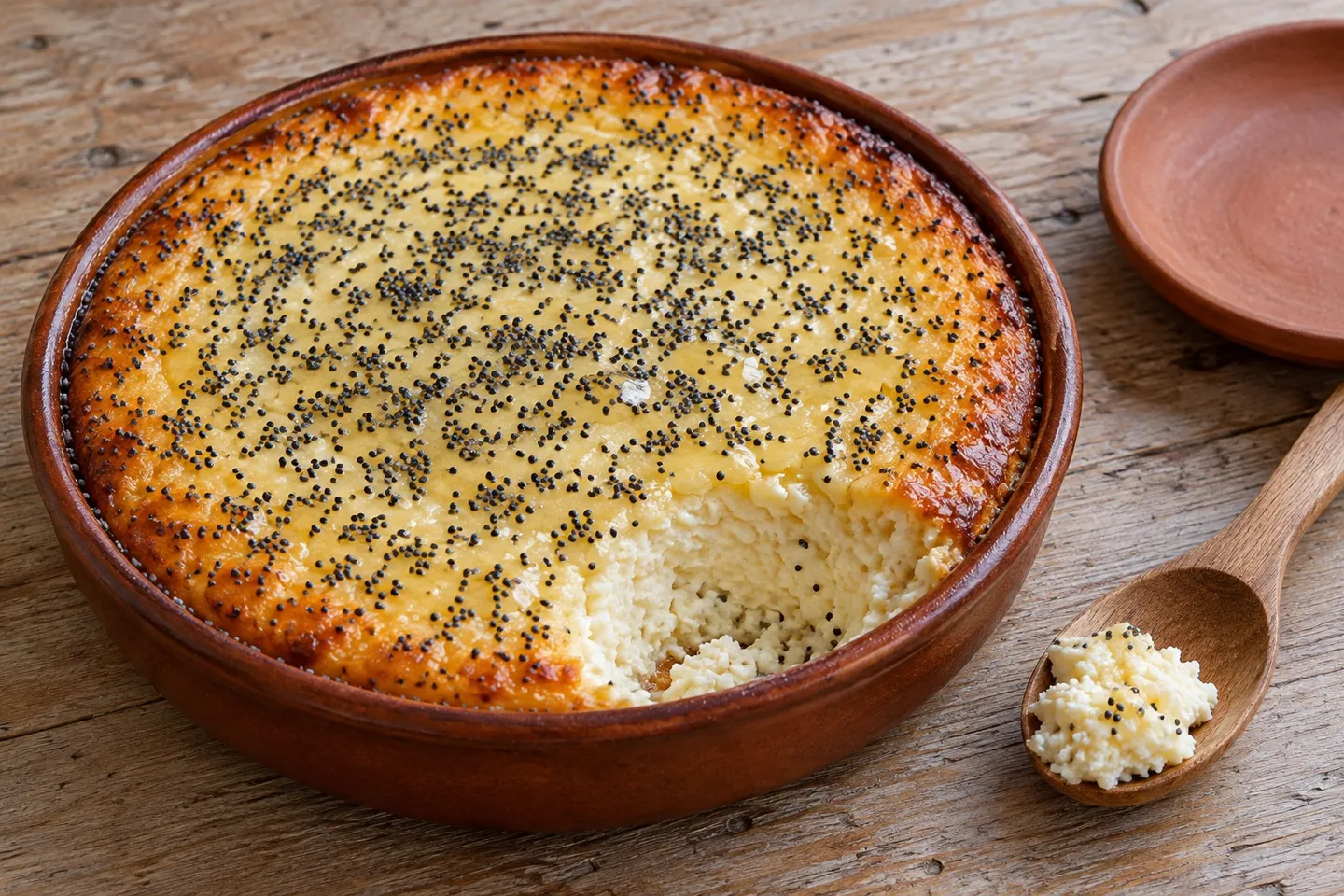
Savillum, Honey Cheesecake (Cato)
Reader ratingsSavillum, a honey cheesecake from Cato’s farming manual of the second century BC: fresh cheese, flour, honey and one egg baked in an oiled dish under a cover, then spread with honey and sprinkled with poppy seed.
- Recipe makes
- One 23 cm cake, 8 servings
- Prep
- Cook
- Total
Drain the ricotta in a sieve for 30 minutes while the oven heats. Leave the cake to settle for 30 minutes before serving; it slices more neatly when cold.
Savillum, a Roman honey and ricotta cake with poppy seeds.
The story behind the recipe
Savillum is a Roman cheesecake, though closer to a baked sweet ricotta than to anything with a crust: fresh cheese and a little flour, sweetened with honey and set with a single egg, then glazed with more honey and scattered with poppy seed. When excavators opened the shops along a street beside the forum at Pompeii, they found charred figs, chestnuts, plums, grapes, lentils, grain, “loaves of bread, and cakes,” August Mau reported. Mau doesn’t describe them. This one was already old when Pompeii was buried.
Cato’s cake
Marcus Porcius Cato wrote his manual on farming in the second century BC, and among its instructions he set down a run of cakes and breads for the household and for offerings to the gods. Savillum is one of them. Its proportions are precise for a Roman recipe: half a pound of flour, two and a half pounds of cheese, a quarter pound of honey and one egg. It bakes in an earthenware dish under a cover, and Cato warns the cook to see it cooked through “in the middle, where it is highest.”
The cake is spread with honey before its poppy seed. In the Paris edition of 1844 that prints the Latin with a French translation beside it, the translator has the cook coat the cake with oil, though the Latin on the same page says honey, melle unguito. The oil belongs to the dish, which is greased before the mixture goes in.
Read more about this recipe
Making it today
A Roman pound weighed about 327 grams, which gives the amounts below. Cato doesn’t name the cheese here, but for his placenta cake in chapter 76 he asks for sheep’s cheese, fresh and not sour. Whole-milk ricotta is our choice, drained so the cake isn’t watery. A ceramic dish covered with foil stands in for the earthenware dish and its cover, and the oven replaces the hot hearth. Cato serves the cake in its dish “with a plate and spoons.” It ends a meal of Duck with Turnips (Apicius), and What Did Pompeii Buy at the Street Counter? follows the cakes and loaves back to the shops where they were found.
Savillum hoc modo facito. Farinæ selibram, cæsei P. II. S. una commisceto quasi libum, mellis. P ¼ et ovum unum Catinum fictile oleo unguito. Ubi omnia bene commiscueris in catinum, indito catinum testo, operito. Videto ut bene percoquas medium, ubi altissimum est. Ubi coctum erit, catinum eximito, melle unguito, papaver infriato, sub testum subde paulisper, postea eximito. Ita pone cum catillo, et lingulis.
Cato, De agri cultura, chapter 84, as printed in Charles Nisard’s Les agronomes latins (Paris, 1844), with the book’s quarter-pound sign written as ¼. In our translation: “Make savillum this way. Mix half a pound of flour and two and a half pounds of cheese together, as for libum, with a quarter pound of honey and one egg. Grease an earthenware dish with oil. When you have mixed everything well, put it in the dish and cover the dish with a lid. See that you cook it well in the middle, where it is highest. When it is cooked, take out the dish, spread it with honey, sprinkle on poppy seed, put it back under the lid for a little while, then take it out. Serve it so, with a plate and spoons.”
Recipe makes: One 23 cm cake, 8 servings
Ingredients
For One 23 cm cake, 8 servings. Quantities are shown as written.
Quantities as written here, for One 23 cm cake, 8 servings.
Cake
- Whole-milk ricotta820 g
- All-purpose flour165 g
- Honey80 g
- Egg1
- Olive oil, for the dish1 tsp
To finish
- Honey60 g
- Poppy seeds1 tbsp
Measurement notes
Ingredients as written here
- 820 g whole-milk ricotta
- 165 g all-purpose flour
- 80 g honey
- 1 egg
- 1 tsp olive oil, for the dish
- 60 g honey
- 1 tbsp poppy seeds
Equipment
 Fine sieve
- Mixing bowl
 Wooden spoon
- Round ceramic or earthenware baking dish, 23 cm across and at least 5 cm deep
- Foil or a lid that fits the dish
- Pastry brush
 Instant-read thermometer
Instructions
Set the ricotta in the sieve over a bowl and leave it to drain for 30 minutes. Heat the oven to 350°F (180°C).
Brush the baking dish with the olive oil.
In the mixing bowl, beat the drained ricotta with the flour until smooth, then beat in the honey and the egg.
Spread the mixture in the dish and smooth the top, leaving it a little higher in the middle. Cover the dish tightly with foil or its lid.
Bake for 40 minutes, then uncover and bake for 15 to 20 minutes more, until the edges are golden, the center is set and barely wobbles, and a thermometer in the middle reads 160°F (71°C).
Warm the honey to finish for a few seconds so it runs, and brush it over the top of the cake. Scatter the poppy seeds over the honey.
Cover the dish again and return it to the oven for 10 minutes.
Leave the cake to settle in its dish for at least 30 minutes, and serve it warm or cold, spooned or cut from the dish.
Nutrition
330calories per serving
- Recipe makes
- One 23 cm cake, 8 servings
- Servings
- 8
Estimated per serving from USDA FoodData Central values for whole-milk ricotta, all-purpose flour, honey, egg, olive oil and poppy seeds.
Recipe notes
When adjusting quantities
Half the recipe fits an 18 cm dish; start checking it 10 minutes sooner. For half, use one small egg.
Notes
Quantities mentioned in these notes don’t change when you adjust the servings.
Cato’s flour was probably coarser than ours; whole wheat flour gives a more rustic cake. The cake keeps, covered, in the refrigerator for three days. Contains milk, wheat and egg.
Scaling changes the ingredients only; pan sizes and cooking times need their own judgment. To adapt this recipe further, try the recipe tool at TuneMyRecipe (opens in a new tab), our sister site.
Sources and attribution
After Cato, De agri cultura 84, Savillum hoc modo facito; Latin text in Les agronomes latins, ed. Charles Nisard (Paris: Dubochet, 1844); our translation
Recipe details
- Course
- Dessert
- Dish family
- Desserts & Sweets
- Era
- Ancient Rome
- Main ingredient
- Milk & cream
- Difficulty
- Easy
- Occasion
- Everyday meal