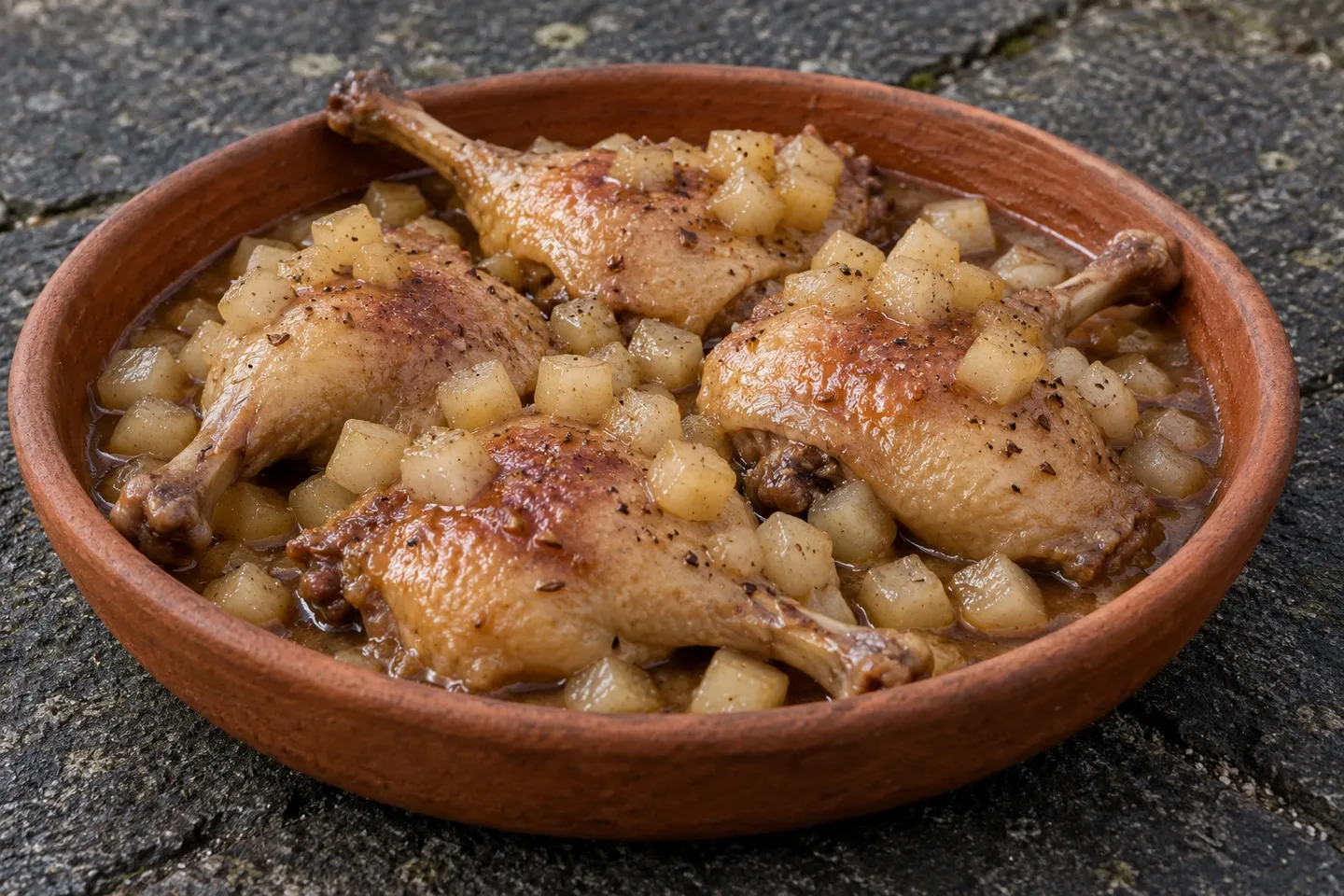
Duck with Turnips (Apicius)
Reader ratingsDuck with turnips from the Roman cookbook Apicius: legs poached with dill, braised under chopped turnips with leek, coriander and grape syrup, and finished with a peppery cumin and vinegar sauce.
- Recipe makes
- 4 servings
- Prep
- Cook
- Total
Peel and boil the turnips while the duck poaches. Keep the poaching broth: part of it braises the duck, and the rest makes soup.
Duck legs braised with turnips, in a terracotta dish.
The story behind the recipe
Apicius has four recipes headed crane or duck, and this one, with turnips, is a whole course: the bird boiled with dill, braised under chopped turnips, colored with grape syrup and finished with a sauce sharp with vinegar and cumin. The street counter dug out at Pompeii in 2020 had two mallard ducks painted on it, hanging head down, and a fragment of duck bone in one of its jars.
What does Apicius say about duck with turnips?
The recipe is headed Gruem vel anatem ex rapis, crane or duck with turnips, and the same chapter treats the two birds as one.
Read more about this recipe
What was laser?
The sauce asks for laseris radicem, the root of laser, and that word carries a story. Laser was the juice of silphium, a plant of Cyrenaica in North Africa that the Romans prized as a medicine and seasoning. Pliny the Elder, writing in the 70s, said it had not been found there for many years: “a single stalk is all that has ever been found there, and that was sent as a curiosity to the Emperor Nero.” The laser that reached Rome in his day came from Persia, Media or Armenia, he wrote, and was often adulterated.
Nothing in Apicius ties the dish to Pompeii; it shows how a Roman cook of some century dressed the bird.
Making it today
Four duck legs replace the whole bird, and one leg makes a serving. Apicius boils the duck halfway, then finishes it in a pan with oil and fish sauce under the turnips; he doesn’t say how much liquid, so we braise it in some of its own poaching broth. Defritum, grape juice boiled down, is replaced by Italian grape saba or Middle Eastern grape molasses. Asafoetida, the pungent resin sold in Indian shops as hing, is the usual stand-in for laser. Starch thickens the sauce, as amulum did. To serve the duck at a Roman table with bread and beans, start the Fava Beans Vitellian Style (Apicius) when the duck goes into its braise, and read the rest of the counter’s finds in What Did Pompeii Buy at the Street Counter?
Gruem vel anatem ex rapis: lavas, ornas et in olla elixabis cum aqua, sale et anetho dimidia coctura. rapas coque, ut exbromari possint. levabis de olla, et iterum lavabis, et in caccabum mittis anatem cum oleo et liquamine et fasciculo porri et coriandri. rapam lotam et minutatim concisam desuper mittis, facies ut coquatur. modica coctura mittis defritum ut coloret. ius tale parabis: piper, cuminum, coriandrum, laseris radicem, suffundis acetum et ius de suo sibi, reexinanies super anatem ut ferveat. cum ferbuerit, amulo obligabis, et super rapas adicies. piper aspargis et adponis.
Apicius, De re coquinaria 6.2.3, in the 1922 edition of Cesare Giarratano and Friedrich Vollmer. In our translation: “Crane or duck with turnips: wash and dress the bird and boil it half done in a pot with water, salt and dill. Cook turnips so that they lose their rank smell. Lift the bird from the pot, wash it again and put it in a pan with oil and fish sauce and a bundle of leek and coriander. Put the washed, finely chopped turnip on top and let it cook. When it is partly cooked, add boiled-down grape juice to color it. Make this sauce: pepper, cumin, coriander, laser root; moisten with vinegar and the bird’s own juice and pour it back over the duck to boil. When it has boiled, thicken it with starch and spoon it over the turnips. Sprinkle with pepper and serve.”
Recipe makes: 4 servings
Ingredients
For 4 servings. Quantities are shown as written.
Quantities as written here, for 4 servings.
Poaching
- Duck legs4
- Water2 l
- Salt, for poaching2 tsp
- Fresh dill4 sprigs
Braising
- Small turnips600 g
- Salt, for the turnip water1 tsp
- Leek1
- Small bunch fresh coriander (cilantro)1
- Olive oil1 tbsp
- Fish sauce1 tbsp
- Grape saba or grape molasses2 tbsp
Sauce
- Black peppercorns1/2 tsp
- Cumin seed1/2 tsp
- Coriander seed1 tsp
- Asafoetida1 pinch
- Red wine vinegar2 tbsp
- Wheat starch or cornstarch1 tbsp
- Cold water2 tbsp
To finish
- Freshly ground black pepper1 pinch
Measurement notes
Ingredients as written here
- 4 duck legs
- 2 l water
- 2 tsp salt, for poaching
- 4 sprigs fresh dill
- 600 g small turnips
- 1 tsp salt, for the turnip water
- 1 leek
- 1 small bunch fresh coriander (cilantro)
- 1 tbsp olive oil
- 1 tbsp fish sauce
- 2 tbsp grape saba or grape molasses
- 0.5 tsp black peppercorns
- 0.5 tsp cumin seed
- 1 tsp coriander seed
- 1 pinch asafoetida
- 2 tbsp red wine vinegar
- 1 tbsp wheat starch or cornstarch
- 2 tbsp cold water
- 1 pinch freshly ground black pepper
Equipment
- Large pot, about 5 liters
 Medium saucepan
- Wide casserole or deep sauté pan with a lid, about 4 liters
- Mortar and pestle or spice grinder
- Kitchen string
- Slotted spoon
 Instant-read thermometer
- Warm serving dish
Instructions
Trim any loose flaps of skin and fat from the duck legs. Put them in the large pot with the water, the salt for poaching and the dill, bring slowly to a simmer, skim, and simmer gently, uncovered, for 45 minutes.
Meanwhile, peel the turnips and cut them into quarters. Boil them in the saucepan of water with the salt for the turnip water for 5 minutes, drain and leave to cool a little, then chop them into small pieces about 1 cm across.
Trim the leek, leaving it whole, and tie it into a bundle with the coriander.
Lift the duck legs from the pot with the slotted spoon and rinse them briefly under warm water. Skim the fat from the broth and keep the broth.
Put the olive oil and the fish sauce in the casserole, lay in the duck legs, skin side up, in one layer, and tuck the leek bundle beside them. Pour in enough of the broth to come halfway up the legs, about a fifth of it. Spread the chopped turnips over the top.
Cover and simmer gently for 40 minutes, until the duck is tender when pierced at the thickest part.
Drizzle the grape saba over the turnips and duck and simmer, uncovered, for 10 minutes more, until the turnips and skin take on a little color.
Meanwhile, grind the peppercorns, cumin and coriander seed in the mortar with the asafoetida. Stir in the vinegar and a ladle of the broth.
Lift out and discard the leek bundle. Pour the spice mixture over the duck and bring to a boil. Check that the thickest part of a leg reads at least 165°F (74°C).
Stir the starch into the cold water, pour it into the pan and stir gently for a minute, until the sauce thickens and turns glossy.
Lift the duck onto the warm dish, spoon the turnips and sauce around and over, grind on the black pepper and serve.
Nutrition
530calories per serving
- Recipe makes
- 4 servings
- Servings
- 4
Estimated per serving from USDA FoodData Central values for duck leg meat and skin, turnips, leek, olive oil, grape syrup and starch, counting part of the duck fat as left in the poaching broth.
Recipe notes
When adjusting quantities
One duck leg per person. For more than six legs, braise in two pans so they sit in one layer.
Notes
Quantities mentioned in these notes don’t change when you adjust the servings.
The leftover broth, with the dill, makes a good soup base; chill it within 2 hours and lift off the fat. Grape saba is sold in Italian delicatessens; grape molasses, called pekmez or dibs, in Middle Eastern shops. Many asafoetida powders are cut with wheat flour, so check the label if cooking without gluten. Contains fish, and wheat if wheat starch or such an asafoetida is used.
Scaling changes the ingredients only; pan sizes and cooking times need their own judgment. To adapt this recipe further, try the recipe tool at TuneMyRecipe (opens in a new tab), our sister site.
Sources and attribution
After Apicius, De re coquinaria, book 6, Gruem vel anatem ex rapis; Latin text ed. Cesare Giarratano and Friedrich Vollmer (Leipzig: Teubner, 1922); our translation
Recipe details
- Course
- Main course
- Dish family
- Meat & Poultry
- Era
- Ancient Rome
- Main ingredient
- Poultry & game birds
- Difficulty
- Intermediate
- Occasion
- Dinner party