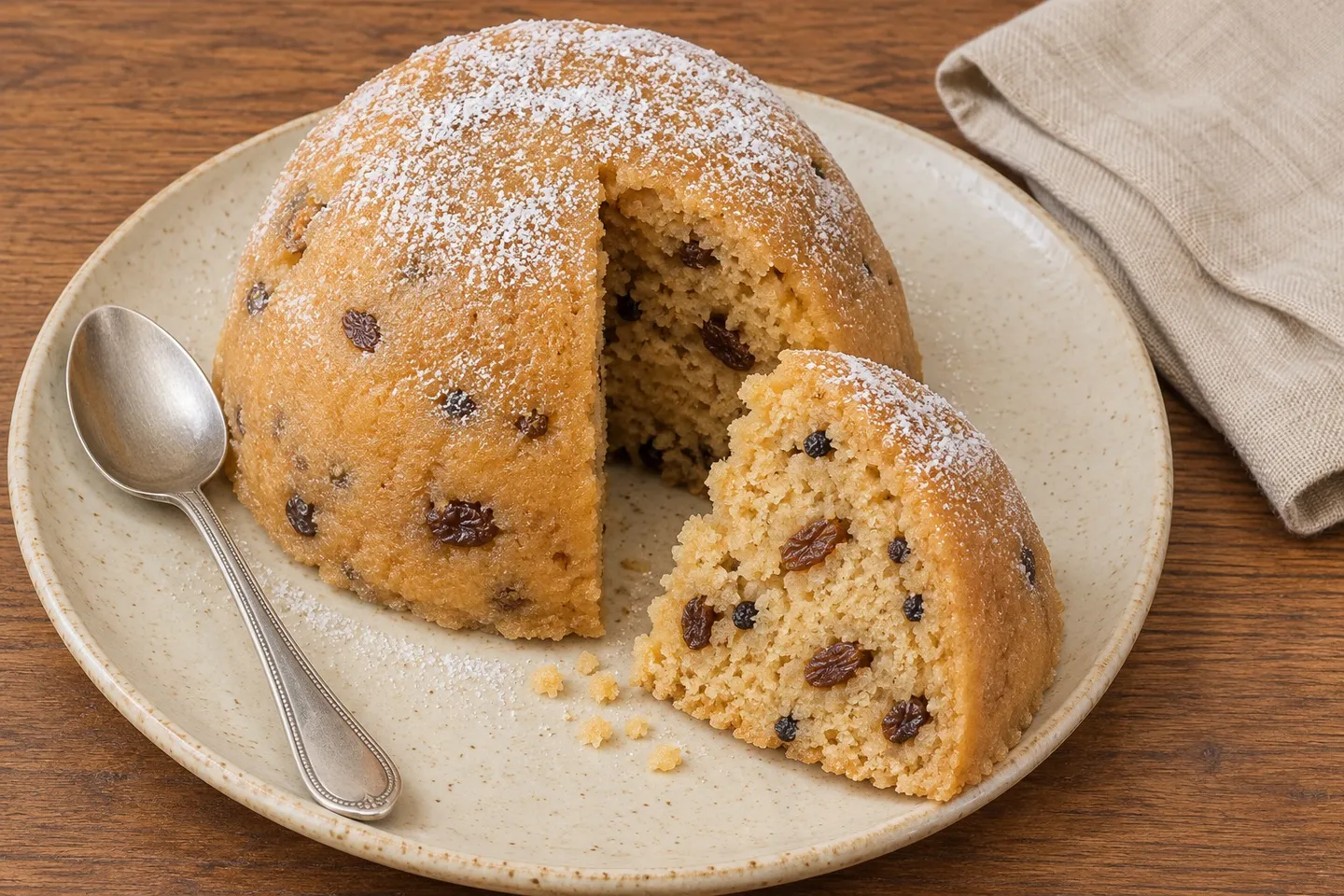
Plain Christmas Pudding for Children (1861)
Reader ratingsIsabella Beeton’s plain Christmas pudding for children: flour, crumbs, raisins, currants, suet and allspice bound with egg and milk, steamed, with no brandy.
- Recipe makes
- One pudding, about 800 g, 6 servings
- Prep
- Cook
- Total
The pudding steams for about 3 hours, so keep a kettle hot for topping up the pot. Made a day ahead and refrigerated, it steams again in about 1 hour.
Plain steamed Christmas pudding dusted with sugar, one slice cut.
The story behind the recipe
Isabella Beeton printed two Christmas puddings side by side in 1861, and the one for children is the plainer. Hers for the grown-ups, marked “Very Good,” is raisins, currants, peel, crumbs, suet, eggs and a glass of brandy, with no flour at all. The children’s pudding takes a pound of flour and a pound of breadcrumbs to a pound and a half of raisins and currants, adds allspice and milk, and leaves the brandy out.
Cheaper by the child
The difference shows in Beeton’s costings. The “Very Good” pudding cost 4s. (about £23 today, by UK consumer prices (Bank of England)) and filled a quart mold for seven or eight people. The children’s pudding cost 1s. 9d. (about £10) and fed nine or ten children. The children’s pudding leans on flour and crumbs, uses less fruit and peel for its size, and has no brandy at all.
It still came to the table dressed for Christmas. Beeton wanted it boiled in a floured cloth for at least five hours and served with a sprig of holly in the middle, “and a little pounded sugar sprinkled over it.”
Read more about this recipe
Making it today
This is a third of Beeton’s quantities, steamed in a 1.5-liter basin where she tied the pudding in a cloth, and done when a thermometer in the center reads 160°F (71°C), since it holds raw egg. We steam it for about three hours, against her five for the full pudding in a cloth, and let the thermometer decide. We leave the holly off a children’s pudding: its berries are poisonous, and America’s Poison Control says children have had symptoms after swallowing as few as two.
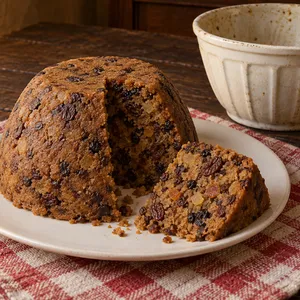
Beeton’s grown-up Christmas Plum Pudding (1861) is the one to make beside it to see the difference. What Did Victorian Children Eat? takes the nursery table from Beeton’s kitchen to the workhouse and an orphan asylum.
A PLAIN CHRISTMAS PUDDING FOR CHILDREN.
1327. INGREDIENTS.—1 lb. of flour, 1 lb. of bread crumbs, ¾ lb. of stoned raisins, ¾ lb. of currants, ¾ lb. of suet, 3 or 4 eggs, milk, 2 oz. of candied peel, 1 teaspoonful of powdered allspice, ½ saltspoonful of salt.
Mode.—Let the suet be finely chopped, the raisins stoned, and the currants well washed, picked, and dried. Mix these with the other dry ingredients, and stir all well together; beat and strain the eggs to the pudding, stir these in, and add just sufficient milk to make it mix properly. Tie it up in a well-floured cloth, put it into boiling water, and boil for at least 5 hours. Serve with a sprig of holly placed in the middle of the pudding, and a little pounded sugar sprinkled over it.
Time.—5 hours. Average cost, 1s. 9d.
Sufficient for 9 or 10 children. Seasonable at Christmas.
Recipe makes: One pudding, about 800 g, 6 servings
Ingredients
For One pudding, about 800 g, 6 servings. Quantities are shown as written.
Quantities as written here, for One pudding, about 800 g, 6 servings.
- Butter, for the basin10 g
- Plain flour150 g
- Fresh white breadcrumbs150 g
- Seedless raisins115 g
- Currants115 g
- Beef suet, finely chopped, or shredded suet115 g
- Candied mixed peel, finely chopped20 g
- Ground allspice1/3 tsp
- Fine salt1 pinch
- Large egg1
- Whole milk, or as needed120 ml
- Caster sugar, to serve1 tsp
Measurement notes
Ingredients as written here
- 10 g butter, for the basin
- 150 g plain flour
- 150 g fresh white breadcrumbs
- 115 g seedless raisins
- 115 g currants
- 115 g beef suet, finely chopped, or shredded suet
- 20 g candied mixed peel, finely chopped
- 1/3 tsp ground allspice
- 1 pinch fine salt
- 1 large egg
- 120 ml whole milk, or as needed
- 1 tsp caster sugar, to serve
Equipment
 Large bowl
 Whisk or fork
 Pudding basin, 1.5 litres
 Parchment, foil and string
 Large pot with a lid and a trivet or folded cloth
 Kettle
 Instant-read thermometer
Instructions
Rub the inside of the basin with the butter and press a round of parchment into the bottom.
In the large bowl, mix the plain flour, breadcrumbs, raisins, currants, suet, candied peel, allspice and salt until the fruit is evenly coated.
Beat the egg with the fork, stir it into the dry mixture, then add the whole milk a little at a time, stirring, until the mixture is evenly moist and drops heavily from the spoon. You may not need all the milk.
Spoon the mixture into the basin and level the top; it should come no more than two-thirds of the way up. Cover it with a sheet of parchment and a sheet of foil, both folded with a pleat across the middle so the pudding can swell, and tie them on tightly under the rim with string.
Set the trivet or folded cloth in the pot, stand the basin on it, and pour in boiling water from the kettle to come halfway up the basin. Cover the pot and keep the water at a steady simmer for 3 hours, topping it up with boiling water whenever it drops.
Lift out the basin and push the thermometer through the covers into the center of the pudding: it should read at least 160°F (71°C). If it doesn’t, cover it again and steam for another 30 minutes before checking again.
Let the pudding stand for 5 minutes, remove the covers, run a knife around the edge and turn it out onto a warm plate. Sprinkle with the caster sugar and serve hot.
Nutrition
470calories per serving
- Recipe makes
- One pudding, about 800 g, 6 servings
- Servings
- 6
Estimated per serving (6) from USDA FoodData Central values for flour, white breadcrumbs, raisins, currants, beef suet, candied peel, egg and whole milk.
Recipe notes
When adjusting quantities
This is a third of Beeton’s quantities, which she says feed 9 or 10 children. A bigger pudding needs a bigger basin and a longer steam; go by the thermometer in the center.
Notes
Quantities mentioned in these notes don’t change when you adjust the servings.
The amounts are a third of Beeton’s: her 1 lb of flour and of crumbs become 150 g each, her ¾ lb of raisins, currants and suet 115 g each, her 2 oz of peel 20 g. For her “3 or 4 eggs” a third is one large egg, and her half saltspoonful of salt becomes a pinch. The milk is our amount; she adds “just sufficient.” Seedless raisins save the stoning, and shredded suet, beef or vegetable, saves the chopping. Steaming in a basin for 3 hours, the thermometer and leaving off the holly are our changes. To make it ahead, cool it in the basin, refrigerate it within 2 hours and use it within 4 days, following USDA guidance on leftovers; steam it again for about 1 hour, until the center reaches 165°F (74°C). Beeton serves it with a sprinkle of sugar and nothing else. Contains wheat, egg and milk; beef suet unless a vegetable suet is used.
Weigh fresh suet after it is chopped, as Eliza Acton told her readers in 1845, since the skin and fibres you trim off don’t count. Boxed shredded suet is coated in wheat flour, so it won’t do for a pudding that has to stay wheat-free.
Scaling changes the ingredients only; pan sizes and cooking times need their own judgment. To adapt this recipe further, try the recipe tool at TuneMyRecipe (opens in a new tab), our sister site.
Sources and attribution
After Isabella Beeton, The Book of Household Management (London: S. O. Beeton, 1861), A Plain Christmas Pudding for Children, no. 1327
See the original pages (scan at Internet Archive) (opens in a new tab)
Recipe details
- Course
- Dessert
- Dish family
- Desserts & Sweets
- Region
- British
- Era
- 19th century
- Source decade
- 1860s
- Main ingredient
- Fruit
- Difficulty
- Intermediate
- Occasion
- Christmas
- Season
- Winter