Plain Cake for Children (1861)
Reader ratingsIsabella Beeton’s “Nice Plain Cake for Children”: bread dough kneaded with sugar, butter, warm milk and nutmeg, then risen again in the tin and baked.
- Recipe makes
- One 9 by 5-inch loaf, 10 slices
- Prep
- Cook
- Total
Prep time includes about 1 hour for the dough’s first rise and 45 to 60 minutes for the second in the tin. Total time adds 30 minutes for the cake to cool on the rack before slicing.
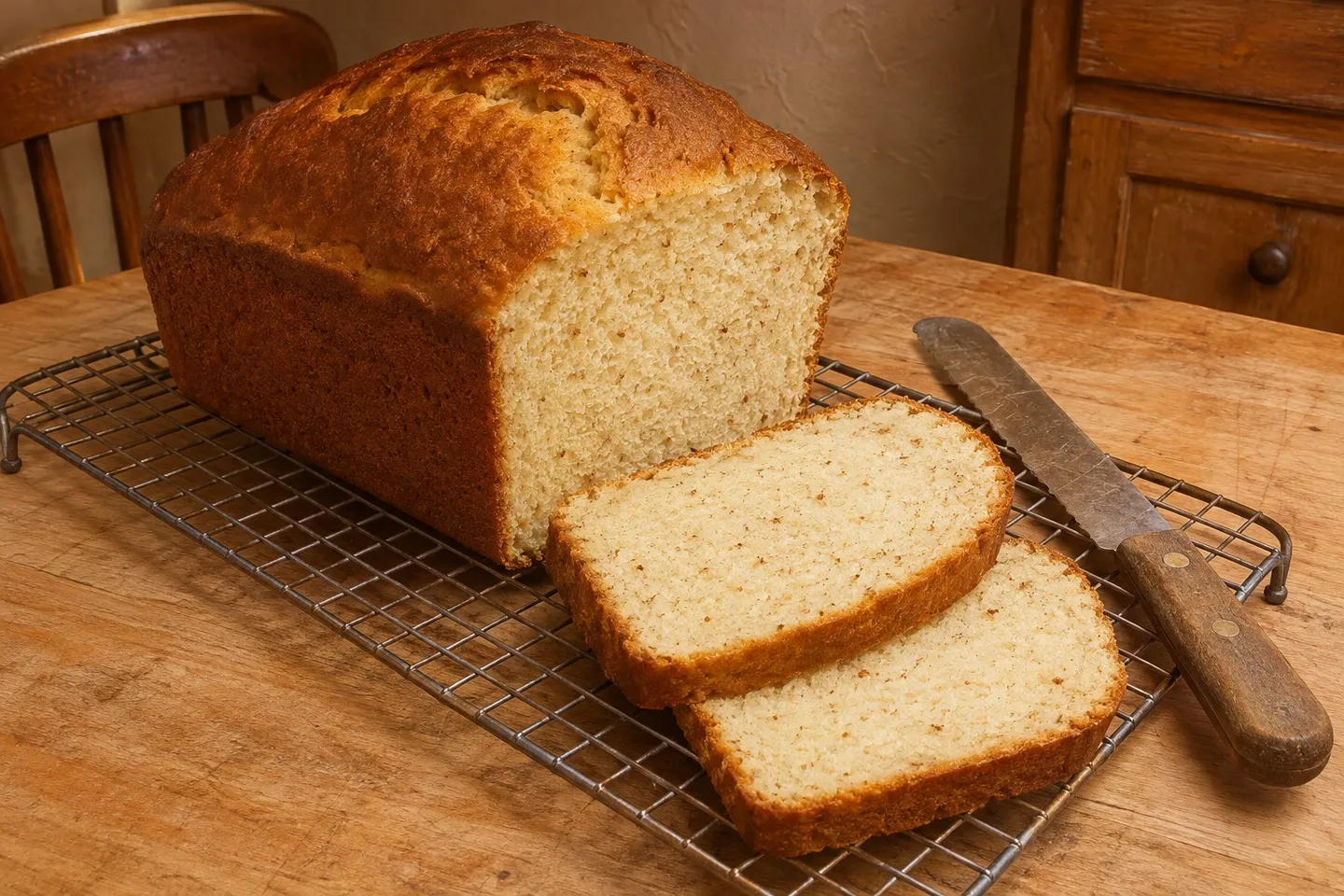
Plain yeast cake baked in a loaf tin, two slices cut.
The story behind the recipe
This is the cake Isabella Beeton wrote for the nursery: a loaf of bread dough with a little sugar, butter, warm milk and nutmeg kneaded through it, risen a second time in the tin and baked. It is a plain cake in her own words, sweet enough for a child’s tea and made with no eggs at all.
Bought from the baker
Beeton expected many readers not to bake their own bread. “If you are not in the habit of making bread at home, procure the dough from the baker’s,” the recipe begins, and the dough was to go straight into a basin by the fire under a thick cloth until it rose. Her Common Seed-Cake, a few pages on, starts the same way, from half a quartern of dough “sent in from the baker’s.”
The plainness shows best beside the seed cake printed after that one, “A Very Good Seed-Cake,” which takes a pound of butter and six eggs to a pound of flour, with a wineglass of brandy. The children’s cake has a quarter pound of butter for a whole quartern of dough and costs 1s. 2d. (about £7 today, by UK consumer prices (Bank of England)). TuneMyRecipe, our sister site, has the richer one as A Very Good Seed-Cake (1861) (opens in a new tab).
Read more about this recipe
Making it today
Few bakers sell raw dough now, so we make it, following the home-made bread in the same chapter, which Beeton credits to Eliza Acton: flour, yeast and warm milk-and-water, kneaded firm and left to rise about an hour. Her quartern is taken as a quartern of flour, the three and a half pounds her bread recipe starts from, and this is a quarter of everything, enough for one loaf pan. We chose butter over her other choice of beef dripping, and nutmeg over caraway; both are hers. Instant yeast stands in for her German yeast, and the bake is a modern bread oven’s, about 40 minutes for one loaf, where Beeton’s larger cakes took up to two hours.
What Did Victorian Children Eat? puts it beside her milk soup and two puddings for children. The Milk Soup for Children (1861) is the one to make on the stove while the dough rises.
A NICE PLAIN CAKE FOR CHILDREN.
1767. INGREDIENTS.—1 quartern of dough, ¼ lb. of moist sugar, ¼ lb. of butter or good beef dripping, ¼ pint of warm milk, ½ grated nutmeg or ½ oz. of caraway seeds.
Mode.—If you are not in the habit of making bread at home, procure the dough from the baker’s, and, as soon as it comes in, put it into a basin near the fire; cover the basin with a thick cloth, and let the dough remain a little while to rise. In the mean time, beat the butter to a cream, and make the milk warm; and when the dough has risen, mix with it thoroughly all the above ingredients, and knead the cake well for a few minutes. Butter some cake-tins, half fill them, and stand them in a warm place, to allow the dough to rise again. When the tins are three parts full, put the cakes into a good oven, and bake them from 1¾ to 2 hours. A few currants might be substituted for the caraway seeds when the flavour of the latter is disliked.
Time.—1¾ to 2 hours. Average cost, 1s. 2d.
Seasonable at any time.
Recipe makes: One 9 by 5-inch loaf, 10 slices
Ingredients
For One 9 by 5-inch loaf, 10 slices. Quantities are shown as written.
Quantities as written here, for One 9 by 5-inch loaf, 10 slices.
- Strong white bread flour400 g
- Fine salt1 tsp
- Instant yeast1 1/2 tsp
- Whole milk, lukewarm, for the dough100 ml
- Lukewarm water100 ml
- Extra lukewarm water, if needed30 ml
- Unsalted butter, softened30 g
- Butter, for the tin10 g
- Soft light brown sugar30 g
- Whole milk, warmed, for the cake35 ml
- Freshly grated nutmeg1/4 tsp
Measurement notes
Ingredients as written here
- 400 g strong white bread flour
- 1 tsp fine salt
- 1 1/2 tsp instant yeast
- 100 ml whole milk, lukewarm, for the dough
- 100 ml lukewarm water
- 30 ml extra lukewarm water, if needed
- 30 g unsalted butter, softened
- 10 g butter, for the tin
- 30 g soft light brown sugar
- 35 ml whole milk, warmed, for the cake
- 1/4 tsp freshly grated nutmeg
Equipment
 Kitchen scale
 Large bowl
 Small saucepan
 Clean kitchen towel
 Nutmeg grater
 9 by 5-inch loaf pan
 Instant-read thermometer
 Wire rack
Instructions
Mix the bread flour and salt in the large bowl and stir in the instant yeast.
Pour in the whole milk for the dough and the lukewarm water and mix to a firm dough. If dry flour is left in the bowl, add the extra lukewarm water a little at a time; Beeton wants the dough “quite firm,” since it softens as it rises.
Knead on a clean surface for about 10 minutes, until the dough is smooth and springs back when pressed. Return it to the bowl, cover with the kitchen towel and leave it in a warm place for about 1 hour, until doubled.
While the dough rises, beat the unsalted butter with a spoon until soft and creamy. Warm the whole milk for the cake in the small saucepan until just lukewarm, about 100°F (38°C), and grease the loaf pan with the butter for the tin.
Add the creamed butter, brown sugar, warm milk and nutmeg to the risen dough and knead for a few minutes, until everything is worked in and the dough is smooth again. It will feel slippery at first.
Shape the dough into a log and lay it in the pan; it should come about halfway up. Cover with the towel and leave in a warm place for 45 to 60 minutes, until it has risen to about three-quarters of the pan’s depth or a little above. Meanwhile heat the oven to 375°F (190°C).
Bake for 35 to 40 minutes, until the top is a deep golden brown and an instant-read thermometer pushed into the center reads 195°F (91°C).
Turn the cake out onto the wire rack and let it cool for at least 30 minutes before slicing.
Nutrition
185calories per serving
- Recipe makes
- One 9 by 5-inch loaf, 10 slices
- Servings
- 10
Estimated per slice (10) from USDA FoodData Central values for bread flour, butter, brown sugar and whole milk.
Recipe notes
When adjusting quantities
This is a quarter of Beeton’s quantities, sized for one 9 by 5-inch loaf pan. Double it for two pans; a bigger cake in one deep tin needs a longer bake, so go by the thermometer.
Notes
Quantities mentioned in these notes don’t change when you adjust the servings.
Beeton bought her dough or made it from a quartern of flour (taken here as 3½ lb, about 1.6 kg), nearly 1 oz of German yeast and 1¼ to 1½ pints of warm milk-and-water. This is a quarter of that, with the cake’s own sugar, butter, milk and nutmeg quartered to match: her ¼ lb of sugar and of butter become 30 g each, her ¼ pint of milk 35 ml, and her half nutmeg about a quarter teaspoon. The salt, the instant yeast and the oven setting are our choices; her bread has only “a little salt” and bakes in “a good oven.” Her moist sugar is a soft brown sugar today. For caraway, use 1 1/2 teaspoons of seeds in place of the nutmeg, or a small handful of currants, as Beeton suggests for children who dislike caraway. Contains wheat and milk.
Scaling changes the ingredients only; pan sizes and cooking times need their own judgment.
Sources and attribution
After Isabella Beeton, The Book of Household Management (London: S. O. Beeton, 1861), A Nice Plain Cake for Children, no. 1767, with the dough from her home-made bread, no. 1718
See the original pages (scan at Internet Archive) (opens in a new tab)
Recipe details
- Course
- Bread & baking
- Dish family
- Breads & Cakes
- Region
- British
- Era
- 19th century
- Source decade
- 1860s
- Main ingredient
- Grains & rice
- Difficulty
- Easy
- Occasion
- Everyday meal