Arrowroot Blancmange (1837)
Reader ratingsEliza Leslie’s arrow root blanc-mange, Philadelphia, 1837: milk steeped with lemon, nutmeg and mace, strained, sweetened and set with arrowroot.
- Recipe makes
- 4 small cups
- Prep
- Cook
- Total
Cook time includes 15 minutes for the spices to steep in the milk. Total time adds 15 minutes standing and 3 hours in the refrigerator for the cups to set; serve them the same day.
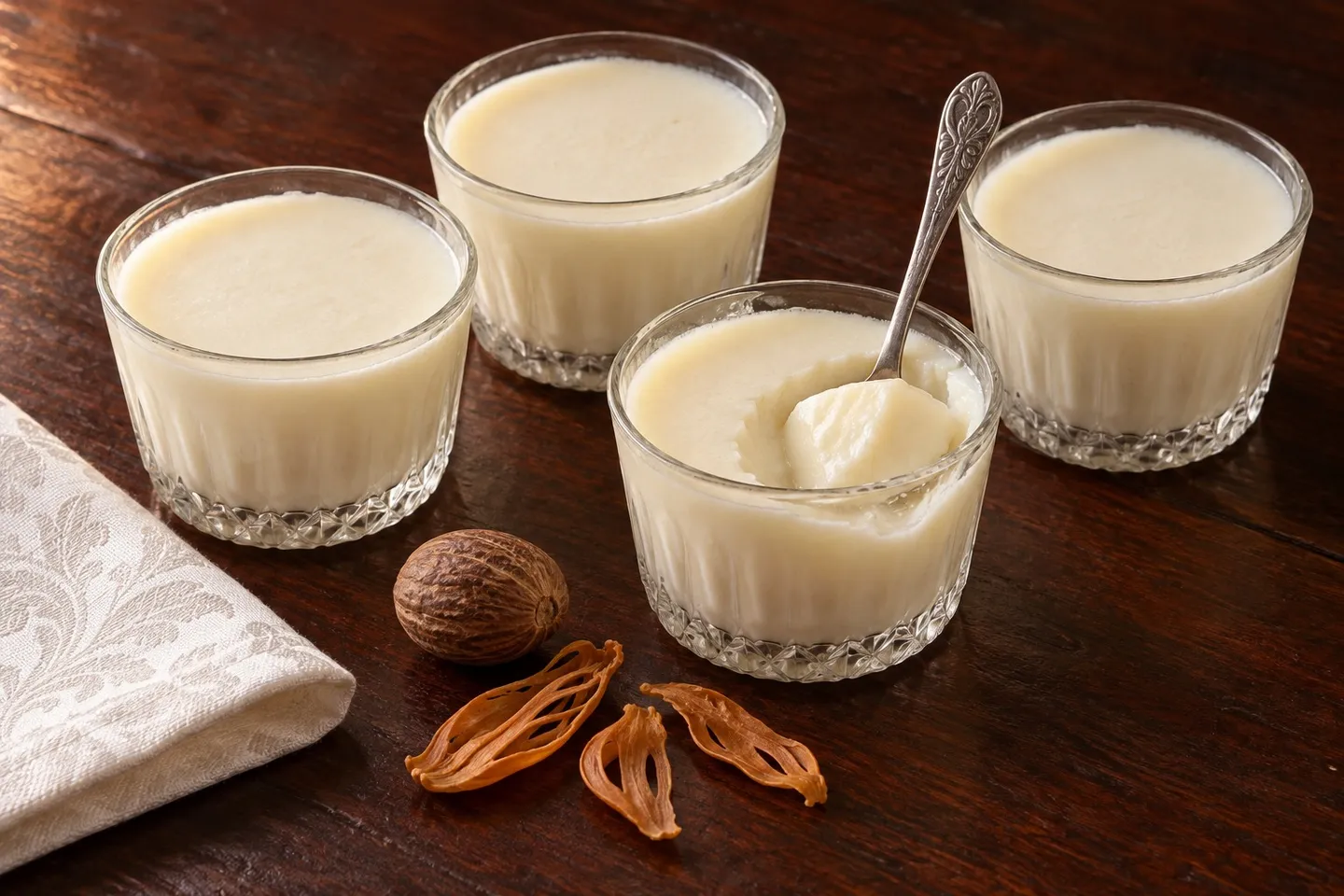
Four small glass cups of ivory arrowroot blancmange beside whole nutmeg and mace.
The story behind the recipe
Eliza Leslie’s blanc-mange is milk, flavored and then set. Directions for Cookery, printed in Philadelphia in 1837, boils half a pint of milk “made very sweet with white sugar” with a beaten nutmeg, eight or nine blades of mace and the juice and grated peel of a lemon, strains it into a pint and a half of very rich milk or cream, and pours the lot, boiling hot, over a tea-cup of arrowroot. Stirred until cold, it goes into molds “to congeal.”
What did a blanc-mange taste of?
It tasted of whatever the cook steeped in the milk, and in 1820 that was the trouble. Fredrick Accum’s Treatise on Adulterations of Food, and Culinary Poisons, reprinted in Philadelphia that year, listed blanc-mange among the dishes cooks flavored with cherry-laurel leaves for their almond taste, beside custards, puddings and creams. He had just reprinted a report of four schoolchildren near Richmond made ill by a laurel custard; What Was in the Pot Accum Warned About in 1820? follows that report from a London weekly into his book.
Seventeen years later, Leslie’s version leaves no room for a leaf. Her flavor is all lemon and spice, drawn out in the first small pan of milk and strained off. The setting comes from the arrowroot, a starch from a tropical root, which needs no flavoring of its own. The sugar goes in twice: once to make the first milk “very sweet,” and again as a quarter of a pound with the cream. Leslie’s book was a household guide for American cooks; the Richmond school’s own recipe is unknown, and this one is no stand-in for it.
Read more about this recipe
Making it today
This is about half of Leslie’s batch, in four cups. The spices steep in hot milk off the heat, and the arrowroot goes in as a cold slurry and is cooked just until thick, where Leslie boils the milk ten minutes and pours it over wetted arrowroot. The lemon juice stays out, and only the grated rind is steeped, because acid juice stirred into hot milk can curdle it. We set it in cups and leave out the molds, which lets it stay soft. Lemon Custards (1806) makes the eggy half of a two-sweet table.
ARROW ROOT BLANC-MANGE.—Take a tea-cup full of arrow root, put it into a large bowl, and dissolve it in a little cold water. When it is melted, pour off the water, and let the arrow root remain undisturbed. Boil in half a pint of unskimmed milk, (made very sweet with white sugar,) a beaten nutmeg, and eight or nine blades of mace, mixed with the juice and grated peel of a lemon. When it has boiled long enough to be highly flavoured, strain it into a pint and a half of very rich milk or cream, and add a quarter of a pound of sugar. Boil the whole for ten minutes; then strain it, boiling hot, over the arrow root. Stir it well and frequently till cold; then put it into moulds and let it set to congeal.
Recipe makes: 4 small cups
Ingredients
For 4 small cups. Quantities are shown as written.
Quantities as written here, for 4 small cups.
- Whole milk, for steeping400 ml
- Finely grated lemon zest, from about 1 lemon1 tsp
- Nutmeg, cracked1/4
- Blades mace2
- White sugar50 g
- Arrowroot35 g
- Cold whole milk, for the arrowroot100 ml
- Cold water30 ml
Measurement notes
Ingredients as written here
- 400 ml whole milk, for steeping
- 1 tsp finely grated lemon zest, from about 1 lemon
- ¼ whole nutmeg, cracked
- 2 blades mace
- 50 g white sugar
- 35 g arrowroot
- 100 ml cold whole milk, for the arrowroot
- 30 ml cold water
Equipment
- Two small saucepans
 Fine sieve
- Small bowl and whisk
 Fine grater
- Four small cups or glasses
Instructions
Put the milk for steeping, lemon zest, nutmeg and mace in a small saucepan over medium heat. When the milk is steaming and small bubbles appear at the edge, take it off the heat, cover and leave 15 minutes.
Pour the milk through the fine sieve into the second saucepan, pressing on the zest, and discard the spices. Stir in the sugar until it dissolves.
In the small bowl, whisk the arrowroot with the cold milk for the arrowroot and the cold water until smooth, with no lumps.
Set the strained milk over medium-low heat. When it is steaming again, whisk in the arrowroot mixture and keep whisking until the blancmange thickens and the first bubbles break at the edge, 2 to 4 minutes. Take it off the heat at once.
Stir it for a minute, then pour it into the cups. Let them stand 15 minutes, then cover and refrigerate for 3 hours, until set.
Serve cold, the same day.
Nutrition
150calories per serving
- Recipe makes
- 4 small cups
- Servings
- 4
Estimated per cup (4) from USDA FoodData Central values for whole milk, arrowroot flour and granulated sugar.
Recipe notes
When adjusting quantities
Leslie’s batch takes two pints of milk and cream, about twice this one. Keep about 35 g arrowroot to each 500 ml of milk.
Notes
Quantities mentioned in these notes don’t change when you adjust the servings.
Our changes from Leslie: about half her quantities; whole milk throughout in place of unskimmed milk and “very rich milk or cream”; the sugar in one measured addition; a quarter nutmeg and two blades of mace for her whole nutmeg and eight or nine blades; no lemon juice; a cold slurry in place of arrowroot washed and drained; a short cook in place of her ten-minute boil; cups in place of molds. For a richer cup, use cream for half the steeping milk. Arrowroot is sold as arrowroot powder or arrowroot flour. Keep the cups covered in the refrigerator and out of it no more than 2 hours in all. Contains milk.
Scaling changes the ingredients only; pan sizes and cooking times need their own judgment. To adapt this recipe further, try the recipe tool at TuneMyRecipe (opens in a new tab), our sister site.
Sources and attribution
After Eliza Leslie, Directions for Cookery (Philadelphia, 1837), Arrow Root Blanc-Mange
See the original pages (scan at Internet Archive) (opens in a new tab)
Recipe details
- Course
- Dessert
- Dish family
- Desserts & Sweets
- Region
- American
- Era
- 19th century
- Source decade
- 1830s
- Main ingredient
- Milk & creamSpices
- Difficulty
- Easy
- Occasion
- Everyday meal