Fredrick Accum’s Treatise on Adulterations of Food, and Culinary Poisons · London
What Was in the Pot Accum Warned About in 1820?
Fredrick Accum’s 1820 Treatise warned of poisons cooks added at home: cherry-laurel leaves in custards, and copper or brass to turn pickles green.
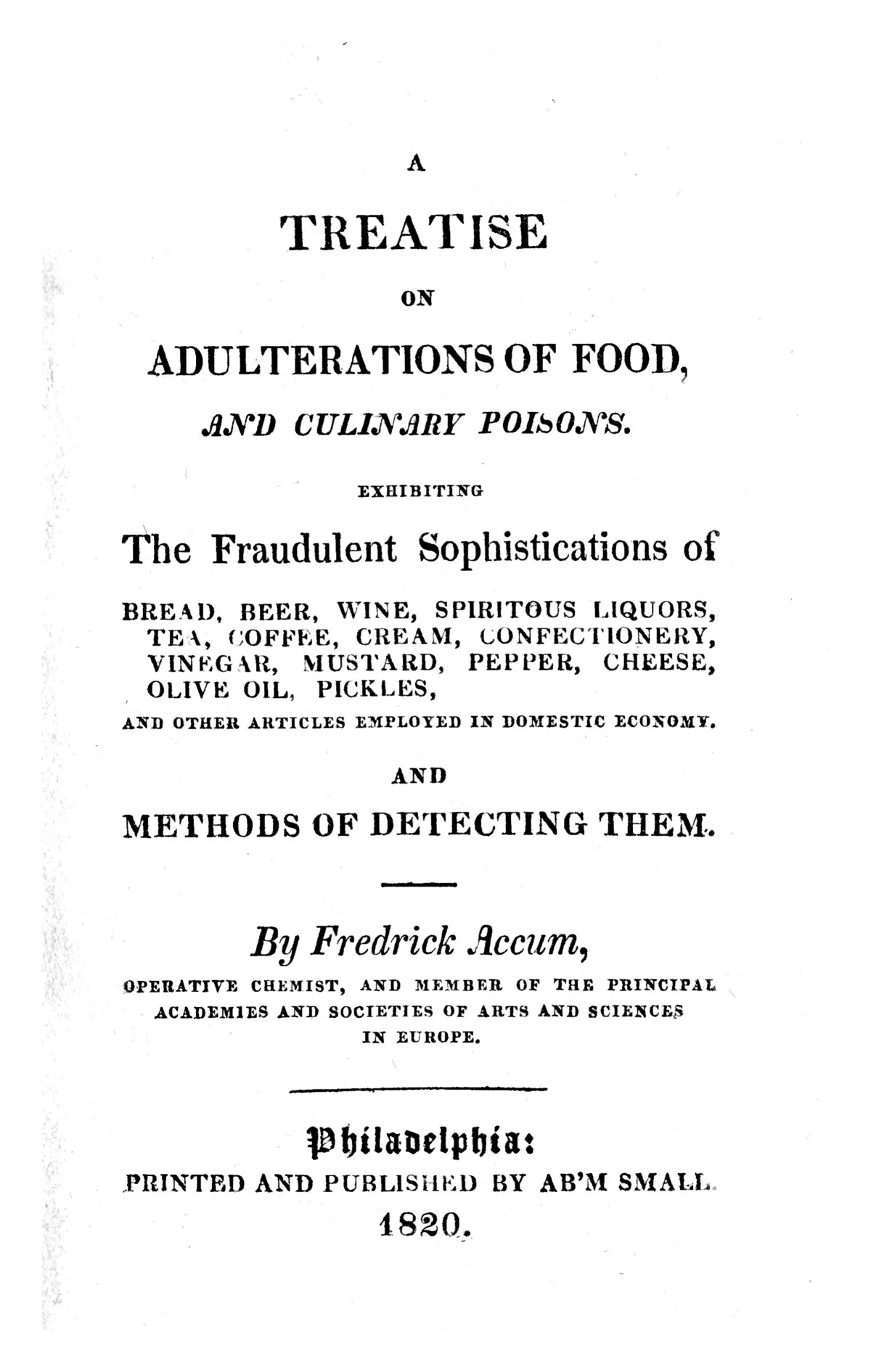
The pot Fredrick Accum warned about held two kinds of poison. One was put there by dealers: bread, beer, tea, pepper and pickles doctored for profit, the frauds that fill most of his Treatise on Adulterations of Food, and Culinary Poisons of 1820. The other was put there at home, by cooks who wanted a dish to taste or look a certain way. In his pages on the kitchen, two of those home poisons stand out: cherry-laurel leaves steeped in custards for their almond flavor, and copper or brass used to turn pickles a lively green. Four children near Richmond had just fallen ill from the first. For the second, Accum named a cookery writer, and the line he quotes from her is not on the pages he cites in three editions of her book.
Death in the pot
Accum was a German-born chemist working in London, and his title page calls him an “Operative Chemist.” His preface promised tests for fraud that people “unacquainted with chemical science” could carry out themselves, and it went further than fraud. He would also take on “certain material errors, sometimes unconsciously committed through accident or ignorance, in private families, during the preparation of various articles of food, and of delicacies for the table.”
He closed the preface with a line from the Second Book of Kings, where the sons of the prophets taste a pottage made with wild gourds and cry out to Elisha. The evil, Accum wrote, prevailed “to an extent so alarming, that we may exclaim with the sons of the Prophet, ‘THERE IS DEATH IN THE POT.’” He signed it from London, 1820. The book crossed the Atlantic the same year: the copy quoted here is the Philadelphia printing by Abraham Small, dated 1820, with the same preface.
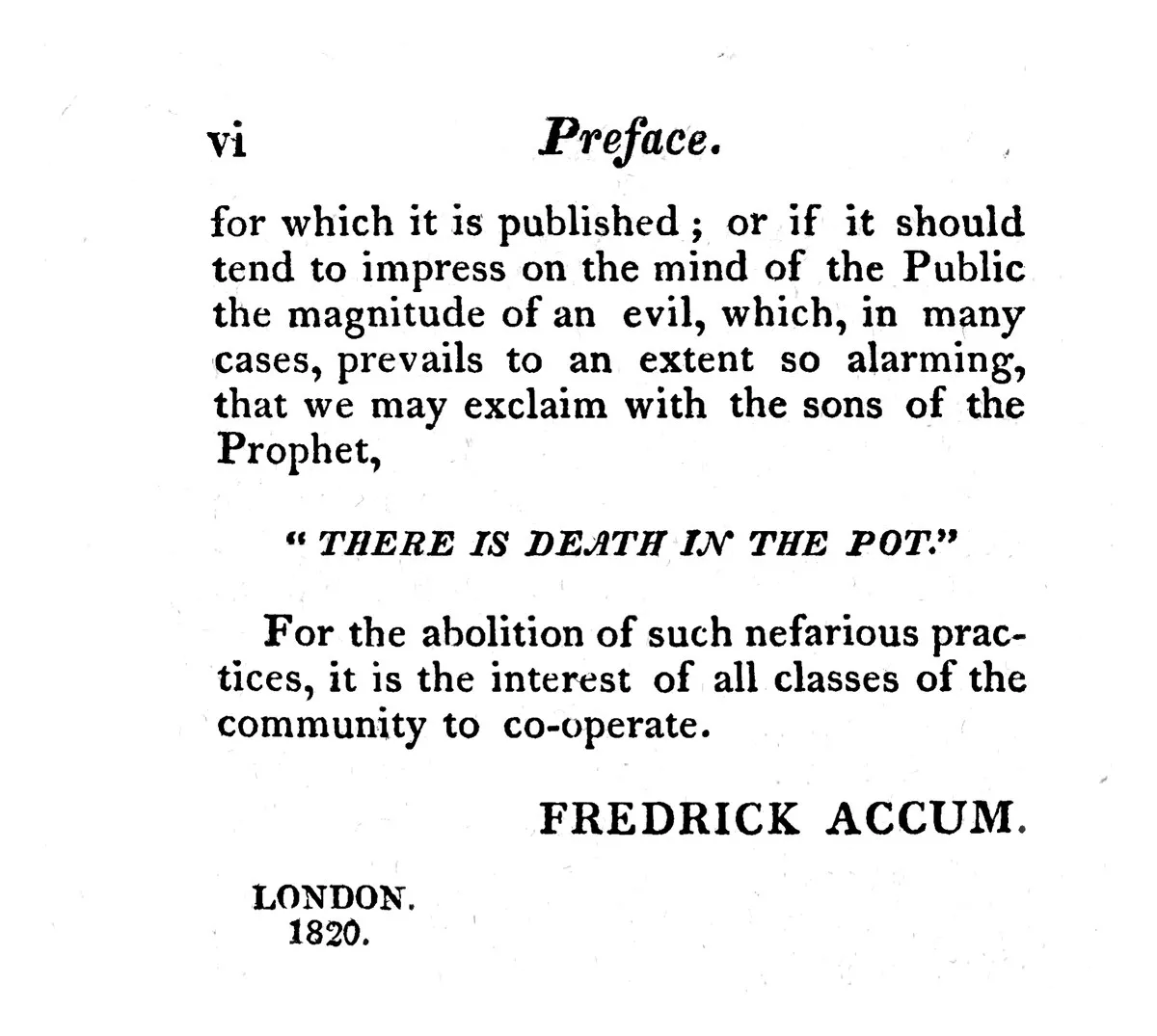 The close of Accum’s preface, p. vi, in the Philadelphia printing of 1820.
The custard near Richmond
The case Accum used for the custard came from a weekly magazine. On October 16, 1819, the Literary Chronicle and Weekly Review in London printed a short letter under the heading “Laurel Leaves, Poisonous,” dated from Richmond on October 4 and signed Thomas Lidiard. Several children at a boarding school near Richmond had eaten “some custard flavoured with leaves of laurel, as is frequently practised by cooks,” and four of them were taken severely ill. A girl of six and a boy of five fell into a sleep from which they could not be roused; the boy stayed in a stupor ten hours, the girl nine. Two other girls, six and seven, had severe pains in the stomach. “They all recovered, after three days illness,” Lidiard wrote.
He named neither the school nor the children, nor said whether he saw them himself. What he wanted is clear. He believed the Chronicle was read at all the schools in that part of the country, and asked for “a corner” so that his lines might “put the unwary on their guard” against flavoring dishes with “that baneful herb, the Cherry Laurel.”
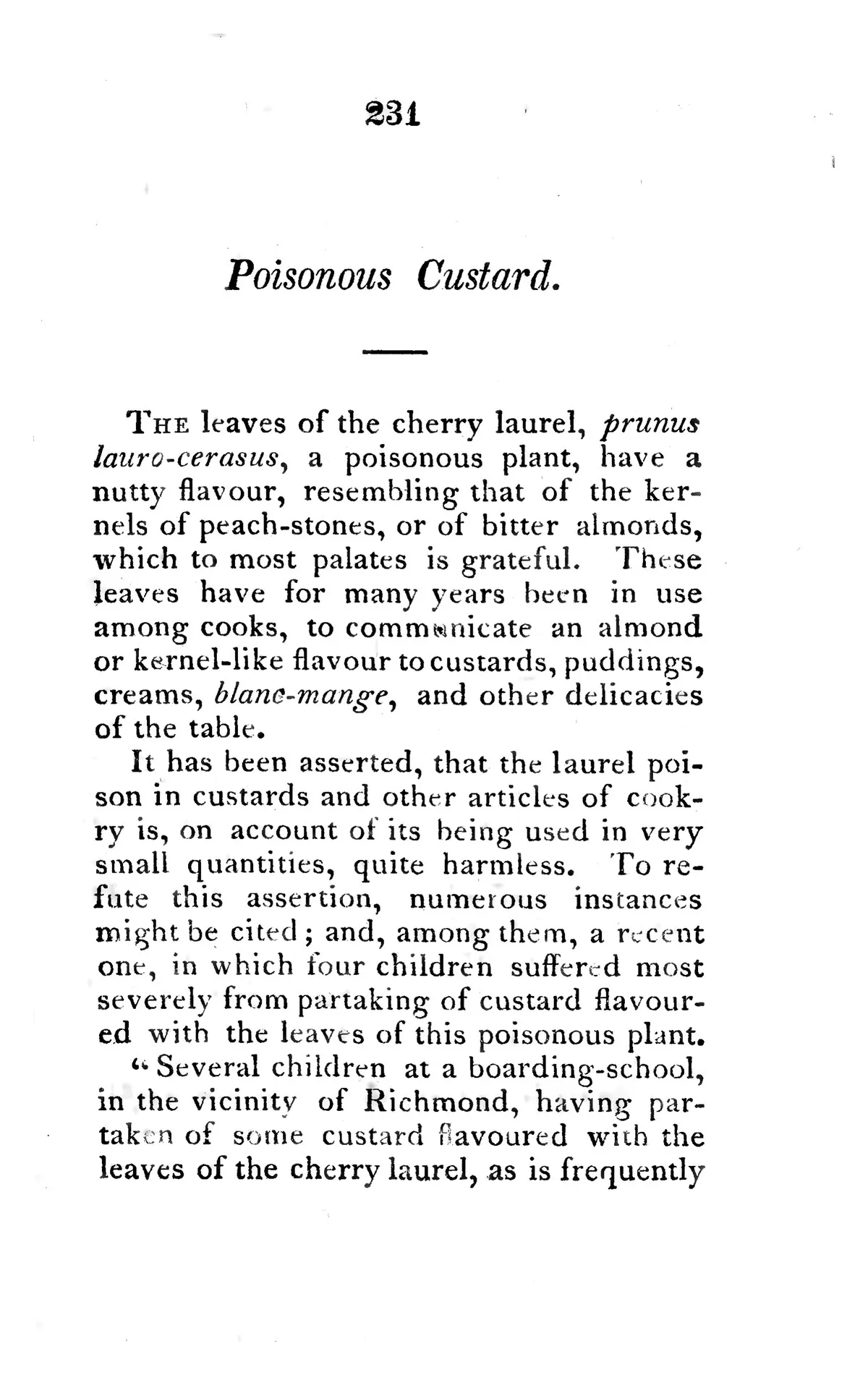 “Poisonous Custard,” p. 231 of Accum’s Treatise (Philadelphia, 1820).
Accum reprinted most of the letter with a footnote to the Chronicle, no. 22, page 348. He dropped Lidiard’s opening and the Richmond dateline, and where Lidiard first wrote “leaves of laurel,” Accum’s version reads “the leaves of the cherry laurel.” Around it he built his case. The leaves, he wrote, “have for many years been in use among cooks, to communicate an almond or kernel-like flavour to custards, puddings, creams, blanc-mange, and other delicacies of the table.” Cooks were told that so little was used that it did no harm. The Richmond children were his answer, and he ended with two questions: “What person of sense or prudence, then, would trust to the discretion of an ignorant cook, in mixing so dangerous an ingredient in his puddings and creams? Who but a maniac would choose to season his victuals with poison?”
Laurel is not bay
The laurel in these pages is the cherry laurel, Prunus laurocerasus, an evergreen shrub with glossy leaves often grown as a tall hedge. It is a different plant from the bay laurel, Laurus nobilis, whose leaves go into stews and sauces. NC State Extension’s plant database lists cyanogenic glycosides among the cherry laurel’s poisons and says its stems, leaves and seeds contain cyanide; a 1999 report by the European Medicines Agency’s veterinary committee puts its acute toxicity down to the hydrocyanic acid those compounds release. That is the bitter-almond note Accum describes, and it is the poison. How much was in the Richmond custard is unknown: Lidiard gives no recipe and no count of leaves.
Lidiard’s letter names the Cherry Laurel outright: the leaf went into the custard on purpose, for its flavor. Accum went on to the distilled water of the same leaves, mixed with brandy to imitate the cordial noyeau, and told of two women in Dublin whose sudden deaths in 1728, he wrote, first showed it to be poisonous.
No amount of cherry laurel is safe to cook with, and steeping it and straining it out does not make a custard safe. None of the recipes on this page uses it, or peach leaves, kernels or bitter almonds in its place.
Green pickles
Accum’s chapter “Poisonous Pickles” starts from the market. The sale of pickles, he wrote, “frequently depends greatly upon a fine lively green colour,” and gherkins, French beans, samphire and green capsicum pods were “oftener than is perhaps expected” found to hold copper. The color came, he said, from “deadly formulæ” in modern cookery books, “such as boiling the pickles with half-pence, or suffering them to stand for a considerable period in brazen vessels.”
He then quoted the books by name, hoping the recipes “will be suppressed in future editions of the works.” The Ladies’ Library told cooks to boil the vinegar for gherkins “in a bell-metal or copper pot.” Modern Cookery, or the English Housewife gave a “greening” of powdered verdigris, the green rust of copper, shaken up with vinegar and alum. Last came “Mrs. E. Raffald,” who, Accum wrote, directs “to render pickles green, boil them with halfpence, or allow them to stand for twenty-four hours in copper or brass pans.” His footnote gives The English Housekeeper, pages 352 and 354, and no edition.
What Raffald wrote
Elizabeth Raffald’s The Experienced English House-keeper first appeared in Manchester in 1769, and its pickling chapter opens with a warning that sounds much like Accum’s own. Pickles were often “made to please the Eye by pernicious Things,” she wrote, “for nothing is more common than to green Pickles in a Brass Pan, for the Sake of having them a good Green,” when they would green as well by heating the liquor on the hearth, “without the Help of Brass, or Verdigrease of any Kind, for it is Poison to a great Degree.” Nothing ought to be avoided more, she went on, than “Brass or Copper that is not well tinned.”
Four pages later, her kidney beans go into a brass pan. The young pods sit three days in strong salt water, then go into the pan between vine leaves, with the same brine poured back over them, and cook over a very slow fire “’till they are a fine Green.” The spiced vinegar comes afterward, poured hot over the drained beans. Her warning leaves room for a well-tinned pan, but the recipe never says the brass is tinned. Her codlins and samphire green in brass too. Her sliced cucumbers, two pages before the beans, go into a stone jar and are greened only by boiling spiced ale vinegar poured over them four times, with no metal named at all.
The halfpence are harder to find. Pages 352 and 354 of the 1769 Manchester edition hold lists of foods in season. In the London second edition of 1771 they hold appendix recipes for fish and sauces. In the eighth edition of 1782, page 352 has an elder-bud pickle that names brass, but neither page has Accum’s sentence. He may have used another edition, mistaken his reference, or misattributed the line. The chemists Tom Coultate and Richard S. Blackburn, in a 2018 history of food colorants, quote Raffald’s warning from the eighth edition and explain that long heating in even mildly acid liquid turns a vegetable’s green to a dull grayish brown. That is the problem a brass pan was meant to solve.
The concern has outlived both writers. The FDA’s model Food Code says copper and copper alloys such as brass may not touch foods with a pH below 6, vinegar among them. Nothing on this page is greened in metal; the pickles here are made in glass and stainless steel and eaten the same day.
The quarrel over what went into food ran on long after 1820. In 1898 an American general told an inquiry the army’s beef was “embalmed,” and What Was the ‘Embalmed Beef’ Scandal of 1898? follows what the inquiry’s chemists found in the cans.
The recipes
No meal joins these four. Each comes from a cookery book of the years around Accum’s Treatise, and each gets its flavor or its green from something other than laurel or metal.
- Lemon Custards (1806): from Maria Rundell’s New System of Domestic Cookery, printed in London thirteen years before the Richmond letter. Lemon rind and juice give the flavor, yolks do the thickening, and boiling water stands where milk might be.
- Arrowroot Blancmange (1837): Eliza Leslie’s, from Philadelphia. Blanc-mange is on Accum’s list of dishes cooks flavored with laurel; hers takes lemon, nutmeg and mace.
- Cucumbers in Slices (1769): Raffald’s stone-jar pickle, the one that names no brass, made here as a quick salad.
- Green Beans in Spiced Vinegar (1769): her kidney beans without the brass pan, greened the way her own warning advised, by heat.
The modern versions are made the same day and kept in the refrigerator, with no metal greening, no storage pickling and no leaves.
Cooking them
Raffald said her pickles would green “as well by heating the Liquor” as in brass, and the Green Beans in Spiced Vinegar (1769) take her at her word in a stainless steel pan: boiled bright green in salted water, they take her mace, allspice and ginger vinegar and are on the table within the hour. Accum went after the brewers too, and Forgotten Drink, our sister site, follows his lists of seized drugs into the breweries in how beer was doctored (opens in a new tab).
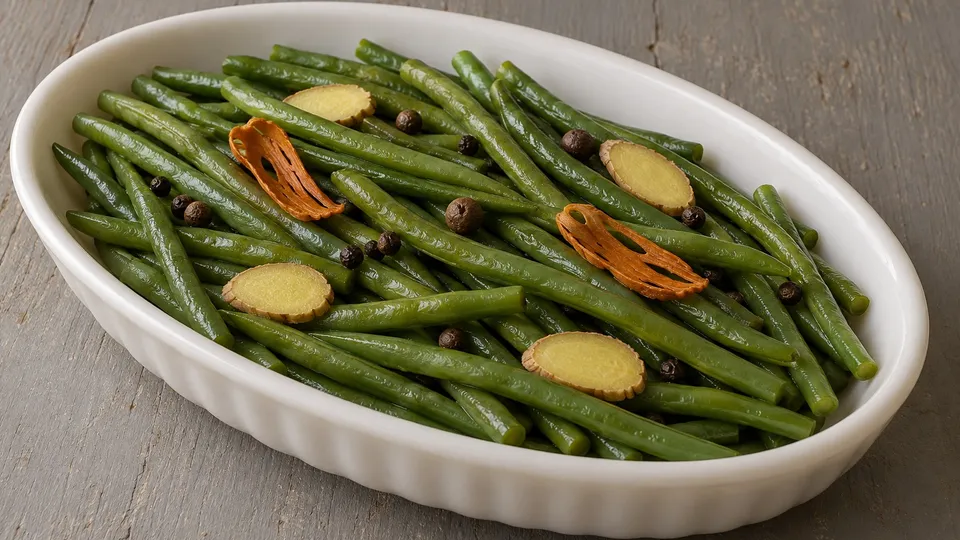 Cook it todayGreen Beans in Spiced Vinegar (1769)
Sources
- Fredrick Accum, A Treatise on Adulterations of Food, and Culinary Poisons (Philadelphia: Abraham Small, 1820), title page, preface pp. iv–vi, “Poisonous Pickles” pp. 217–219, “Poisonous Custard” pp. 231–233. Internet Archive (opens in a new tab).
- Thomas Lidiard, “Laurel Leaves, Poisonous,” The Literary Chronicle and Weekly Review, no. 22 (London, October 16, 1819), p. 348. Internet Archive (opens in a new tab).
- Elizabeth Raffald, The Experienced English House-keeper (Manchester: J. Harrop, for the author, 1769), pp. 321, 323–326, 352, 354; second edition (London: printed for the author, sold by R. Baldwin, 1771), pp. 296–297, 352, 354; eighth edition (London: R. Baldwin, 1782), pp. 342, 352, 354.
- Maria Eliza Rundell, A New System of Domestic Cookery (London: J. Murray and J. Harding, 1806), pp. 159–160. Internet Archive (opens in a new tab).
- Eliza Leslie, Directions for Cookery (Philadelphia: E. L. Carey & A. Hart, 1837), p. 329. Internet Archive (opens in a new tab).
- The Holy Bible, King James Version, 2 Kings 4:38–41.
- NC State Extension, “Prunus laurocerasus,” North Carolina Extension Gardener Plant Toolbox. plants.ces.ncsu.edu (opens in a new tab).
- European Medicines Agency, Committee for Veterinary Medicinal Products, Prunus laurocerasus: Summary Report, EMEA/MRL/675/99-FINAL (August 1999). ema.europa.eu (opens in a new tab).
- Tom Coultate and Richard S. Blackburn, “Food colorants: their past, present and future,” Coloration Technology 134, no. 3 (2018): 165–186. White Rose eprint (opens in a new tab).
- U.S. Food and Drug Administration, Food Code 2022, §4-101.14, copper use limitation. fda.gov (opens in a new tab).