General Miles’s statement on beef to the Dodge Commission · Washington, D.C.
What Was the ‘Embalmed Beef’ Scandal of 1898?
In 1898 a general said the army’s beef was embalmed. An inquiry found no chemicals, but agreed the canned beef was unpalatable as issued in the tropics.
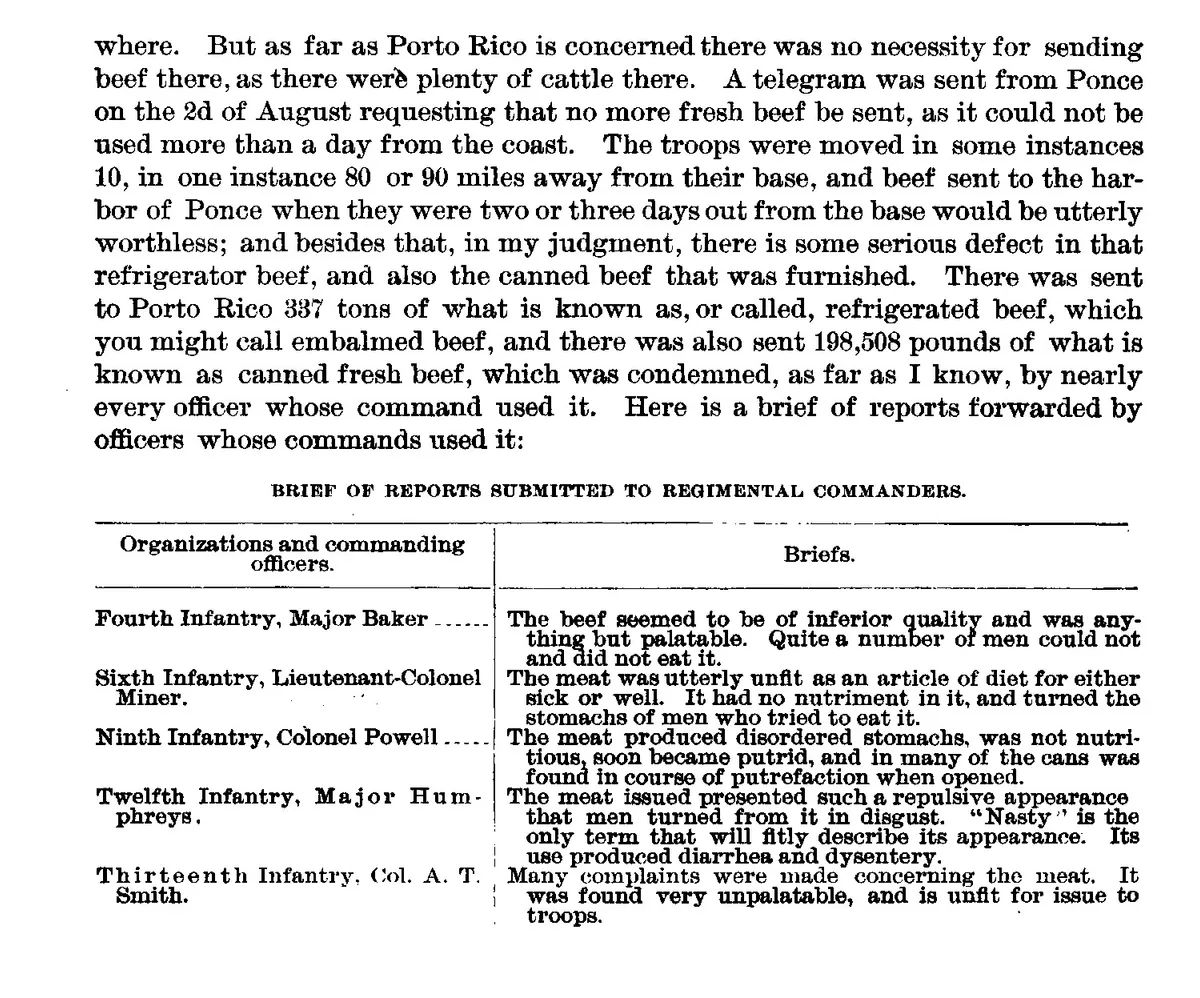
The “embalmed beef” scandal was a fight over the meat the United States Army fed its soldiers in the war with Spain in 1898. On December 21, 1898, Major General Nelson A. Miles, who had led the campaign in Puerto Rico, told the presidential commission investigating the War Department that the refrigerated beef shipped to his troops was what “you might call embalmed beef.” He also read out officers’ reports condemning the army’s canned roast beef. The commission, chaired by Grenville M. Dodge, found no chemicals in either kind of beef. It did agree that the canned meat, as soldiers got it in the tropics, was unpalatable.
So the scandal held two charges. One was poison, and it was never proved. The other was bad food, badly handled, and that one the record bears out.
Two kinds of beef
The army sent beef south in two forms. Refrigerated beef came in refrigerator ships and, as a telegram from Ponce put it, “could not be used more than a day from the coast.” Canned beef, issued as “fresh roast beef” or “canned fresh beef,” was cooked and sealed in tins in the packing houses of Chicago, Kansas City and other stockyard towns, and it kept.
Miles wanted neither. In the Civil War, he told the commission, beef had been “largely driven on the hoof and slaughtered as it was required by the troops,” and Puerto Rico was full of cattle that cost “6¼ cents per pound in our money” (about $2.50 today, by US consumer prices, using the Minneapolis Fed and BLS CPI-U tables). His troops had moved as far as 80 or 90 miles inland, and beef landed at Ponce for men two or three days out “would be utterly worthless.” By his count the army sent 337 tons of refrigerated beef to Puerto Rico, “which you might call embalmed beef,” and 198,508 pounds of canned beef, “condemned, as far as I know, by nearly every officer whose command used it.”
What the officers wrote
Then he read the reports, fifteen short summaries from regiments and batteries, all about the canned beef. The Fourth Infantry found it “anything but palatable,” adding that “Quite a number of men could not and did not eat it.” The Ninth Infantry reported many cans “in course of putrefaction when opened.” The Twelfth Infantry settled on one word: “‘Nasty’ is the only term that will fitly describe its appearance.” Others called it soft, watery, insipid or too fat, and two tied it to “disordered stomachs” or to “diarrhea and dysentery.” None of the fifteen calls it poisoned. Two artillery reports found it more acceptable in a stew, and one said the men would eat it in no other form. A man who refused it got nothing in its place: “they could get no other beef from the stores sent by the Commissary Department,” Miles said.
The chemicals charge
The word “embalmed” belonged to the refrigerated beef, and it came from a doctor. Miles read the commission a report from his chief surgeon, Major W. H. Daly of the volunteers, who wrote that he had found “the fresh beef to be apparently preserved with secret chemicals,” most likely boric acid, salicylic acid or saltpeter. Beef taken aboard the transport Panama at Ponce had, Daly said, “an odor similar to that of a dead human body after being injected with preservatives.” Miles offered the beef as one cause of the sickness in the camps and hedged in the same breath: “There may be other causes, of course.”
The commission was not persuaded. Its report notes that Miles declined to be sworn, when every other witness had sworn or affirmed. Daly’s letter mentioned no analysis, and nobody on the Panama spoke of chemicals when that beef, kept on ice with no refrigerator, went bad and was thrown overboard. A government chemist did find traces of boric and salicylic acid in a bottle of broth Daly had saved, but the commissioners set that against the meat’s time ashore at Ponce out of a refrigerator, and against Daly’s description of a taste like “decomposed boric acid,” when, they wrote, boric acid in meat “has no taste.” The quarter of beef Daly remembered seeing left in the sun at Tampa, they concluded, came from a trial of a New York man’s preserving process, which the Commissary General turned down, and was never army beef.
What the commission found
The commission signed its report on February 9, 1899. On refrigerated beef it found that none supplied by the contractors “was subjected to or treated with any chemicals.” On canned beef it noted “neither allegation nor proof” of any acid, then had the cans analyzed anyway and tasted some itself, including cans brought back from Puerto Rico.
The inquiry also learned how the product was made. The meat came mostly from the forequarters, and the Department of Agriculture’s account, which the report quotes, has large pieces “put in vats of boiling water and thus cooked,” then boned, cut to fit, soldered into the can and heated again. W. O. Atwater, the Wesleyan University chemist who gave evidence on its food value, called the process “in the nature of boiling rather than roasting.” Canned beef had been in the army ration since 1878, meant, the testimony said, as an emergency ration.
The verdict was mixed, and the report says so plainly:
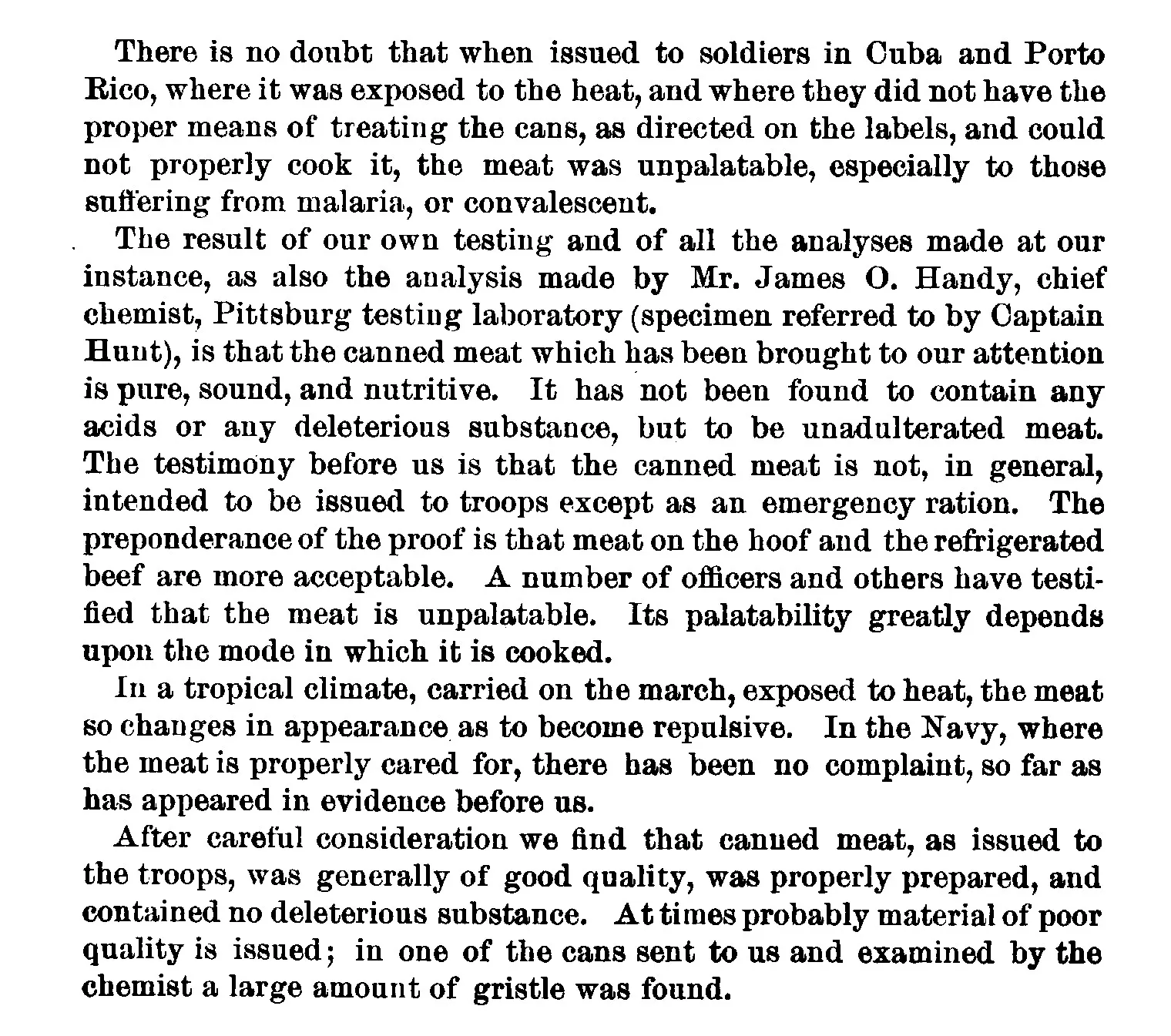 The commission’s finding on canned meat in its report of February 9, 1899, vol. 1 (Washington, 1900), p. 166.
The meat was “pure, sound, and nutritive,” it concluded, and also unpalatable when issued in the heat to men who could not cook it, “especially to those suffering from malaria, or convalescent.” Its palatability “greatly depends upon the mode in which it is cooked.”
What the cooks were told
The army had a book on that mode of cooking. The War Department’s Manual for Army Cooks, printed in 1896, sets out a travel ration per hundred men of 75 pounds of canned beef, 100 pounds of hard bread, baked beans, coffee and sugar: three-quarters of a pound of canned beef a man each day. After four days of it, the men could be allowed a pound of canned tomatoes each, and in place of coffee and sugar they could be given 21 cents a man a day (about $8.40 today) to buy coffee ready-made.
The manual’s camp pages assume a kettle and some time. “If preserved or cooked rations have been served out, and there is time,” they advise, “they should be warmed or made into soup or bouilli before being eaten.” Two of its camp recipes are for canned meat, and a sample bill of fare for eleven days in camp puts beef hash at breakfast four times and beef in some form at nearly every dinner. The same camp pages turn hard bread and salt pork into the layered stew of Salt Pork and Hard Bread (1896).
Cuba was rarely like that. Mary C. Gillett’s history of the Army Medical Department, published by the army’s Center of Military History in 1995, describes cauldrons arriving late and fuel running short, and names malaria and typhoid as the greatest threats to the V Corps there. Her verdict on the beef is short: “None of the V Corps’ many health problems involved the much publicized so-called embalmed beef.” The meat was often unappetizing, she adds, and sometimes inedible after too long without refrigeration. The record leaves boiled beef in a can, issued in the heat to men who often had no way to cook it, and chilled beef carried too far from the ship.
The recipes
These four come from the 1896 Manual for Army Cooks, the army’s cookbook in the years before the war. No document puts them on one soldier’s plate, and the grouping is ours: the canned beef as the manual says to use it, the fresh beef Miles wanted, a pot of the tomatoes the travel ration added, and the breakfast the cooks made from what was left.
- Stew with Canned Meat (1896): potatoes and onions stewed soft, with the opened beef added for the last ten minutes.
- Fresh Beef Stew (1896): stewing beef simmered two hours alone and one more with potatoes, tomatoes, onions and carrots.
- Stewed Tomatoes (1896): peeled tomatoes stewed with butter and thickened with rolled cracker.
- Dry Beef Hash (1896): cold cooked beef, potato and onion, minced and fried brown in one cake.
The army’s bread a generation earlier has its own story in How Was Bread Baked at a Frontier Fort?, which follows the bakery at Fort Larned and the hardtack that stood in for its loaves.
Cooking it
Make the Stew with Canned Meat (1896) on a weeknight: it takes under an hour, needs only potatoes, onions and two cans of beef, and it is the form in which one regiment reported its men would eat the canned beef at all. The four Army dishes join the Klondike trail cooking of the year before in our 19th-century recipes.
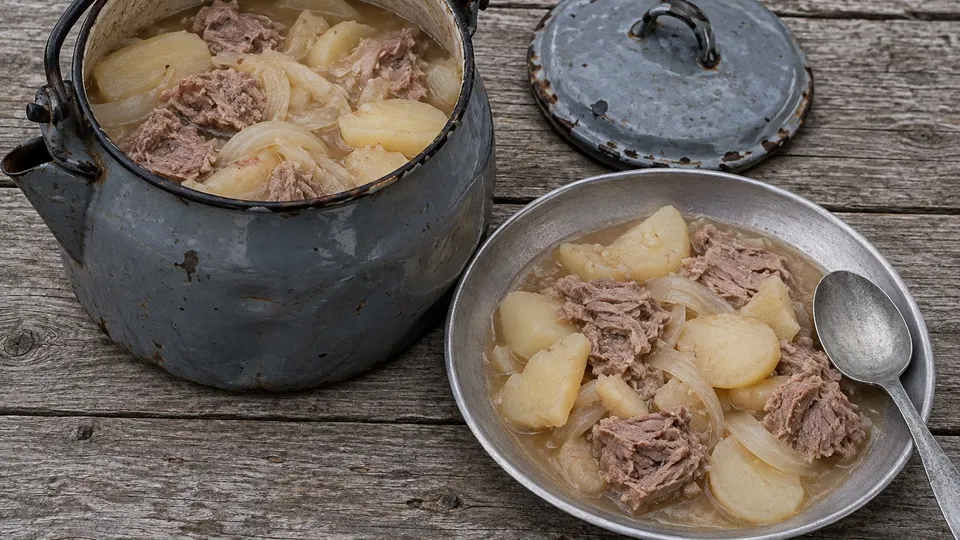 Cook it todayStew with Canned Meat (1896)
Sources
- Report of the Commission Appointed by the President to Investigate the Conduct of the War Department in the War with Spain, Senate Document 221, 56th Congress, 1st session (Washington: Government Printing Office, 1900), vol. 1, pp. 104, 155–159, 163–166. Internet Archive (opens in a new tab).
- The same report, vol. 7, General Nelson A. Miles’s statement of December 21, 1898, pp. 3240, 3256–3258, and Brig. Gen. Charles P. Eagan’s statement of January 12, 1899, pp. 3564–3568. Internet Archive (opens in a new tab).
- War Department, Manual for Army Cooks (Washington: Government Printing Office, 1896), pp. 50, 196–197, 257, 261, 265. Internet Archive (opens in a new tab).
- Mary C. Gillett, The Army Medical Department, 1865–1917 (Washington: Center of Military History, United States Army, 1995), p. 151.