Salt Pork and Hard Bread (1896)
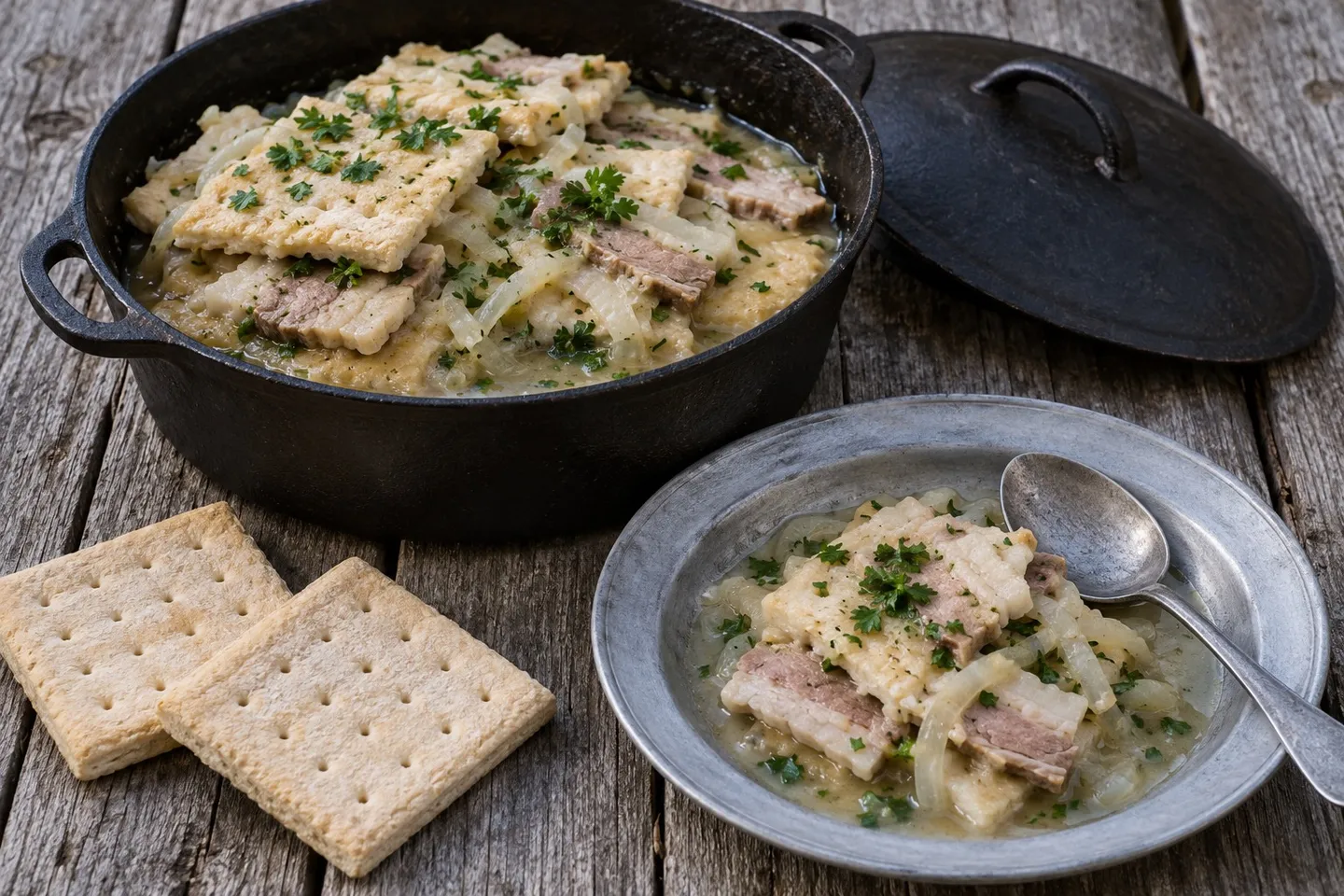
Reader ratingsSalt pork and hard bread from the field-cooking pages of the War Department’s 1896 Manual for Army Cooks: hardtack soaked soft and layered in a pot with boiled salt pork, onions and parsley, then stewed gently.
- Recipe makes
- 4 servings
- Prep
- Cook
- Total
The hardtack soaks for an hour while the pork boils, so start both together. The layered pot then cooks gently for 1 hour 15 minutes.
Salt pork and hardtack stew with onion.
The story behind the recipe
What is hard bread?
Hard bread, better known as hardtack, is a square biscuit of flour and water, and the army’s 1896 ration table lists sixteen ounces of it as an alternative to eighteen ounces of soft bread. Eaten dry it is close to rock, so cooks soaked it. The War Department’s Manual for Army Cooks, printed in 1896, a generation after Fort Larned’s bakery and eighteen years after the post closed, puts this dish among its recipes for camp cookery, made with a camp kettle and not much else: hard bread soaked for an hour, then layered in the kettle with slices of boiled salt pork, onions, parsley and pepper, covered with water and cooked “gently over a slow fire.”
Read more about this recipe
How did army cooks make salt pork and hardtack?
The manual gives two ways. The first is the layered pot made here. The second soaks the hard bread for two hours, squeezes it dry, mixes it with minced pork, onion and parsley, and rolls it into balls to simmer. Both, it adds, can be cooked between two camp kettle lids with “a few live embers underneath and on the top.”
Making it today
If you can’t find hardtack, plain unsalted crackers are a softer stand-in. The manual says only to “wash, clean, and boil the pork”, with no time, so we simmer it for half an hour in fresh water, enough to cook it through and take off some of the salt. The hard bread swells and softens in the pot and thickens the liquid, so the dish comes out between a stew and a savory pudding.
It stands for the soldier’s bread away from the oven in How Was Bread Baked at a Frontier Fort?.
Meat. Onions. Pepper. Hard bread. Parsley. Water.
(a) Soak the hard bread in cold water for one hour; wash, clean, and boil the pork; drain the water off the hard bread, and cut up the pork into thin slices; peel and slice the onions, wash and chop up the parsley; pour a little water into the camp kettle; place a layer of the slices of pork at the bottom of the kettle, with some onions, parsley, and pepper, then a layer of the soaked hard bread on top, then another layer of pork, and so on alternately, until the kettle is nearly full. Cover the whole with water, and cook gently over a slow fire for one hour and fifteen minutes, and serve.
(b) Treat the pork, onions, parsley, as in (a); soak the hard bread for two hours, then squeeze it dry; mince up the pork and mix it with the hard bread, onions, parsley, and pepper; then roll it into balls, and place them in a camp kettle with sufficient water to cover, and cook gently over a slow fire for one hour, and serve.
These recipes can also be prepared in the camp kettle lids, by placing the layers of pork and hard bread or balls in one camp kettle lid, and covering it with another, and placing a few live embers underneath and on the top of the lids.
Recipe makes: 4 servings
Ingredients
For 4 servings. Quantities are shown as written.
Quantities as written here, for 4 servings.
- Hardtack, or plain unsalted crackers8 oz
- Salt pork, rind removed8 oz
- Medium onions, thinly sliced2
- Chopped parsley1/4 cup
- Black pepper1/2 tsp
- Water, or as needed3 cups
Measurement notes
Ingredients as written here
- 8 oz hardtack, or plain unsalted crackers
- 8 oz salt pork, rind removed
- 2 medium onions, thinly sliced
- ¼ cup chopped parsley
- ½ tsp black pepper
- 3 cups water, or as needed
Equipment
 Medium saucepan
 Large bowl
 Colander
- Heavy 4-quart pot or Dutch oven with a lid
Instructions
Break the hardtack into pieces about 2 inches across, put them in the bowl, cover with cold water and leave to soak for 1 hour. If you are using crackers, skip the soak: dip them in cold water just before you layer them, so they hold together in the pot.
Meanwhile, rinse the salt pork, put it in the saucepan, cover with cold water and bring to a boil. Lower the heat and simmer for 30 minutes. Drain and let it cool a little, then cut it into thin slices.
Drain the hardtack in the colander.
Pour a little of the water into the heavy pot. Lay in a third of the pork slices, scatter over some of the onions, parsley and pepper, and cover with a layer of hardtack. Repeat the layers, finishing with hardtack.
Pour in enough of the remaining water to just cover. Bring to a simmer, cover the pot, and cook over low heat for 1 hour 15 minutes, until the onions are soft and the hardtack is swollen and tender. Check now and then and add a little water if it is drying out.
Serve hot in bowls, with some of the liquid.
Nutrition
665calories per serving
- Recipe makes
- 4 servings
- Servings
- 4
Estimated per serving from USDA FoodData Central values for the listed ingredients.
Recipe notes
When adjusting quantities
Two ounces of hardtack and two ounces of salt pork to each serving.
Notes
Quantities mentioned in these notes don’t change when you adjust the servings.
Taste before serving; with salt pork it will need no added salt. Very hard, old hardtack may need two hours’ soaking, as in the manual’s second method. Crackers soften far faster than hardtack; dipping them instead of soaking them is our choice, and the dish comes out softer and more like a savory pudding. The same manual turns dry bread into a Baked Bread Pudding (1896), and on the same page lets hard bread stand in for crackers in its cracker pudding. Contains wheat.
Scaling changes the ingredients only; pan sizes and cooking times need their own judgment. To adapt this recipe further, try the recipe tool at TuneMyRecipe (opens in a new tab), our sister site.


Sources and attribution
After War Department, Manual for Army Cooks (Washington: Government Printing Office, 1896), Salt Pork and Hard Bread
Recipe details
- Course
- Main course
- Dish family
- Meat & Poultry
- Region
- American
- Era
- 19th century
- Source decade
- 1890s
- Main ingredient
- Pork & ham
- Difficulty
- Easy
- Occasion
- Everyday meal