An inspector reports on Fort Larned’s bakery · Fort Larned, Kansas
How Was Bread Baked at a Frontier Fort?
One brick oven, two soldier bakers and an army rule that the bread be cold: how Fort Larned on the Santa Fe Trail baked its bread in the 1860s.
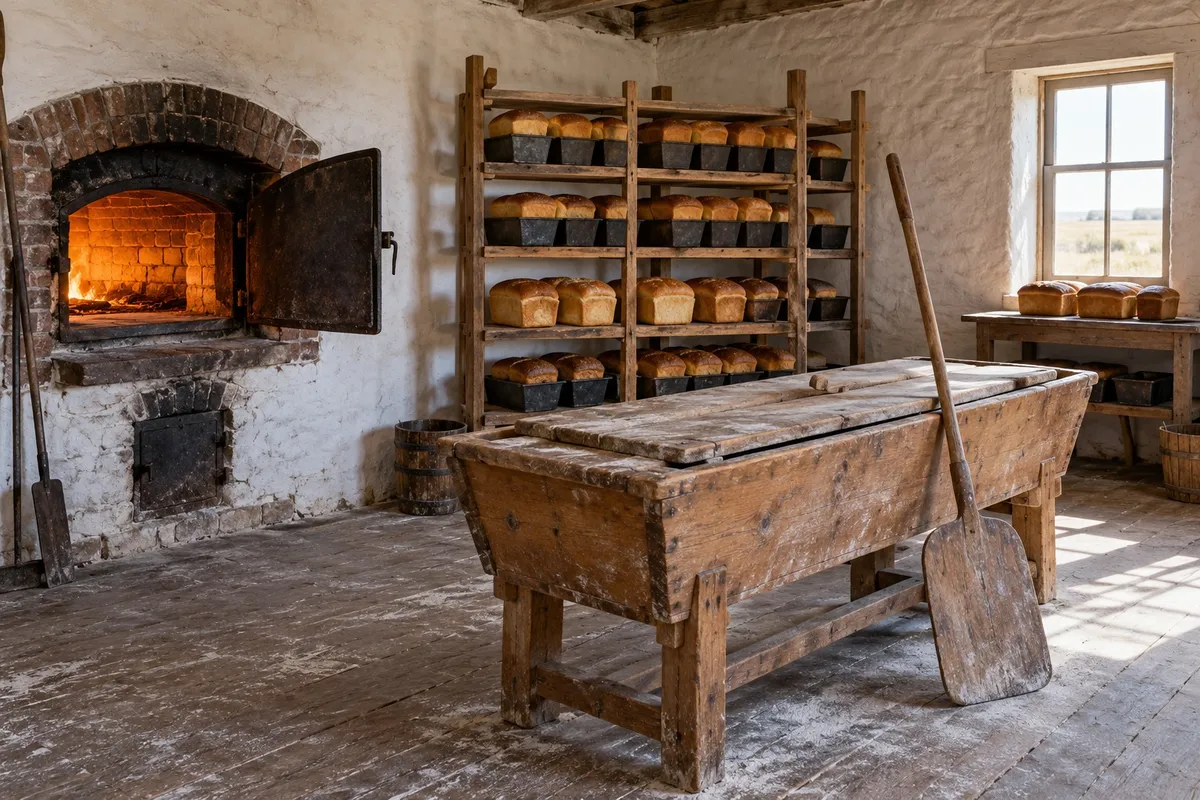
At Fort Larned in Kansas, bread was baked in one big brick oven, usually kept fired seven days a week by enlisted men detailed from the companies. The oven could take 340 loaves at a time, and when they came out the army’s rule was that nobody ate them until they were cold. No recipe from the post survives, but an army baker’s method printed in 1862 shows the work such a bakery did: a ferment of potatoes and yeast set the night before, a long rise, and about fifty minutes in the oven.
On the Pawnee Fork
The army set up camp on the Pawnee Fork in October 1859 to guard traffic on the Santa Fe Trail, and in June 1860 the post became Fort Larned. It was also the headquarters and main annuity post of the Indian Bureau for the Central Plains nations, and on April 12, 1867 General Winfield Scott Hancock met Cheyenne chiefs there before the campaign that became Hancock’s War. By early 1868 most of its sod and adobe buildings had given way to sandstone. Before then the bake house had been dug into the creek bank, much like a field oven. The new one stood at the end of a long shop building that also held the blacksmith, the wheelwright and the saddler.
An inspector’s report of April 30, 1868 judged it well: “The bakery is large and ample to supply 500 men.” The post surgeon’s medical history, which the Park Service’s furnishing study dates to 1869, gave the room as 27 by 18 feet with 12-foot ceilings and “one large oven of sufficient capacity to bake 340 loaves of bread at one time.” The Park Service puts the 1868 garrison at about 275 soldiers and reckons that meant at least 275 loaves a day.
Not eaten until it is cold
The rule that governed the bread was printed in the army’s regulations of 1861, among the paragraphs on soldiers’ messes: “The bread must be thoroughly baked, and not eaten until it is cold.” The same paragraph orders soup boiled at least five hours and vegetables cooked until “perfectly soft and digestible.” It was a rule about food the officers inspected every day, and it set no time.
The National Park Service tells visitors that army regulations required bread at least two days old, and that company cooks at Larned were handed bread baked two days before, because fresh bread was thought bad for the men. The 1861 regulations say cold, not two days old, and no dated order for a two-day wait has been found.
A night and a day
The method comes from a Union officer’s handbook of 1862. Captain James M. Sanderson’s Camp Fires and Camp Cooking, issued to the troops by the Government Printing Office, gives a “receipt written by a practical baker,” Frank M. Lockwood of the 23rd New York Volunteers, for a portable field oven.
His bread took more than a day from fresh yeast. First came yeast, made with hops and cracked malt and left for fifteen hours. Then the “ferment”: potatoes boiled in their skins, mashed with flour, thinned with warm water and yeast, and left overnight in tubs. In the morning a barrel and a half of flour went into the trough with salt, the ferment and hot water, and the dough was kneaded, left to prove for at least two hours, weighed out into loaves and left again for forty minutes. Meanwhile the oven was fired, the coals and ashes drawn out and the inside swabbed. “Fifty minutes is the time generally required to bake the regular sized army loaves.”
That batch made 288 loaves. A barrel of flour held 196 pounds, so each loaf took about a pound of flour. Larned’s masonry oven was a different machine from Lockwood’s portable one, and his is a camp method from the war years, but the stages are the ones any yeast bakery of the 1860s had to work through: the ferment, the rise, the oven, and the cooling the regulations asked for.
The bakers
At Larned the bakers were enlisted men, detailed daily from the companies. The surgeon’s 1869 entry names “one chief and one assistant baker, detailed from among the men of the companies.” According to the Park Service’s 1969 history of the buildings, skill at baking wasn’t a qualification until the 1880s, and the work went on all week. Lockwood’s method needed three men at the shaping stage alone: one to weigh, one to mold and one to pan the loaves.
The bakery also earned money. Companies could sell the part of their flour allowance they didn’t use, and the money went to the company fund for vegetables, crockery, newspapers, even a cow or some pigs. Anyone at the post who drew no army ration could buy bread, and those receipts went to the post fund, which went on such things as instruments for the band or books for the library.
Beans, bacon and hard bread
The bread went to the company kitchens to sit beside the rest of the ration, which the Park Service lists as beef, beans, bacon, coffee and bread. Sanderson’s book gives the company’s bean soup in two kettles, salt pork boiled separately and served “with a slice of pork, in a separate dish,” and half the beans kept back to be warmed up for breakfast “with bread and coffee.” His pork soup with vegetables used up stale bread too, three or four loaves cut into squares and divided among the kettles.
Away from the oven, the soldier’s bread was hard bread, a hard, square biscuit of flour and water better known as hardtack. The War Department’s Manual for Army Cooks of 1896 shows what a cook could do with it: soak it, layer it in the camp kettle with boiled salt pork, onions and parsley, and stew it. The same manual turns dry bread into a baked pudding and gives a plain corn bread that could be “Eaten either warm or cold.” It is a generation later than Larned’s bakery, which closed with the post in 1878, but it is the army’s own kitchen book.
The recipes
The four recipes come from two army books, one from the war years and one from 1896. None comes from Fort Larned itself. In those war years bread ran short on the other side too, and the bread riot in Richmond in 1863 shows what the Confederate capital’s kitchens made do with.
- Army Potato Bread (1862): Lockwood’s method cut down to one army-size loaf, with an overnight potato ferment.
- Pork and Bean Soup (1862): Sanderson’s company bean soup, mashed, with boiled salt pork on the side.
- Salt Pork and Hard Bread (1896): the field cook’s way with hardtack, layered and stewed.
- Baked Bread Pudding (1896): dry bread crumbs, milk and eggs, baked to a brown.
Cooking it
Start the Army Potato Bread (1862) the evening before, the way Lockwood did, with the potato ferment left to work overnight. Bake it in the morning, and then do as the 1861 regulations say: leave it on the rack until it is cold before you cut it. The 1862 bread and bean soup sit among our Civil War recipes. What the frontier drank with its bread is on Forgotten Drink, our sister site: the drinks of a Wild West saloon (opens in a new tab), from whiskey at two bits a glass to black coffee on the trail.
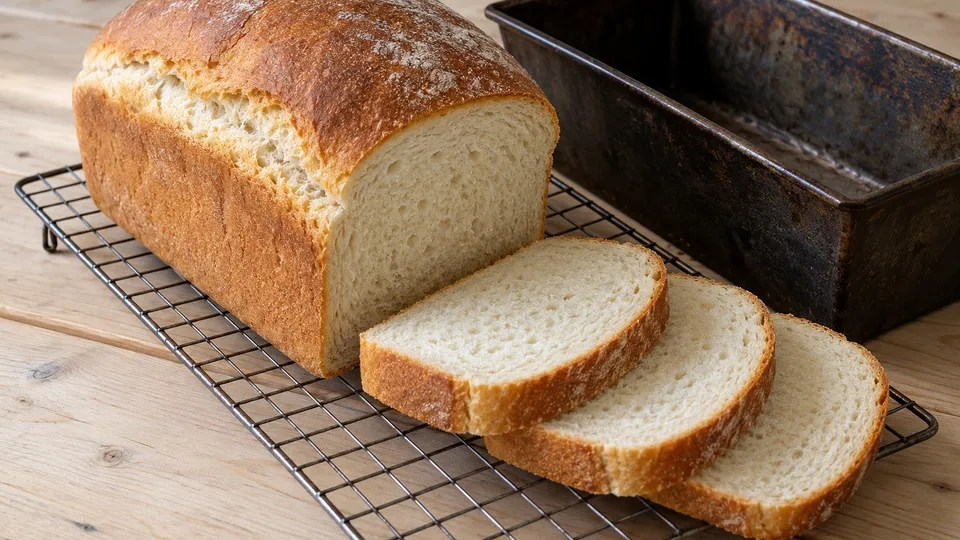 Cook it todayArmy Potato Bread (1862)
Sources
- Revised Regulations for the Army of the United States, 1861 (Philadelphia, 1862), paragraphs 116 and 117, p. 23 (Wellcome Collection (opens in a new tab)).
- James M. Sanderson, Camp Fires and Camp Cooking; or, Culinary Hints for the Soldier (Washington: Government Printing Office, 1862), pp. 6 to 8, 12 to 14.
- War Department, Manual for Army Cooks (Washington: Government Printing Office, 1896), pp. 160 to 161, 181, 267.
- James W. Sheire, Fort Larned National Historic Site: Historic Structures Report, Part II (National Park Service, 1969), chapter 2 (online (opens in a new tab)) and pp. 56, 58, 60 (PDF (opens in a new tab)).
- John Albright and Douglas D. Scott, Historic Furnishing Study, Fort Larned (National Park Service, 1974), pp. 85 to 86 (PDF (opens in a new tab)).
- “Fort Larned Bakery (opens in a new tab),” National Park Service.
- “Kansas: Fort Larned National Historic Site (opens in a new tab),” National Park Service, and “Hancock’s War (opens in a new tab),” Fort Larned National Historic Site.
- “Barrel,” Webster’s Revised Unabridged Dictionary (Springfield, Mass.: G. & C. Merriam, 1913): “A barrel of flour is 196 pounds.”