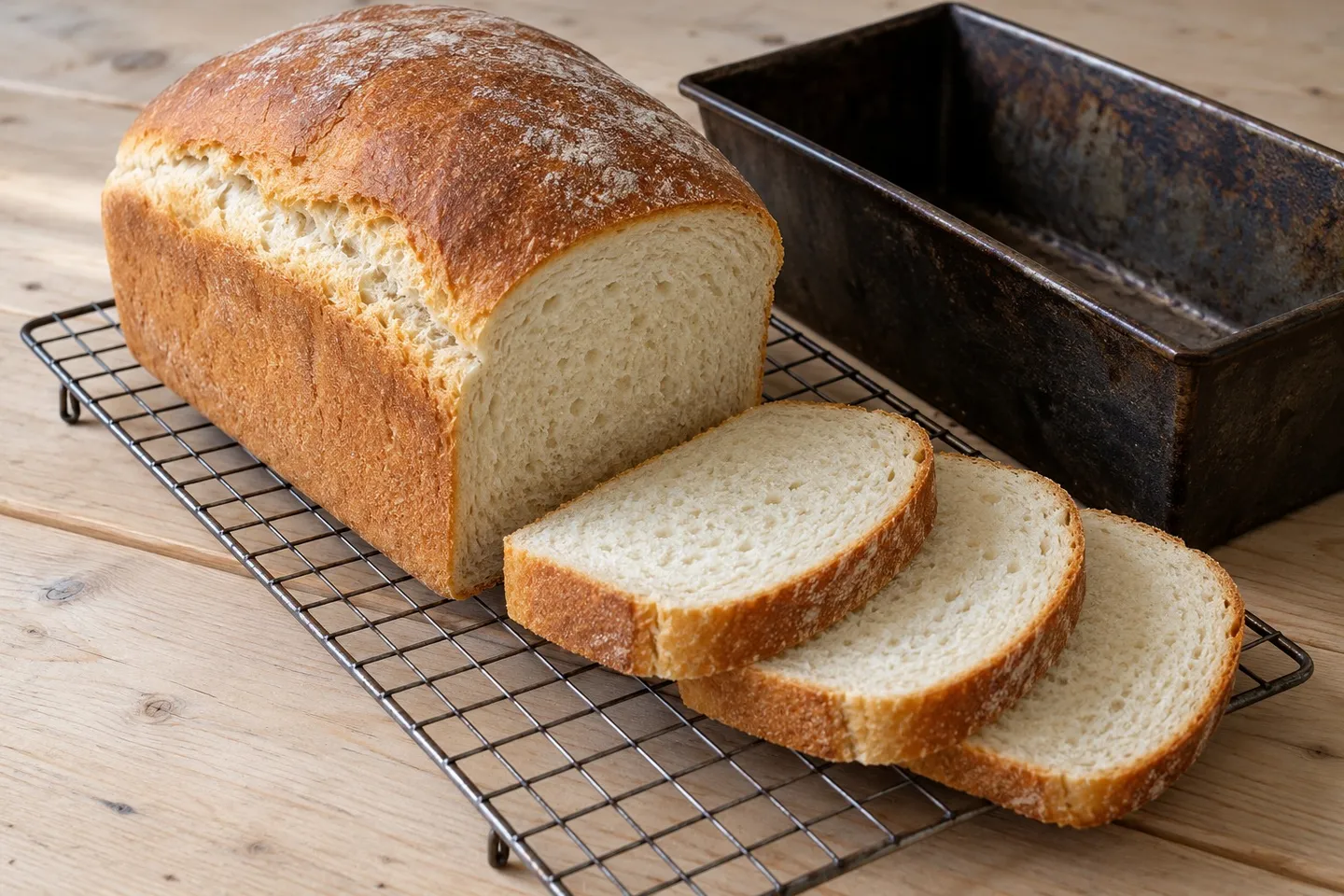
Army Potato Bread (1862)
Reader ratingsArmy potato bread from Captain Sanderson’s 1862 handbook for the troops: a one-pound loaf raised on an overnight ferment of potatoes, flour and yeast, cut down from an army baker’s method.
- Recipe makes
- 1 large loaf, about 16 slices
- Prep
- Cook
- Total
Start the ferment the evening before; it works for 10 to 15 hours. Next day allow about 3 hours for kneading, two rises and baking, then at least 2 hours for the loaf to cool.
Army potato bread, a plain pan loaf, sliced.
The story behind the recipe
Lockwood’s bread is a plain wheat loaf with no sugar and no fat, raised slowly on a ferment of potatoes, flour and yeast that works overnight. The recipe comes from Camp Fires and Camp Cooking, a small handbook that Captain James M. Sanderson wrote in 1862 and the Government Printing Office issued to the troops. No recipe from Fort Larned’s bakery survives; this one was printed six years before the 1868 inspection, for a portable field oven. Most regiments had a baker or two among the men, Sanderson wrote, but in case one didn’t, he printed a method “written by a practical baker,” Frank M. Lockwood of the 23rd New York Volunteers.
Three batches of 288
Lockwood worked for a regiment, with a portable “Shiras oven” that the commissary handed out. His yeast was home-brewed from hops and cracked malt, and his ferment began with “a peck and a half of potatoes, with their skins on,” boiled and mashed with six pounds of flour, then left in a tub through the night. In the morning a barrel and a half of flour went into the dough trough for one batch of 288 loaves, about a pound of flour to each loaf, and the night’s ferment was enough for three such batches. The loaves baked for fifty minutes.
Read more about this recipe
Making it today
We bake one of those army loaves. Lockwood’s potatoes were there to feed the yeast, and at his scale there was well under an ounce of potato in each loaf. A one-loaf ferment needs more to work on, so ours has several times his share, raised overnight on a pinch of dried yeast in place of his hop yeast. His salt comes to a little over one percent of the flour, and we keep it. A 9 by 5 inch pan holds the loaf; Lockwood’s loaves went into the oven in pans too.
The army’s own rule was that bread was “not eaten until it is cold,” and the loaf slices more cleanly if you keep to it. Fort Larned’s bakery and the army’s cold-bread rule are the subject of How Was Bread Baked at a Frontier Fort?.
The first process is to prepare the ferment. This is formed by boiling thoroughly a peck and a half of potatoes, with their skins on, ...
Recipe makes: 1 large loaf, about 16 slices
Ingredients
For 1 large loaf, about 16 slices. Quantities are shown as written.
Quantities as written here, for 1 large loaf, about 16 slices.
Potato ferment
- Russet potato, unpeeled3 oz
- All-purpose flour for the ferment2 tbsp
- Warm water for the ferment1 cup
- Active dry yeast1/4 tsp
Dough
- Bread flour1 lb
- Table salt1 tsp
- Warm water for the dough, or as needed1/4 cup
- Neutral oil for the bowl and pan1 tsp
Measurement notes
Ingredients as written here
- 3 oz russet potato, unpeeled
- 2 tbsp all-purpose flour for the ferment
- 1 cup warm water for the ferment
- ¼ tsp active dry yeast
- 1 lb bread flour
- 1 tsp table salt
- ¼ cup warm water for the dough, or as needed
- 1 tsp neutral oil for the bowl and pan
Equipment
 Small saucepan
- Potato masher or fork
- Large mixing bowl and a medium bowl
 Fine sieve
- 9 by 5 inch loaf pan, greased
- Wire rack
 Instant-read thermometer
Instructions
The evening before, put the potato in the saucepan, cover with water and boil for 20 to 25 minutes, until soft right through. Drain, let it cool until you can handle it, and mash it, skin and all, in the medium bowl with the flour for the ferment.
Stir in the warm water for the ferment, then the yeast. The mixture should feel just warm to a finger. Cover the bowl and leave it at room temperature, about 70°F (21°C), for 10 to 15 hours, until it is frothy and smells of yeast.
In the morning, pour the ferment through the sieve into the large bowl, pressing the potato through and leaving the skins behind.
Add the bread flour and salt and mix to a rough dough, adding the warm water for the dough a spoonful at a time until no dry flour is left. Knead on the counter for 10 minutes, until smooth and springy.
Oil the bowl with some of the oil, put the dough back, cover and leave in a warm place for about 2 hours, until doubled.
Press the dough flat, roll it up into a loaf and put it seam side down in the oiled pan. Cover and leave for 40 to 60 minutes, until it has risen about an inch above the rim. Heat the oven to 375°F (190°C) while it rises.
Bake for 40 to 45 minutes, until the crust is deep golden, the loaf sounds hollow when tapped underneath, and the middle reads 190 to 200°F (88 to 95°C).
Turn the loaf out onto the rack and leave it until it is completely cold, at least 2 hours, before cutting.
Nutrition
110calories per serving
- Recipe makes
- 1 large loaf, about 16 slices
- Servings
- 16
Estimated per slice (16) from USDA FoodData Central values for the listed ingredients.
Recipe notes
When adjusting quantities
One pound of flour makes one loaf, as in the army’s batch; for two loaves, use two pans.
Notes
Quantities mentioned in these notes don’t change when you adjust the servings.
One small russet potato is about 3 oz, and a pound of bread flour is about 3½ cups. The ferment is the slow part, and in a cool kitchen it may need the full 15 hours. If it hasn’t frothed by morning, set it somewhere warmer for an hour. The bread keeps for 3 or 4 days wrapped in a cloth, and stale slices go into the Baked Bread Pudding (1896). Contains wheat.
Scaling changes the ingredients only; pan sizes and cooking times need their own judgment. To adapt this recipe further, try the recipe tool at TuneMyRecipe (opens in a new tab), our sister site.
Sources and attribution
After Frank M. Lockwood’s method in James M. Sanderson, Camp Fires and Camp Cooking (Washington: Government Printing Office, 1862)
Recipe details
- Course
- Bread & baking
- Dish family
- Breads & Cakes
- Region
- American
- Era
- 19th century
- Source decade
- 1860s
- Difficulty
- Intermediate
- Occasion
- Everyday meal