Richmond Bread Riot · Richmond, Virginia
What Was Richmond Cooking in the Year of the Bread Riot?
In April 1863 hungry women marched through Richmond. A receipt book printed in the city that year shows how its kitchens were told to make do.
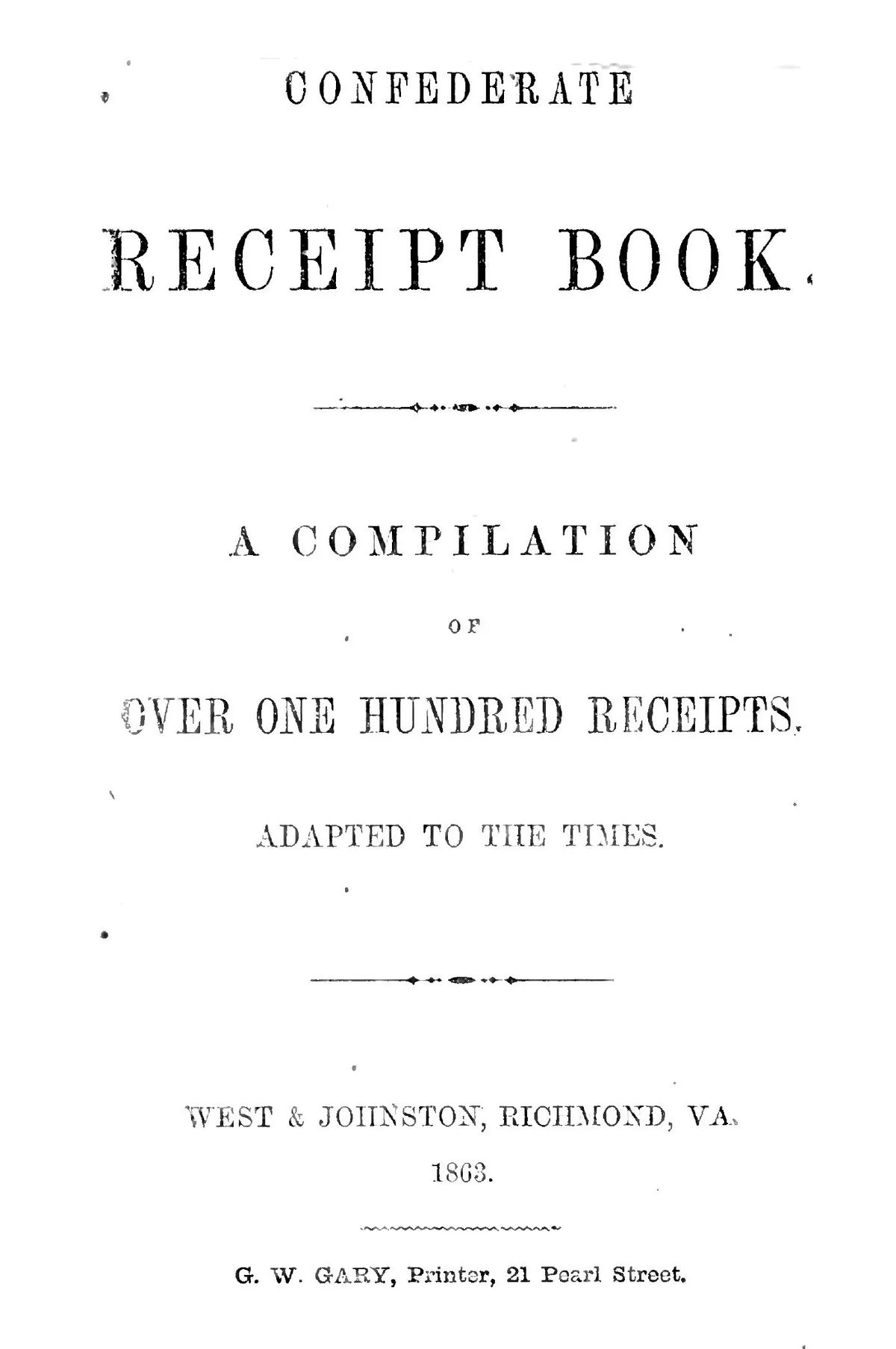
Less than it needed, and at prices it could not pay. By the spring of 1863 Richmond, the Confederate capital, struggled to get food into the city at all, and prices were almost ten times what they had been in 1861. On April 2 that shortage brought hundreds of people, led by women, into the streets. The same year a Richmond publisher printed the Confederate Receipt Book, “adapted to the times,” and its pages show how the city’s kitchens were told to make do: rice flour to stretch the wheat, boiled potato in the pie crust, and soaked crackers where there were no apples.
The riot
On April 1, a group of women, among them workers in the Confederate ordnance shops and wives of men at the Tredegar Iron Works, met at Belvidere Hill Baptist Church in the Oregon Hill neighborhood. Led by Mary Jackson and Minerva Meredith, they agreed to take their case to Governor John Letcher at Capitol Square the next day.
When the governor would not see them, the crowd turned toward the business district. J. B. Jones, a clerk in the War Department who kept a diary through the war, watched it go by. “Not knowing the meaning of such a procession, I asked a pale boy where they were going,” he wrote that afternoon. “A young woman, seemingly emaciated, but yet with a smile,” answered instead: they were going to find something to eat. Jones said he hoped they would, and remarked that they were heading the right way “to find plenty in the hands of the extortioners,” his word for the dealers he blamed for the prices.
Government warehouses, grocers and other stores were broken into, and food, clothing and shoes carried off. By Jones’s account, the crowd emptied the stores of the speculators first and then moved on to the shops on Main Street, where it wanted silks and jewelry. Mayor Joseph Mayo read the Riot Act, which the crowd ignored. Jefferson Davis came to the scene, and accounts differ on what he said and who threatened to fire. Jones recorded that the President told the crowd he “was willing to share his last loaf with the suffering people” and asked it to go home. It was over in about two hours, and more than sixty people were arrested. By three o’clock, Jones wrote, the city was quiet, and he understood that the government was handing out rice.
The Secretary of War, James Seddon, asked Richmond’s papers not to report it, fearing what the North would make of it. The Richmond Examiner reported the trials anyway. Its April 4 account of the Mayor’s Court, which sat the day after the riot, is one of the fullest records of what people took. One witness described “a dray load of flour and bacon, which they had taken during the riot.” At a grocery, another witness said, “two of the boys had a pot of butter each.” Another man carried off “a lard firkin full of coffee.” A police officer told the court that Mary Jackson had said “she would have bread or blood.” Hearing the case of another woman, Mary Elizabeth Foy, the Mayor insisted the riot “was not for bread,” and went on: “Boots are not bread, brooms are not bread.”
Why there was so little
Encyclopedia Virginia sets out the causes. Inflation outran wages. A new impressment law and heavy taxes pushed farmers and merchants to hold back food. More than 100,000 people were crowded into Richmond, and rents were high. The winter of 1862 to 1863 brought more than twenty measurable snowfalls, and thaws turned the roads to mud, so food and firewood could hardly reach the city.
The Richmond Dispatch, which reported the markets almost daily, shows what that meant at the stalls. On March 3 it found the city markets nearly empty of the supplies people were used to buying there, with butchers keeping their stalls shut because they could get no cattle. It blamed the mud and expected the country carts back once the roads dried. A week later the weather, “or some other cause,” was still keeping beef and every other food from the markets. Everything to eat fetched the highest prices, and fifteen butchers’ stalls in the Second Market stood closed for want of anything to sell.
Even food that did reach the city was priced out of reach. Two days after the riot, the Richmond Dispatch reported that fresh butter was “coming in very freely now, but is sold outrageously high.”
The book printed that year
The Confederate Receipt Book is a thin pamphlet, printed by G. W. Gary for the Richmond publishers West & Johnston. Its publishers explain that they collected “many valuable receipts which have appeared in the Southern newspapers since the commencement of the war,” all of them “designed to supply useful and economical directions and suggestions in cookery, housewifery, &c., and for the camp.”
A good deal of it offers replacements. There is a substitute for coffee made from roasted acorns, a substitute for cream in coffee made from egg white and butter, and a paste for pies that replaces a third of the wheat flour with boiled potato. The appendix reprints a set of rice-flour recipes that a reader had sent to a Georgia newspaper in 1862, and most of them put rice flour where wheat would usually go.
The rest reads like a list of what Richmond was running short of. One receipt opens by saying that salt is a relish but no necessity for keeping meat, and goes on to dry beef in slices in the sun, over a fire of rotten wood, in a hut with an open top for the smoke; slices an inch thick, it says, cure in a day. The next cures bacon with little salt. Vinegar comes from molasses and warm water left in a jug for two months. The acorns for the coffee are parched until they open, shelled and roasted in a little bacon fat. For beef too tough to chew, steaks are rubbed with soda the night before. And there is a test for the flour itself: knead a pinch, and good flour should form a smooth, stretchy paste that takes any shape without breaking.
Rice runs through the book’s last pages, and it was rice that the government handed out on the afternoon of the riot. Nothing in the book says who cooked from it, or whether any of the women arrested on April 2 owned a copy.
The recipes
Four recipes from the Confederate Receipt Book, each adapted for a modern kitchen.
- Rice Bread (1863): a loaf that stretches wheat flour with a cooked rice-flour paste.
- Artificial Oysters (1863): grated green corn fritters, fried a spoonful at a time.
- Apple Pie without Apples (1863): soaked crackers, sharpened with tartaric acid, in a potato pastry.
- Rice Flour Blancmange (1863): milk set with rice flour and scented with rose water.
Making do, on paper
So the answer to what Richmond was cooking is less bread than before, made to go further, and a printed set of ways to stretch it. The advice did not stop at the stove. A few lines after the last rice recipe, the book turns to “Hints for the Ladies” and explains how a dress that is soiled or worn at the hem can be made “to look very well at very small expense,” with a new band of alpaca. Elsewhere it gives directions for soap, candles and ink, and home cures for croup, burns and toothache.
The bread is the place to begin, since bread is what the riot is named for. The rice paste for the Rice Bread (1863) has to cool for most of an hour before the yeast goes in, so make it first and let it stand while you weigh the wheat flour. The rice bread and the other substitutes are part of our Civil War recipes. Two years after the riot, Union troops entered Richmond four weeks after Lincoln’s second inaugural ball. The acorn coffee of the receipt book had a London cousin, and Forgotten Drink, our sister site, explains why Victorians put chicory in their coffee (opens in a new tab).
 Cook it todayRice Bread (1863)
Sources
- Mary DeCredico, “Richmond Bread Riot (opens in a new tab),” Encyclopedia Virginia, Virginia Humanities, updated September 12, 2025.
- “Mayor’s Court,” Richmond Examiner, April 4, 1863, p. 1, transcribed at mdgorman.com (opens in a new tab).
- Richmond Dispatch, April 4, 1863, p. 1, transcribed at Civil War Richmond (opens in a new tab).
- J. B. Jones, A Rebel War Clerk’s Diary at the Confederate States Capital, vol. 1 (Philadelphia: J. B. Lippincott, 1866), pp. 284–286, entry for April 2, 1863.
- “The Markets,” Richmond Dispatch, March 3, 1863 (opens in a new tab), p. 1, and March 11, 1863 (opens in a new tab), p. 1, transcribed at Civil War Richmond.
- Confederate Receipt Book: A Compilation of Over One Hundred Receipts, Adapted to the Times (Richmond: West & Johnston, 1863).