Apple Pie without Apples (1863)
Reader ratingsAn apple pie without apples from the Confederate Receipt Book of 1863: soaked crackers sharpened with tartaric acid, butter and nutmeg, in the same book’s potato pastry.
- Recipe makes
- 1 pie, 9 inches, serving 8
- Prep
- Cook
- Total
The potato boils for about 20 minutes and must cool, the pastry chills for 30 minutes, the pie bakes for about 35 minutes, and it needs two hours to cool and set before slicing.
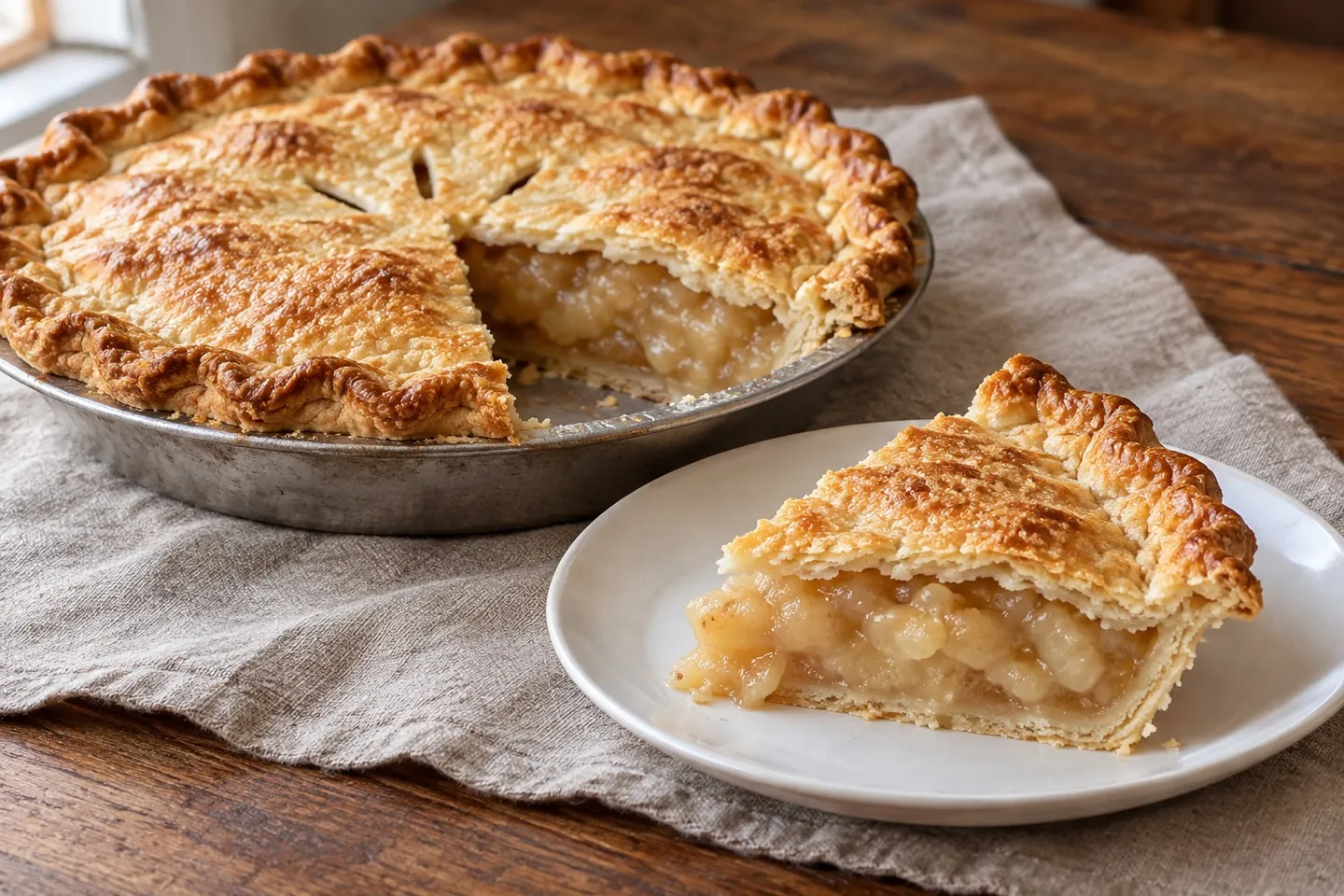
Apple pie without apples, a double-crust cracker pie, with one slice cut.
The story behind the recipe
Soaked crackers, sugar, butter and nutmeg make the filling of this mock apple pie, and a teaspoon of tartaric acid stands in for the sharpness of the fruit. The recipe takes four lines on page 7 of the Confederate Receipt Book, directly under a pastry made partly from potatoes.
Why did Confederate cooks make apple pie without apples?
The book’s publishers say they gathered receipts “which have appeared in the Southern newspapers since the commencement of the war.” Crackers keep for months, and apples have a season. The page offers two thrifty crusts just above the pie: a “Potato Crust” of mashed potato worked with flour, and a “Paste for Pies” that replaces a third of the wheat flour with “the flour of boiled potatoes,” with butter or dripping and warm water. We pair the pie with the second, since it sits right above.
The book doesn’t say whether to use one crust or two, how hot to bake it, or for how long. We make it as a double-crust pie, which hides the filling as an apple pie would, and bake it as modern mock apple pies are baked. The shortages that made advice like this worth printing are set out in What Was Richmond Cooking in the Year of the Bread Riot?
Read more about this recipe
Making it today
Use plain, unsalted crackers, such as water crackers or unsalted saltines. Buttery crackers came in with the twentieth-century versions of this pie. Tartaric acid is sold for baking and winemaking; most modern mock apple pies use cream of tartar, while this book names the acid itself.
The book says to “sweeten to your taste” and add “some butter.” Our amounts are a starting point, and the filling can take more sugar if it is too sharp. The next recipe in the book, Artificial Oysters (1863), makes its savory point with grated green corn.
APPLE PIE WITHOUT APPLES.—To one small bowl of crackers, that have been soaked until no hard parts remain, add one teaspoonful of tartaric acid, sweeten to your taste, add some butter, and a very little nutmeg.
PASTE FOR PIES.—Excellent paste for fruit or meat pies may be made with two-thirds of wheat flour, one-third of the flour of boiled potatoes, and some butter or dripping, the whole being brought to a proper consistence with warm water, and a small quantity of yeast added when lightness is desired. This will also make palateable cakes for breakfast, and may be made with or without spices, fruit, &c.
Recipe makes: 1 pie, 9 inches, serving 8
Ingredients
For 1 pie, 9 inches, serving 8. Quantities are shown as written.
Quantities as written here, for 1 pie, 9 inches, serving 8.
Potato pastry
- Medium potato1Author measures: about 6 oz.
- All-purpose flour8 oz
- Salt1/2 tsp
- Cold butter4 oz
- Warm water3 tbsp
Filling
- Plain unsalted crackers6 oz
- Cold water24 fl oz
- Tartaric acid1 tsp
- Water for the acid1 tbsp
- Sugar6 oz
- Butter for the filling1.5 oz
- Ground nutmeg1/8 tsp
Measurement notes
Ingredients as written here
- 1 medium potato (about 6 oz)
- 8 oz all-purpose flour
- 0.5 tsp salt
- 4 oz cold butter
- 3 tbsp warm water
- 6 oz plain unsalted crackers
- 24 fl oz cold water
- 1 tsp tartaric acid
- 1 tbsp water for the acid
- 6 oz sugar
- 1.5 oz butter for the filling
- 0.125 tsp ground nutmeg
Equipment
 Small saucepan
- Potato ricer or masher
- Mixing bowls
- Rolling pin
- 9-inch pie plate
Instructions
Peel the potato, cut it in chunks and boil in unsalted water until very tender, about 20 minutes. Drain, press through a ricer or mash until completely smooth, and leave to cool.
Mix the flour and salt in a bowl. Rub in the cold butter until the mixture looks like coarse crumbs.
Work in the cooled potato, then add the warm water a spoonful at a time, until the pastry holds together. Divide in two, wrap and chill for 30 minutes.
Break the crackers into pieces in a bowl, pour over the cold water and leave for about 15 minutes, until they are soft all the way through with no hard parts left. Tip off any water that hasn’t been absorbed.
Dissolve the tartaric acid in the water for the acid and stir it into the crackers with the sugar, butter for the filling, cut small, and the nutmeg. Taste, and add more sugar if you like.
Heat the oven to 425°F (220°C).
Roll out half the pastry and line the pie plate. Spoon in the filling. Roll out the rest, lay it over the top, trim and crimp the edges, and cut two or three slits in the top.
Bake for 30 to 35 minutes, until the crust is crisp and golden brown.
Leave to cool for at least 2 hours before slicing, so the filling sets.
Nutrition
430calories per serving
- Recipe makes
- 1 pie, 9 inches, serving 8
- Servings
- 8
Estimated per serving from USDA FoodData Central values for the listed ingredients.
Recipe notes
When adjusting quantities
Makes one 9-inch double-crust pie. The pastry and filling scale together.
Notes
Quantities mentioned in these notes don’t change when you adjust the servings.
Potato pastry is softer than an all-wheat pastry; keep it cold and lift it on the rolling pin.
The pie contains wheat and milk (butter).
Scaling changes the ingredients only; pan sizes and cooking times need their own judgment. To adapt this recipe further, try the recipe tool at TuneMyRecipe (opens in a new tab), our sister site.
Sources and attribution
After the Confederate Receipt Book (Richmond: West & Johnston, 1863), Apple Pie without Apples and Paste for Pies
Recipe details
- Course
- Dessert
- Dish family
- Desserts & Sweets
- Region
- American
- Era
- 19th century
- Source decade
- 1860s
- Main ingredient
- Grains & rice
- Difficulty
- Intermediate
- Occasion
- Everyday meal