Lincoln’s second inaugural ball, Patent Office, Washington · Washington, D.C.
What Was on the Sweets Table at Lincoln’s Inaugural Ball?
Lincoln’s 1865 ball bill of fare: ornamental pyramids, a dozen cakes and tarts, charlottes and creams, six ice creams. What they were, and four to make.
Pyramids of nougat, orange, caramel, coconut, macaroon, croquant and chocolate; a dozen cakes and tarts; calf’s-foot and wine jelly, charlottes, blanc mange and a row of molded creams; six ice creams and three fruit ices; then grapes, almonds and raisins, with coffee and chocolate. That is the sweet half of the printed bill of fare for Abraham Lincoln’s inaugural ball on March 6, 1865, and it was “furnished by G. A. Balzer, Confectioner,” of Ninth and D Streets in Washington. It was a confectioner’s table, built to be looked at before it was eaten, and the newspapers reported that it didn’t stay standing for long. At its center, the National Park Service and the Lincoln Lore bulletin both report, stood a model of the Capitol in sugar.
Two days after the oath
Lincoln took the oath for his second term on March 4, 1865, and the ball followed two nights later in the Patent Office building. A ticket cost $10 (about $210 today, by the US consumer price index as tabulated by the Federal Reserve Bank of Minneapolis), and the money went to the families of soldiers. According to the National Park Service’s account, more than 4,000 guests had arrived by midnight, when supper opened in the west hall among the cases of patent models, at a table about 250 feet long with room for some 300 people at a time.
The rooms had another recent history. Walt Whitman went to look at them a few hours before the ball, “the gorgeous array’d dance and supper-rooms,” and remembered them “fill’d with a crowded mass of the worst wounded of the war,” brought in from Second Bull Run, Antietam and Fredericksburg, when the halls had served as wards. The war was not yet over; Lee would surrender at Appomattox five weeks later.
The sweet half of the bill
The bill of fare is printed in two columns. The savory side runs from oyster stews and terrapin through four kinds of beef, veal, poultry, game, pâtés of duck and foie gras, ham and tongue, to chicken and lobster salads. The sweet side comes in groups:
- Ornamental pyramids: nougat, orange, caramel with fancy cream candy, coconut, macaroon, croquant, chocolate and tree cakes.
- Cakes and tarts: almond sponge, Belle Alliance, Dame Blanche, macaroon tart, tarts à la Nelson, à l’Orléans, à la Portugaise and à la Vienne, pound cake, sponge cake, lady cake and fancy small cakes.
- Jellies and creams: calf’s-foot and wine jelly, Charlotte à la Russe plain and vanilla, blanc mange, five named creams (Neapolitan, Nelson, Chateaubriand, Smyrna and Nesselrode) and a vanilla bombe.
- Ice cream: vanilla, lemon, white coffee, chocolate, burnt almond and maraschino.
- Fruit ices: strawberry, orange and lemon.
The printed names are about all that survives. No recipe of Balzer’s is known for any of them, and a name like “Belle Alliance” or “à la Nelson” could mean different things to different confectioners. What the grouping does show is how a confectioner thought about a table: things built up into shapes, things baked, things set in molds, and things frozen.
Pyramids and molds
An American reader in 1865 didn’t need a French confectioner to explain those groups. Eliza Leslie’s Directions for Cookery, first published in Philadelphia in 1837, was in its eleventh edition by 1840, and it covers nearly every kind of dish on Balzer’s sweet side, from cocoa-nut maccaroons to Charlotte Russe.
Her ice cream instructions read like a description of the table. The cream is frozen once in a freezer packed with ice and salt, then packed into a mold and frozen again, and turned out at the last minute. “If a pyramid or obelisk mould, lift it carefully off the top,” she wrote. Other molds, “doves, dolphins, lap-dogs, fruit baskets, &c.,” opened down the middle. Her Charlotte Russe is lined with cut sponge cake, “each wrapping a little over the other so as to leave not the smallest vacancy between,” filled with set cream, and turned out onto a china dish. “They are introduced at large parties,” she added, “and it is usual to have two or four of them.”
None of this proves that Balzer used her book. It shows that the forms on his bill were familiar household ambitions, made with the same ice, salt, molds and patience on a smaller scale.
Supper at midnight
Built food is fragile, and the supper room was crowded. The Washington Evening Star’s account, reprinted in the bulletin Lincoln Lore in 1959, describes guests who couldn’t reach the tables “snatching whole pates, chickens, legs of veal, halves of turkies, ornamental pyramids etc. from the tables” and carrying them off over the heads of the crowd. “The floor of the supper room was soon sticky, pasty and oily with wasted confections, mashed cake,” the reporter wrote.
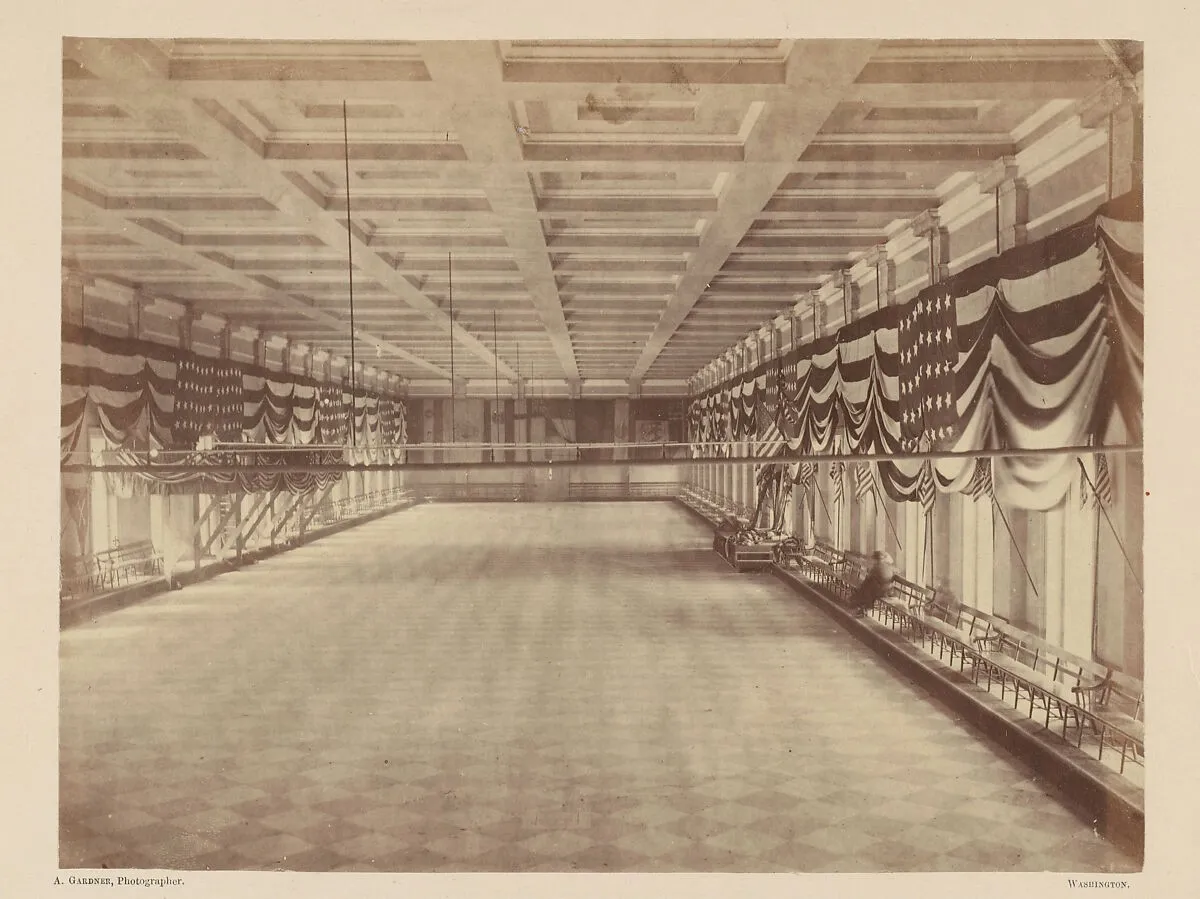
A photograph by Alexander Gardner gives a calmer view of the same building: the ballroom before the guests arrived, flags swagged down both walls, chairs and benches lined up, the floor bare. It shows the dance hall, not the supper room, and it can’t settle what happened at midnight.
The recipes
These four come from Eliza Leslie’s Directions for Cookery (eleventh edition, 1840), each for a sweet that Balzer’s bill of fare names. They follow the order of the bill’s sweet column.
- Cocoa-nut Maccaroons (1840): coconut, sugar and egg white, one period way to build the “Cocoanut” pyramid.
- Lady Cake (1840): a white almond cake made with seventeen egg whites in the original, iced with lemon.
- Charlotte Russe (1840): vanilla custard and whipped cream set in a mold lined with sponge cake.
- Vanilla Ice Cream (1840): the first ice cream on the bill, frozen twice as Leslie directs.
Making a sweets table
Balzer’s bill tells you that a party table could be divided by technique, and that is still a sensible way to plan one: something baked the day before, something set overnight, something frozen. Leslie’s lady cake is “best the day after it is baked,” and her charlotte needs time to set.
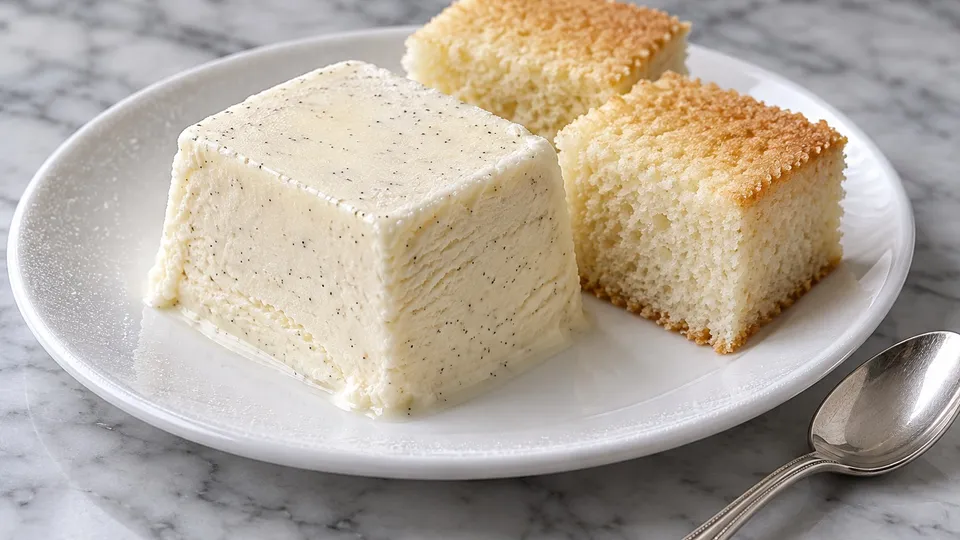
Start with the Vanilla Ice Cream (1840). Leslie told her readers to begin ice cream “about five or six hours before it is wanted,” because it is frozen twice, and a block of it turned out of a mold onto a cold plate is the closest a home kitchen gets to Balzer’s ice creams. Leslie’s ices and cakes are among our Civil War recipes, beside the substitutes of the Confederate receipt book. Four weeks after the ball, Union troops entered Richmond, where two years earlier the city’s women had rioted for bread. For what Washington poured at dinner in those years, Forgotten Drink, our sister site, reads the wine list at Willard’s Hotel (opens in a new tab).
 Cook it todayVanilla Ice Cream (1840)
Sources
- Bill of fare of the Presidential Inauguration Ball, Washington, March 6, 1865, furnished by G. A. Balzer, Confectioner; a copy shown in the Grolier Club exhibition A Century of Dining Out, item 920 (opens in a new tab).
- Eliza Leslie, Directions for Cookery, in Its Various Branches, 11th ed. (Philadelphia: Carey & Hart, 1840).
- “The Honor of Your Company Is Requested: Lincoln’s Second Inaugural Ball at the Patent Office (opens in a new tab),” National Park Service.
- Lincoln Lore (opens in a new tab), March 1959, quoting the Washington Evening Star, March 1865.
- Walt Whitman, entry for March 6, 1865, in Specimen Days, at Whitman Web (opens in a new tab), University of Iowa.
- Alexander Gardner, Interior View of the Ballroom for Lincoln’s Second Inaugural Ball (opens in a new tab), March 1865, The Metropolitan Museum of Art.
- “Mary Todd Lincoln’s White Almond Cake (opens in a new tab),” National Park Service, Lincoln Home.
- Federal Reserve Bank of Minneapolis, Consumer Price Index, 1800– (opens in a new tab).