Stewed Tomatoes (1896)
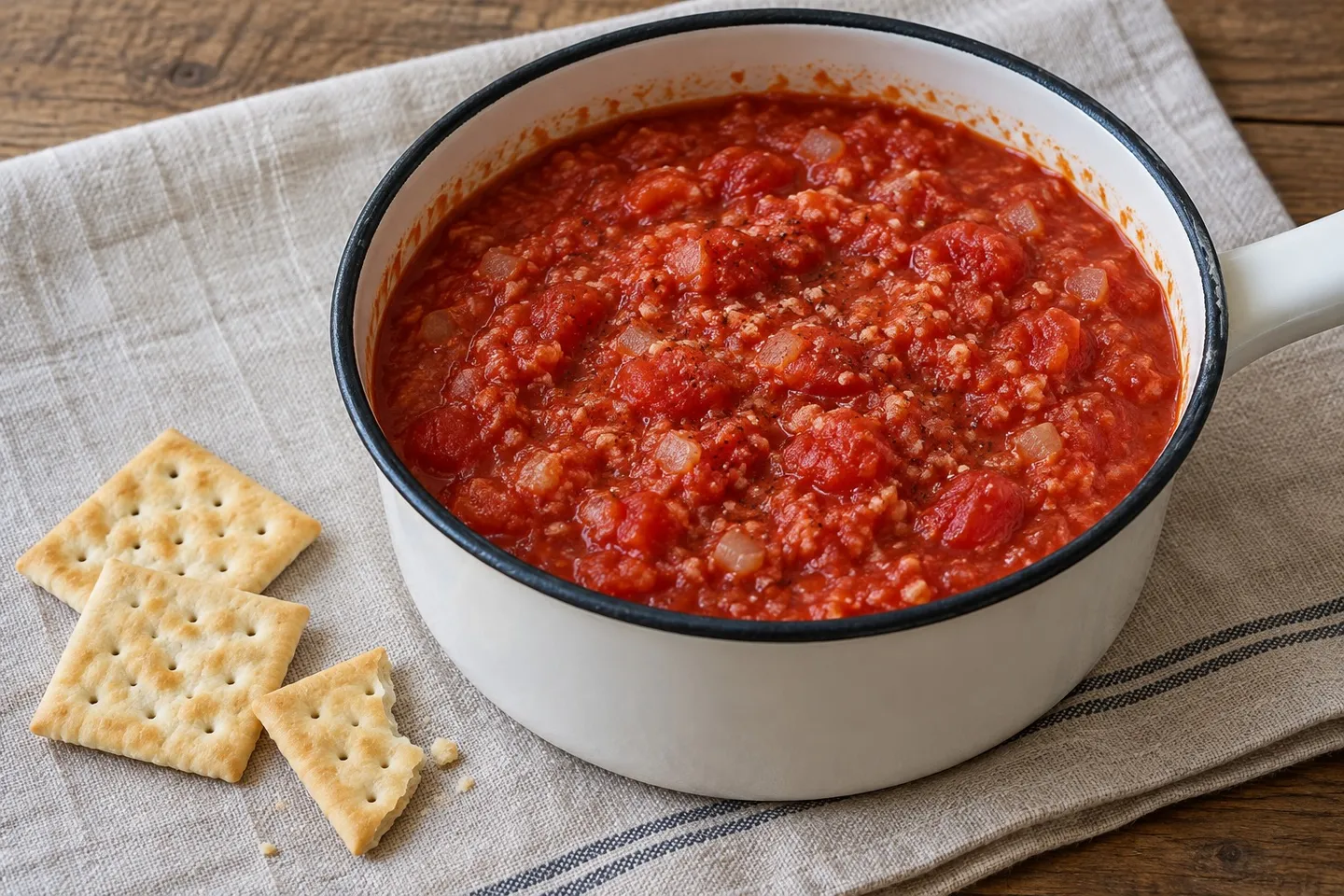
Reader ratingsStewed tomatoes from the army’s 1896 Manual for Army Cooks: peeled ripe tomatoes stewed gently with butter, salt, pepper and a little onion, then thickened with rolled cracker.
- Recipe makes
- About 3 cups, 4 servings
- Prep
- Cook
- Total
The manual’s three-quarters of an hour of gentle stewing, plus a few minutes to bring the pot up and to thicken it with the cracker at the end.
Stewed tomatoes thickened with cracker crumbs in a white enamel pan.
The story behind the recipe
Tomatoes were what the army added after four days of canned beef. The War Department’s 1896 Manual for Army Cooks says that soldiers living on the travel ration, which was canned beef, hard bread, baked beans and coffee, could be given canned tomatoes after four straight days of it, a pound a man a day. Its sample bill of fare for a camp puts “stewed tomatoes” at dinner beside bean soup and roast beef.
How did the army cook its tomatoes?
Two ways, and the manual does not quite agree with itself. The recipe here is written for fresh tomatoes, with the “unripe and hard parts” thrown out, a long, gentle stew and bread crumbs “or rolled cracker” to thicken it. Sugar is allowed for very sharp tomatoes, “but not enough to sweeten them.” Sixty-odd pages on, in its advice on cooking canned goods, the same book warns that canned tomatoes “should be cooked quickly over a hot fire,” because “allowing tomatoes to simmer long tends to extract the bitter taste from the seed and gives dissatisfaction.” The army cook had both in the same volume and could take his pick.
The manual also asks for a pot “preferably tin or porcelain lined,” which says something about the kitchens it was written for: garrison posts at home, with time and proper pans.
Read more about this recipe
Making it today
This version follows the fresh-tomato recipe and takes the manual’s own options of a little minced onion and rolled cracker. Plain unsalted crackers stand in for the soldier’s hard bread, which the manual grates into its camp stews to thicken them; if you have hardtack, use that. We chose the amounts. On the table it goes with the Fresh Beef Stew (1896), and the travel ration’s canned beef, the reason the tomatoes were issued, has its own history in What Was the “Embalmed Beef” Scandal of 1898?
Peel by pouring boiling-hot water over them, when the skin will easily come off. Cut up the tomatoes, rejecting the unripe and hard parts; put them into a pot, preferably tin or porcelain lined; season with butter, pepper, and salt, and, if the tomatoes are very acid, enough sugar to partially counteract the acidity, but not enough to sweeten them. Cover, and stew gently for three-quarters of an hour, frequently stirring. The stew can be thickened with bread crumbs or rolled cracker. Minced onion cooked with the tomatoes improves the flavor of the stew; or the minced onion may be fried and then cooked with the stew. A mixture of equal quantities of tomatoes and young corn, cut from the cob, may be cooked as above.
Recipe makes: About 3 cups, 4 servings
Ingredients
For about 3 cups, 4 servings. Quantities are shown as written.
Quantities as written here, for about 3 cups, 4 servings.
- Ripe tomatoes2 lb
- Butter1 tbsp
- Salt1/2 tsp
- Black pepper1/4 tsp
- Sugar, if the tomatoes are sharp1 tsp
- Small onion, minced1/2
- Cracker crumbs, from plain crackers or hardtack1/4 cup
Measurement notes
Ingredients as written here
- 2 lb ripe tomatoes
- 1 tbsp butter
- ½ tsp salt
- ¼ tsp black pepper
- 1 tsp sugar, if the tomatoes are sharp
- ½ small onion, minced
- ¼ cup cracker crumbs, from plain crackers or hardtack
Equipment
 Large bowl
- Stainless steel or enameled saucepan, about 3 quarts, with a lid
- Rolling pin and a bag, for the crackers
Instructions
Put the ripe tomatoes in the large bowl and pour boiling water over them to cover. After about a minute, lift them out; when cool enough to handle, slip off the skins.
Cut the tomatoes into rough pieces, cutting away the stem ends and any hard, pale or unripe parts.
Put the tomatoes in the saucepan with the butter, salt, black pepper and onion. Taste a piece of tomato; if it is very sharp, add the sugar.
Bring to a simmer over medium heat, then cover, turn the heat low and stew gently for 45 minutes, stirring often so nothing catches. The tomatoes should break down into a loose, chunky sauce.
Stir in the cracker crumbs and cook, uncovered, for 3 to 4 minutes, until they swell and the stew thickens. Taste for salt and serve hot.
Nutrition
100calories per serving
- Recipe makes
- About 3 cups, 4 servings
- Servings
- 4
Estimated per serving from USDA FoodData Central values for tomatoes, butter, onion, sugar and unsalted soda crackers.
Recipe notes
When adjusting quantities
The manual gives no amounts. Allow about half a pound of tomatoes a serving.
Notes
Quantities mentioned in these notes don’t change when you adjust the servings.
The weights, salt, pepper, sugar, onion and crumbs are our measures, and we stir the crumbs in at the end. It says only that the stew “can be thickened.” A stainless steel or enameled pan does the job of its tin or porcelain-lined pot. For the manual’s canned version, use two 28-ounce cans of whole tomatoes, drained of half their juice, and cook them quickly as it advises, about 10 minutes at a brisk simmer before the crumbs go in. Its last line allows equal parts of tomatoes and fresh corn cut from the cob, cooked the same way. The soldier’s hard bread, soaked and stewed with salt pork, has its own page: Salt Pork and Hard Bread (1896).
Scaling changes the ingredients only; pan sizes and cooking times need their own judgment. To adapt this recipe further, try the recipe tool at TuneMyRecipe (opens in a new tab), our sister site.

Sources and attribution
After War Department, Manual for Army Cooks (Washington: Government Printing Office, 1896), Stewed Tomatoes
See the original pages (scan at Internet Archive) (opens in a new tab)
Recipe details
- Course
- Side dish
- Dish family
- Vegetables & Sides
- Region
- American
- Era
- 19th century
- Source decade
- 1890s
- Main ingredient
- Vegetables
- Difficulty
- Easy
- Occasion
- Everyday meal
- Season
- Summer