Stew with Canned Meat (1896)
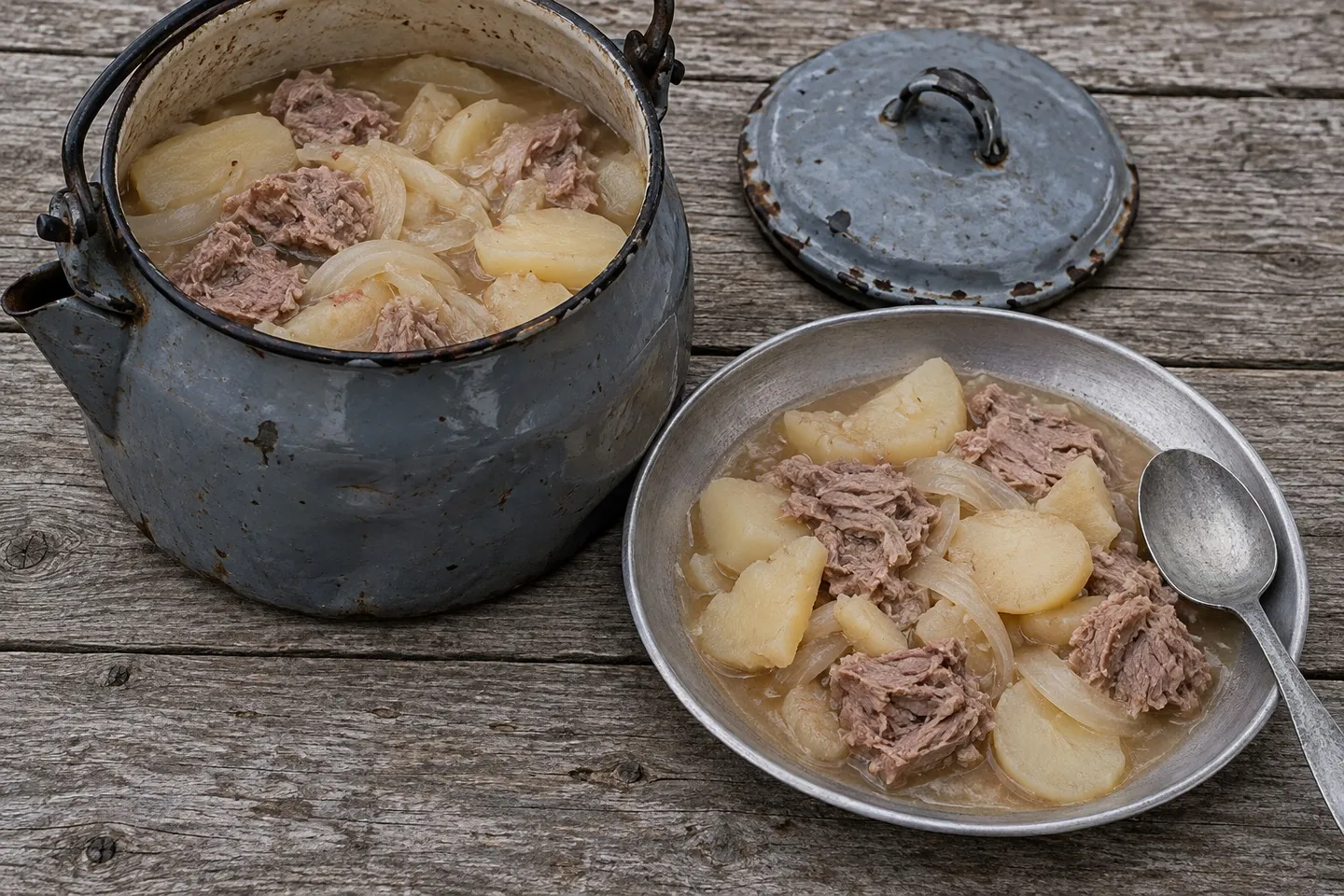
Reader ratingsA stew with canned meat from the 1896 Manual for Army Cooks: sliced potatoes and onions stewed soft in a covered pot, then canned beef cut up and simmered in for ten minutes.
- Recipe makes
- 4 servings
- Prep
- Cook
- Total
About 20 minutes for the potatoes and onions to come nearly tender, then 10 minutes with the beef, as the manual says.
Canned beef stewed with sliced potatoes and onions in an enamel kettle.
The story behind the recipe
In 1898 one regiment called the army’s canned beef “utterly unfit as an article of diet for either sick or well,” yet the army’s own book had a recipe for it. The War Department’s Manual for Army Cooks of 1896 puts “Stew, with Canned Meats” among its dishes for camp, a kettle of potatoes and onions with the tinned meat warmed through at the end. Of all the book’s dishes, it was the one most to the point that year.
Why stew canned beef?
Because some regiments found their men would eat it no other way. The commission that investigated the War Department in 1898 and 1899 learned that the beef was boiled in vats before canning, and its own verdict was that the meat’s palatability “greatly depends upon the mode in which it is cooked.” The regimental reports General Miles read out agree in their way. The Second Artillery wrote that the men “could be induced to eat it only when prepared as a stew,” and the Fifth Artillery found it “more palatable” stewed.
The same manual, in its pages on cooking canned goods, tells the cook to look at the can before opening it. If the ends are “sunk in,” the contents are sound; if they are “springy or bulged outward, look upon it with suspicion.” It also reminds him that “all canned goods have received a cooking,” so “but little further cooking is necessary.” The recipe belongs to the army’s peacetime book, and no record says which camp kettles it went into in Cuba or Puerto Rico.
Read more about this recipe
Making it today
Canned roast beef in its own juices is still sold in grocery stores, and two ordinary cans make this pot for four. The manual names no amounts at all, so we set the weights of potato, onion, beef and water. If you use canned corned beef instead, it is saltier, so hold back the salt. The fresh-meat counterpart from the same book is Fresh Beef Stew (1896). What the officers wrote about the cans, and what the commission made of it, is in What Was the “Embalmed Beef” Scandal of 1898?
Meat. Onions. Salt. Potatoes. Pepper. Water.
Peel and slice the potatoes and onions; put them in the camp kettle, season with pepper and salt, pour in sufficient water to cover them, and stew gently, keeping the lid of the kettle closely shut until the potatoes are nearly cooked; then open the tins of meat and cut up the contents and put them in the kettle with the potatoes; let the whole simmer for ten minutes, then serve.
Recipe makes: 4 servings
Ingredients
For 4 servings. Quantities are shown as written.
Quantities as written here, for 4 servings.
- Potatoes, from about 6 medium2 lb
- Medium onions2
- Salt1 tsp
- Black pepper1/2 tsp
- Water, or enough to cover3 cups
- Canned roast beef, from about two cans1.5 lb
Measurement notes
Ingredients as written here
- 2 lb potatoes, from about 6 medium
- 2 medium onions
- 1 tsp salt
- ½ tsp black pepper
- 3 cups water, or enough to cover
- 1½ lb canned roast beef, from about two cans
Equipment
- Heavy pot, about 4 quarts, with a lid
- Can opener
 Instant-read thermometer
Instructions
Check the cans before you start: the ends should be flat or drawn in, with no bulge, leak, deep dent or rust. Set aside any can that fails.
Peel the potatoes and slice them about ¼ inch thick. Peel the onions, halve them and slice them thin.
Put the potatoes and onions in the pot, sprinkle with the salt and black pepper, and pour in the water, just enough to cover the vegetables. Bring it to a boil, turn the heat down, cover tightly and simmer gently for about 20 minutes, until a knife meets only a little resistance in the potatoes.
Open the cans of canned roast beef and turn the meat and its juices into a bowl. Cut or pull it into pieces about 1 inch across, removing any large pieces of gristle.
Stir the beef and its juices into the pot. Cover and simmer for 10 minutes, stirring once, until the potatoes are soft and the beef is steaming hot right through, at least 165°F (74°C) in the center of a piece.
Taste for salt and serve hot.
Nutrition
520calories per serving
- Recipe makes
- 4 servings
- Servings
- 4
Estimated per serving from USDA FoodData Central values for canned beef, boiled potatoes and onion.
Recipe notes
When adjusting quantities
The manual gives no amounts. A third to half a pound of canned beef a serving; the travel ration allowed three-quarters of a pound a man a day.
Notes
Quantities mentioned in these notes don’t change when you adjust the servings.
The slice thickness, the 20 minutes for the vegetables, the thermometer reading and removing gristle (the commission found “a large amount of gristle” in one of its sample cans) are our additions as well. Use only commercially canned meat, checked as above, and refrigerate leftovers within 2 hours. The manual’s next recipe, Brown Stew, with Canned Meats, fries the onions brown in the fat from the can, thickens water with a batter of flour, and warms the sliced meat through in it. Leftover stew beef also makes the Dry Beef Hash (1896).
Scaling changes the ingredients only; pan sizes and cooking times need their own judgment. To adapt this recipe further, try the recipe tool at TuneMyRecipe (opens in a new tab), our sister site.
Sources and attribution
After War Department, Manual for Army Cooks (Washington: Government Printing Office, 1896), Stew, with Canned Meats
See the original pages (scan at Internet Archive) (opens in a new tab)
Recipe details
- Course
- Main course
- Dish family
- Meat & Poultry
- Region
- American
- Era
- 19th century
- Source decade
- 1890s
- Main ingredient
- Beef
- Difficulty
- Easy
- Occasion
- Everyday meal