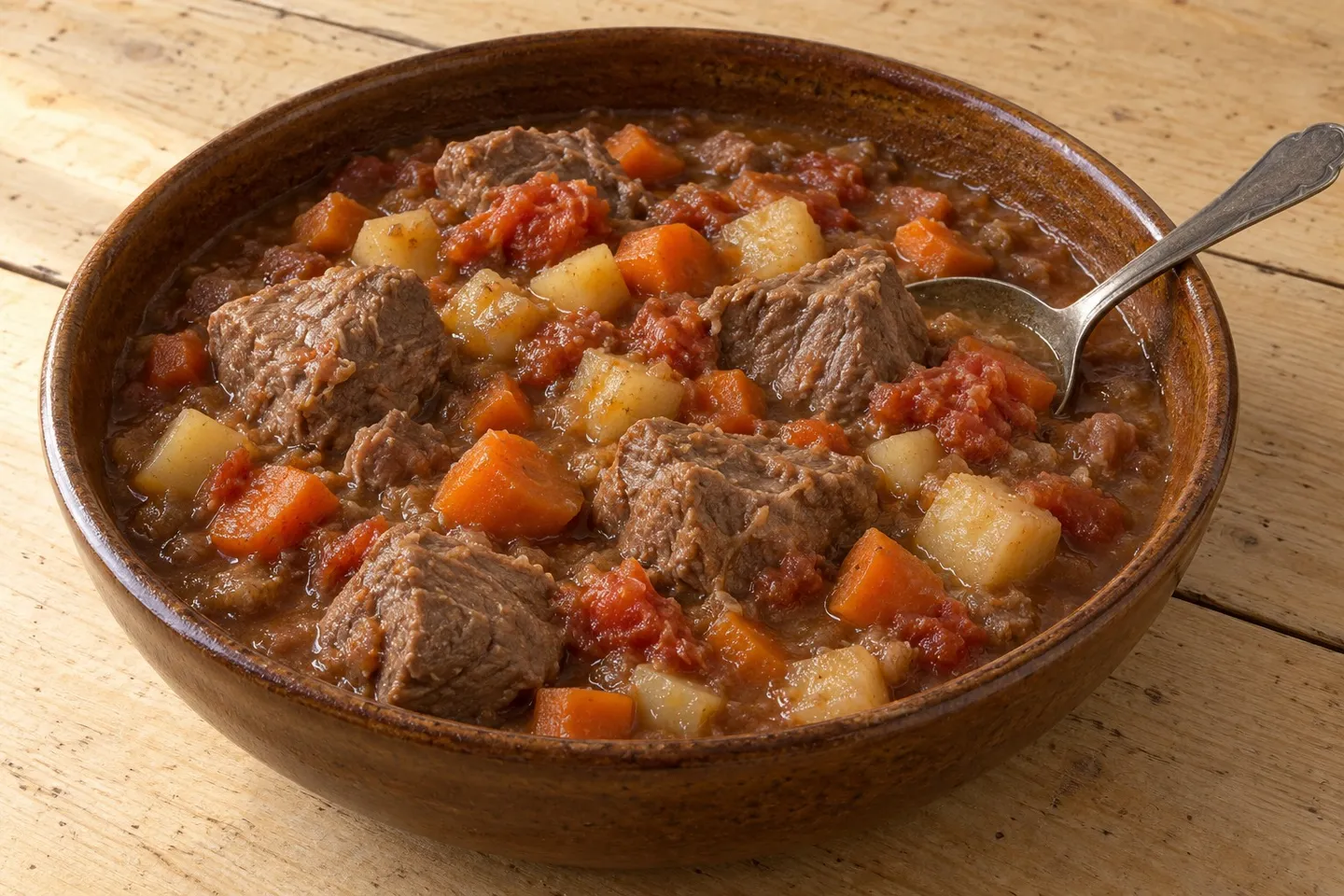
Fresh Beef Stew (1896)
Reader ratingsA fresh beef stew from the 1896 Manual for Army Cooks: stewing beef simmered two hours with bay, then an hour more with potatoes, tomatoes, onions and carrots, kept thick.
- Recipe makes
- 4 servings
- Prep
- Cook
- Total
The manual’s “Time, three hours”: two hours for the beef alone and one with the vegetables, plus about 10 minutes to reach the simmer and thicken.
Thick beef stew with potatoes, tomatoes and carrots in a stoneware dish.
The story behind the recipe
This is the beef General Miles wanted his men to have. When he told the presidential commission in December 1898 that the army’s beef had failed its soldiers, his answer was fresh meat: cattle bought on the island or “driven on the hoof” behind the troops, as in the Civil War. What a company cook was meant to do with fresh beef is in the War Department’s Manual for Army Cooks of 1896, and its stew of beef, potatoes, carrots, onions and tomatoes is the simplest thing it does with it.
Was fresh beef the better ration in 1898?
The army did not agree on it. The commission concluded that “meat on the hoof and the refrigerated beef are more acceptable” than canned. The Commissary General, Charles P. Eagan, rejected cattle on the hoof outright, telling the commission that in the tropics “the meat goes to the fire before the animal heat is out of the body.” The cookbook itself takes a practical line. “It is not necessary to use the choice parts of beef for a stew,” it says, and it closes with a complaint that sounds like experience: “Too much water is commonly used in making stews.” It was written for garrison kitchens in peacetime, with three hours to spare.
Read more about this recipe
Making it today
Boneless chuck is the usual modern stewing cut, and it fits the manual’s advice about the cheaper parts. Halving the batch for four people is our choice; the proportions are the manual’s, four parts beef to one each of potato and tomato, with half as much onion and a quarter as much carrot. The browned flour is optional, as it is in the book, which kept a jar of it on hand “to thicken gravy and darken it.” The canned beef of the same war goes into Stew with Canned Meat (1896), and the article on the embalmed beef scandal of 1898 sets the two beside each other.
4 pounds fresh beef, free from bone. ½ pound onions. 1 pound potatoes. ¼ pound carrots. 1 pound fresh or canned tomatoes. Pepper and salt.
Time, three hours.
It is not necessary to use the choice parts of beef for a stew.
Cut the meat into pieces about two inches square. Cut the vegetables into small pieces. Put the meat into a pot with enough cold water to cook it; add a tablespoonful of salt. Cover closely. Put the pot over the fire to simmer; skim carefully. When the stew has simmered for two hours put in the prepared vegetables; season with pepper and salt. Simmer one hour longer, stirring occasionally. When done serve in a hot dish. If it is desired to serve the potatoes whole, put them into the pot twenty or thirty minutes before the stew is cooked. If the water gets too low, replenish carefully with boiling water.
If the liquor of the stew is not sufficiently thick, stir into it two tablespoonfuls of blended browned flour. A bay leaf to every pound of meat may be put into the pot of cold water with the meat.
Stew mutton, lamb, veal, and fresh pork as above. The bones of mutton and veal, if small, need not be removed. Add thin slices of fat pork or bacon to a veal stew.
The onions may be fried brown before they are put into the stew.
Too much water is commonly used in making stews. They should be thick rather than thin.
Recipe makes: 4 servings
Ingredients
For 4 servings. Quantities are shown as written.
Quantities as written here, for 4 servings.
- Boneless beef chuck2 lb
- Salt for the pot1 1/2 tsp
- Bay leaves2
- Cold water4 cups
- Potatoes0.5 lb
- Ripe or canned tomatoes0.5 lb
- Onions, from about 1 medium0.25 lb
- Carrots, from about 1 small0.13 lb
- Black pepper1/2 tsp
- Salt to finish, to taste
- All-purpose flour, for browning1 tbsp
- Cold water, for the flour2 tbsp
- Boiling water, for topping up
Measurement notes
Ingredients as written here
- 2 lb boneless beef chuck
- 1½ tsp salt for the pot
- 2 bay leaves
- 4 cups cold water
- ½ lb potatoes
- ½ lb ripe or canned tomatoes
- ¼ lb onions, from about 1 medium
- ⅛ lb carrots, from about 1 small
- ½ tsp black pepper
- Salt to finish, to taste
- 1 tbsp all-purpose flour, for browning
- 2 tbsp cold water, for the flour
- Boiling water, for topping up
Equipment
- Heavy pot or Dutch oven, about 4 quarts, with a lid
- Small dry skillet, for browning the flour
 Kettle
 Instant-read thermometer
Instructions
Trim any thick fat from the beef chuck and cut it into 2-inch pieces.
Put the beef in the pot with the salt for the pot, the bay leaves and the cold water; it should come almost to the top of the meat. Cover and bring slowly to a simmer over medium heat, skimming off the gray foam as it rises.
Turn the heat to low, cover closely and simmer gently for 2 hours. Look in now and then; if the liquid falls well below the meat, add a little boiling water from the kettle.
About 15 minutes before the 2 hours are up, peel the potatoes, onions and carrots and cut them, with the tomatoes, into pieces about ½ inch across.
After the 2 hours, stir in the vegetables, the black pepper and salt to finish. Cover and simmer for 1 hour more, stirring now and then, until the beef is fork-tender and the vegetables are soft. The beef will be far above 145°F (63°C), the safe minimum for beef; check a piece with the thermometer if in doubt.
For a thicker, darker gravy, stir the flour in the dry skillet over medium heat for 4 to 6 minutes, until it is evenly the color of light cocoa and smells toasty; don’t let it scorch. Let it cool for a minute, blend it smooth with the cold water for the flour, stir it into the stew and simmer for 5 minutes, stirring, until thickened.
Remove the bay leaves and serve hot, in a warmed dish.
Nutrition
565calories per serving
- Recipe makes
- 4 servings
- Servings
- 4
Estimated per serving from USDA FoodData Central values for braised beef chuck, potato, tomato, onion, carrot and flour.
Recipe notes
When adjusting quantities
Half the manual’s batch, which used 4 lb of beef. Doubled, use a 6- to 8-quart pot; the times stay the same.
Notes
Quantities mentioned in these notes don’t change when you adjust the servings.
We halved the manual’s quantities, including its opening tablespoon of salt, which becomes 1½ teaspoons, with more to taste at the end. Two bay leaves follow its one to every pound of meat. We set the water amount, the cut size for the vegetables and the browning time; the manual says only “enough cold water to cook it” and keeps browned flour ready in a jar. Its options, left out here: whole potatoes added for the last 20 or 30 minutes, onions fried brown before going in, and mutton, lamb, veal or pork in place of beef. Refrigerate leftovers within 2 hours; cold stewed beef is what the manual’s Dry Beef Hash (1896) was made from.
Scaling changes the ingredients only; pan sizes and cooking times need their own judgment. To adapt this recipe further, try the recipe tool at TuneMyRecipe (opens in a new tab), our sister site.
Sources and attribution
After War Department, Manual for Army Cooks (Washington: Government Printing Office, 1896), To Stew Fresh Beef
See the original pages (scan at Internet Archive) (opens in a new tab)
Recipe details
- Course
- Main course
- Dish family
- Meat & Poultry
- Region
- American
- Era
- 19th century
- Source decade
- 1890s
- Main ingredient
- Beef
- Difficulty
- Easy
- Occasion
- Everyday meal
- Season
- Winter