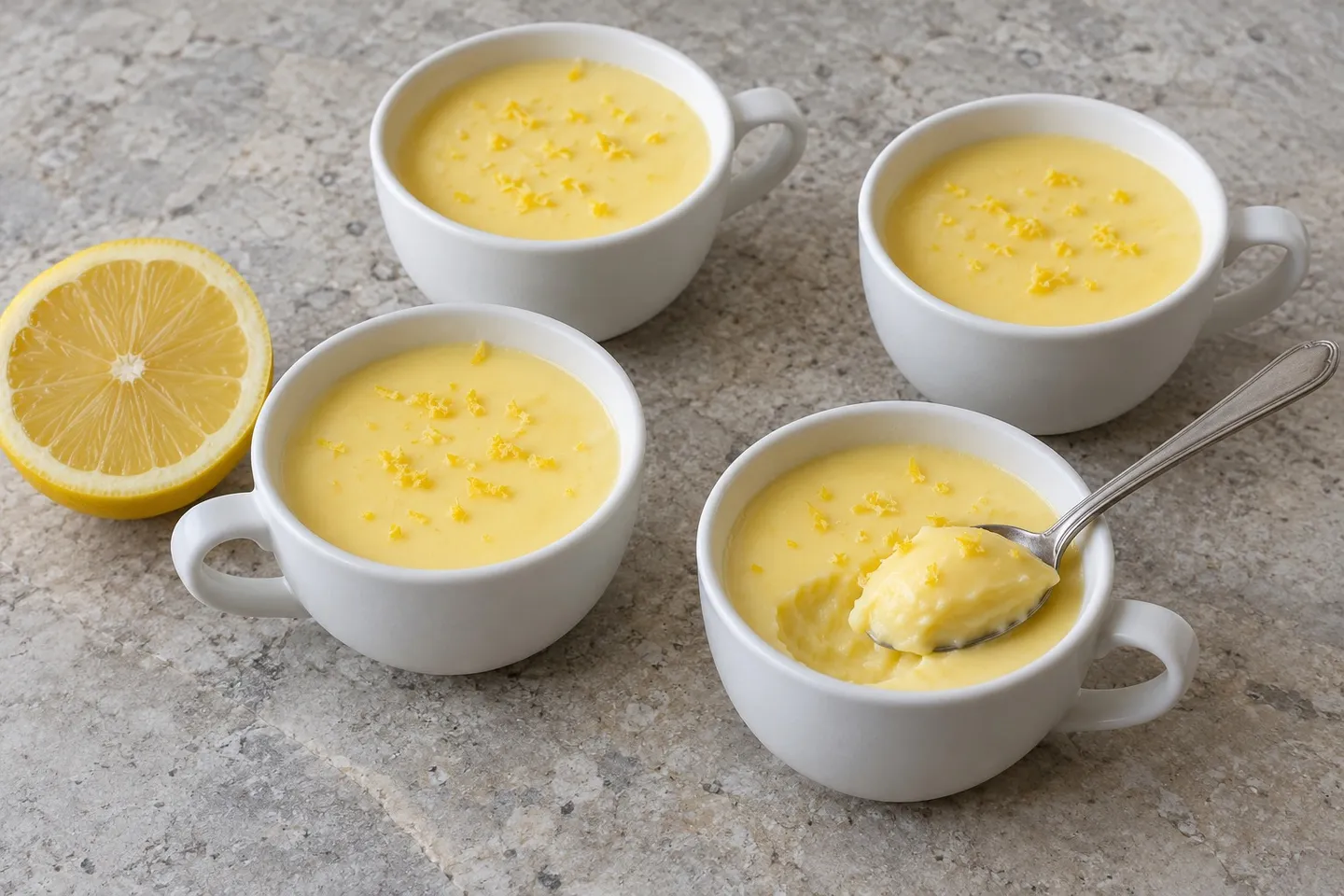
Lemon Custards (1806)
Reader ratingsMaria Rundell’s lemon custards, 1806: egg yolks thickened with boiling water, grated lemon rind and sweetened juice, set in cups and eaten cold.
- Recipe makes
- 4 small cups
- Prep
- Cook
- Total
Total time includes 10 minutes standing and 2 hours in the refrigerator, enough to chill small cups through. Rundell’s custards are eaten cold; serve them the same day.
Four small cups of cold lemon custard flecked with grated rind.
The story behind the recipe
Rundell’s lemon custards are made with water. The 1806 London edition of A New System of Domestic Cookery beats eight yolks “till they are as white as milk,” pours on a pint of boiling water, and flavors the custard with the grated rind of two lemons and their juice, sweetened to taste. Wine and brandy go in at the end, the whole gets “one scald,” and the custards go into cups “to be eaten cold.”
Where did a lemon custard’s flavor come from?
In Rundell’s custard it came from the lemon, and that is the point of setting it beside the custard Fredrick Accum warned about in 1820. The cooks he wrote of got an almond flavor into custards from cherry-laurel leaves, and four children at a school near Richmond fell ill after eating one. The letter that reported it gives no recipe at all: no milk, no eggs, no quantities. Rundell’s book was in print thirteen years before, and its custard does two separate jobs with two ingredients. The lemon gives the taste. The yolks, stirred over the fire “till thick enough,” do the setting. How the Richmond custard became Accum’s case against “an ignorant cook” is told in What Was in the Pot Accum Warned About in 1820?
The same book shows how much cooks wanted that kernel flavor. On the page where the custard ends, Rundell finishes a rice flummery with “a spoonful of peach water, or a bitter almond beaten.” Accum likened the laurel’s taste to exactly these, “the kernels of peach-stones, or of bitter almonds,” and neither belongs in a custard made today.
The book came out as the work of “A Lady”; library catalogues give it to Maria Eliza Rundell.
Read more about this recipe
Making it today
These cups are half Rundell’s batch: four yolks, with the water, sugar and lemon measured out where she leaves them to taste and to the size of the lemon. Rundell’s large glass of rich wine and half glass of brandy are left out, and the second scald with them, so this is the plain lemon custard; the notes give a way to add them back. We stir it in a bowl over simmering water, where she stirs it on the fire, and finish it by thermometer, since yolks are safe once they reach 160°F (71°C). It sets soft and spoonable, a custard to eat from its cup with a spoon. For a second sweet from the same years, make Arrowroot Blancmange (1837) alongside.
Beat the yelks of eight eggs till they are as white as milk; then put to them a pint of boiling water, the rinds of two lemons grated, and the juice sweetened to your taste. Stir it on the fire till thick enough, then add a large glass of rich wine, and half a glass of brandy—give the whole one scald, and put it in cups, to be eaten cold.
Recipe makes: 4 small cups
Ingredients
For 4 small cups. Quantities are shown as written.
Quantities as written here, for 4 small cups.
- Large egg yolks4
- White sugar40 g
- Strained lemon juice50 ml
- Finely grated lemon zest, from about 1 lemon1 tsp
- Water250 ml
Measurement notes
Ingredients as written here
- 4 large egg yolks
- 40 g white sugar
- 50 ml strained lemon juice
- 1 tsp finely grated lemon zest, from about 1 lemon
- 250 ml water
Equipment
- Heatproof mixing bowl
- Saucepan the bowl can sit on without touching the water
- Kettle or small pan for boiling water
- Whisk and silicone spatula
 Instant-read thermometer
 Fine grater
- Four small heatproof cups or ramekins
Instructions
Set the saucepan over medium heat with a few centimeters of water and bring it to a gentle simmer. The bowl should sit on top without touching the water.
Whisk the egg yolks and sugar in the heatproof bowl until pale and thick, about 2 minutes. Whisk in the lemon juice and lemon zest.
Bring the water to a boil in the kettle or small pan. Pour it into the yolks in a thin stream, whisking all the time.
Set the bowl over the simmering water. Stir constantly with the spatula, scraping the sides and bottom, until the custard thickens enough to coat the back of a spoon and reads at least 160°F (71°C) on the thermometer, about 8 to 12 minutes. If it starts to look grainy at the edges, lift the bowl off for a moment and stir hard.
Pour the custard at once into the cups. Let them stand 10 minutes, then cover and refrigerate for 2 hours, until cold.
Serve cold, the same day.
Nutrition
100calories per serving
- Recipe makes
- 4 small cups
- Servings
- 4
Estimated per cup (4) from USDA FoodData Central values for raw egg yolk, granulated sugar and lemon juice.
Recipe notes
When adjusting quantities
Rundell uses eight yolks to a pint of boiling water, twice this batch. Keep the yolks, water and juice in step when you scale, and stir larger batches longer.
Notes
Quantities mentioned in these notes don’t change when you adjust the servings.
Our changes from Rundell: half her eight yolks; 250 ml water in place of half her pint; measured juice, zest and sugar where she sweetens the juice to taste; a bowl over simmering water and a thermometer in place of the open fire; no wine, no brandy and no second scald. To put the alcohol back, stir in 2 tablespoons sweet wine such as Madeira or sweet sherry and 1 tablespoon brandy once the custard has thickened, and stir 1 minute more over the water; her glasses had no fixed size, so these amounts are ours. Keep the custards covered in the refrigerator and out of it no more than 2 hours in all. Contains eggs.
Scaling changes the ingredients only; pan sizes and cooking times need their own judgment. To adapt this recipe further, try the recipe tool at TuneMyRecipe (opens in a new tab), our sister site.
Sources and attribution
After Maria Eliza Rundell, A New System of Domestic Cookery (London, 1806), Lemon custards
See the original pages (scan at Internet Archive) (opens in a new tab)
Recipe details
- Course
- Dessert
- Dish family
- Desserts & Sweets
- Region
- British
- Era
- 19th century
- Source decade
- 1800s
- Difficulty
- Intermediate
- Occasion
- Dinner party