The Cratchits’ Christmas dinner in A Christmas Carol · Camden Town, London
What Did the Cratchits Eat for Christmas Dinner?
In A Christmas Carol the Cratchits eat roast goose with sage and onion, apple sauce, mashed potatoes and a flaming plum pudding, then chestnuts and hot gin.
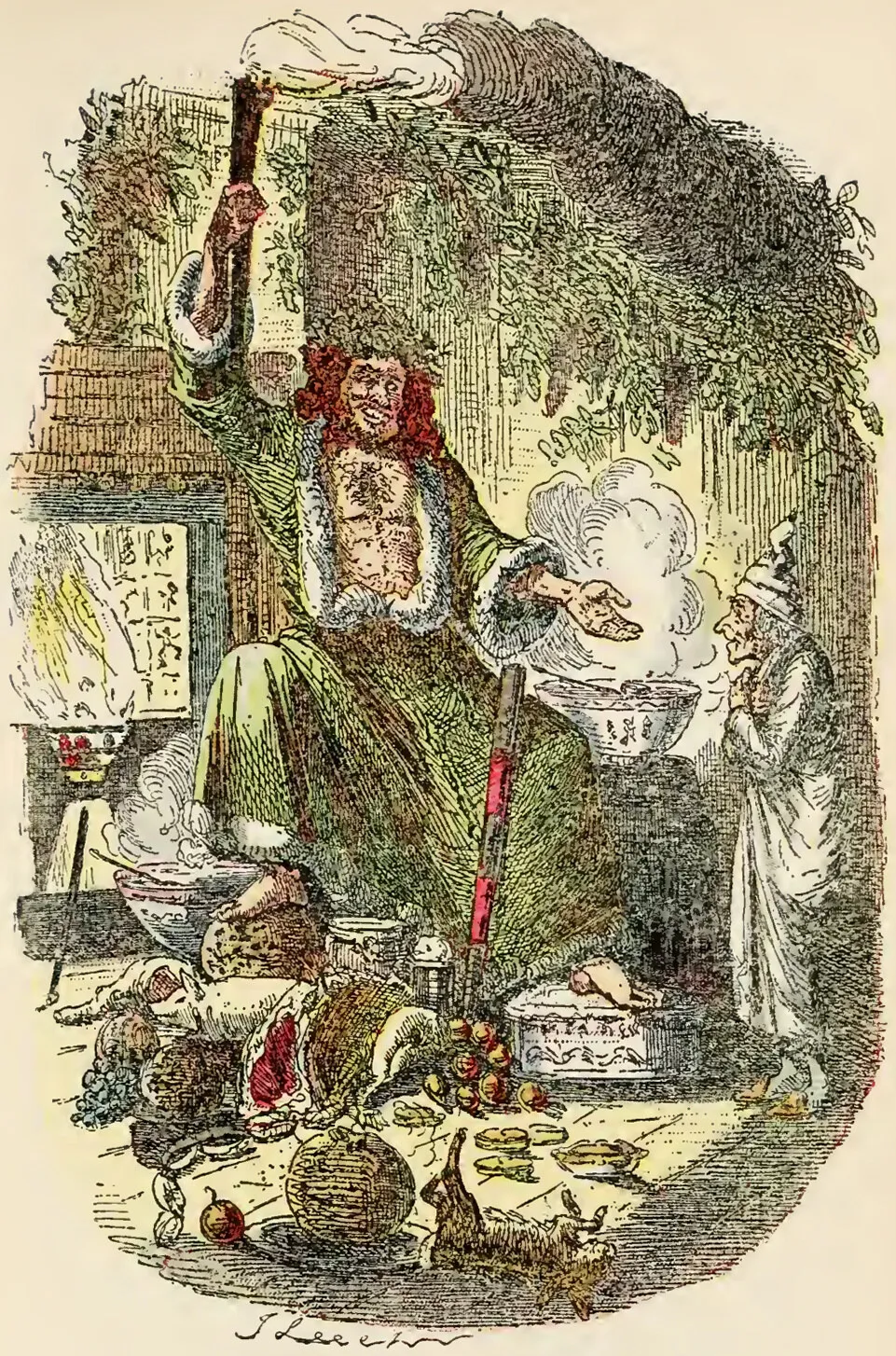
Roast goose with sage and onion stuffing, gravy, apple sauce and mashed potatoes, then a boiled plum pudding brought in blazing with brandy, then apples, oranges and roast chestnuts with a jug of hot gin and lemons. That is the Christmas dinner Charles Dickens gave the Cratchit family in A Christmas Carol, published in London in December 1843. It’s fiction, but Dickens set out the meal dish by dish, and household cookbooks of the next twenty years give recipes for its goose, stuffing, sauce, potatoes and pudding, so the main courses can be cooked today from books of the Cratchits’ own era.
Christmas morning in the street
The Ghost of Christmas Present first appears to Scrooge enthroned on a heap of food. Dickens lists it: “turkeys, geese, game, poultry, brawn, great joints of meat, sucking-pigs, long wreaths of sausages, mince-pies, plum-puddings, barrels of oysters, red-hot chesnuts, cherry-cheeked apples, juicy oranges, luscious pears, immense twelfth-cakes, and seething bowls of punch.”
That heap is the whole season’s market at once. The two of them then walk out into the London morning, past the poulterers’ and fruiterers’ shops, with their “great, round, pot-bellied baskets of chesnuts” and their Norfolk Biffins, apples “squab and swarthy,” “urgently entreating and beseeching to be carried home in paper bags and eaten after dinner.” At the grocers’ Dickens finds “the raisins were so plentiful and rare, the almonds so extremely white, the sticks of cinnamon so long and straight.” Raisins head the list in Soyer’s Christmas plum pudding.
Such a goose
The Ghost then takes Scrooge to the four-roomed house of Bob Cratchit, the clerk who copies letters in “a dismal little cell” beyond his own office. On Christmas Eve Scrooge had grumbled about him: “my clerk, with fifteen shillings a-week, and a wife and family, talking about a merry Christmas.” Fifteen shillings is about £85 a week today by UK consumer prices (Bank of England). The dinner the Ghost shows him has a goose at its center, and Dickens makes clear what that bird meant in a small house in Camden Town: “Such a bustle ensued that you might have thought a goose the rarest of all birds.”
Everyone has a job. Mrs. Cratchit has the gravy “ready beforehand in a little saucepan.” “Master Peter mashed the potatoes with incredible vigour; Miss Belinda sweetened up the apple-sauce.” When Mrs. Cratchit finally carves, out comes “the long expected gush of stuffing,” and the youngest Cratchits end the meal “steeped in sage and onion to the eyebrows.”
Dickens is precise about why the goose is praised: “Its tenderness and flavour, size and cheapness, were the themes of universal admiration. Eked out by the apple-sauce and mashed potatoes, it was a sufficient dinner for the whole family.” Cheapness comes fourth on that list, and the potatoes and sauce are there to make one bird go round.
Christmas came at the end of the goose’s best season. When Isabella Beeton priced one in The Book of Household Management in 1861, a goose cost on average 5s. 6d., about £30 today, and was “in perfection from Michaelmas to Christmas.” Her recipe is the one we give for the Cratchits’ bird, with her sage and onion stuffing, the dish the younger children were “basking in luxurious thoughts of” before the goose came home.
Cooked at the baker’s
The Cratchits didn’t roast their goose at home. The two younger children come running in to say that “outside the baker’s they had smelt the goose, and known it for their own,” and later Peter and the young Cratchits “went to fetch the goose.”
The Cratchits were far from alone. Earlier that morning the Ghost had stood with Scrooge in a baker’s doorway, watching “innumerable people, carrying their dinners to the bakers’ shops,” and “taking off the covers as their bearers passed, sprinkled incense on their dinners from his torch.” Then Dickens leaves a picture of the whole city cooking at once: “the thawed blotch of wet above each baker’s oven; where the pavement smoked as if its stones were cooking too.”
Not everyone approved. The chef Alexis Soyer, writing for working families in A Shilling Cookery for the People in 1854, called the baker’s oven a “semi-barbarian method of spoiling food,” and explained its appeal in one line: “it gives them no trouble.” He worried about dinners going astray, with “joints changing dishes, and by mistake, going to the wrong home.” Beeton was kinder, allowing in 1861 that “the baker’s oven, or the family oven, may often … be substituted for the cook and the spit with greater economy and convenience.”
The Christmas dinner Soyer planned in the same book is a small turkey boiled in the black pot with salt pork, a plum pudding warmed up in the same pot, and potatoes “baked in the embers.” Nothing in it needs an oven at all.
The pudding
The pudding was boiled at home, in the copper, and Dickens gives its arrival by smell first: “Hallo! A great deal of steam! The pudding was out of the copper. A smell like a washing-day! That was the cloth.”
Mrs. Cratchit carries it in “like a speckled cannon-ball, so hard and firm, blazing in half of half-a-quartern of ignited brandy, and bedight with Christmas holly stuck into the top.” A quartern was a quarter of a pint, so Dickens’s measure works out to a sixteenth of a pint, about 35 ml of brandy. A small measure, but in Dickens’s telling enough to set the whole pudding blazing.
Isabella Beeton describes the same ending in 1861: a sprig of holly in the middle and a wineglassful of brandy poured round and lit, so the pudding came “to table encircled in flame.” Her Christmas pudding, the one she marked “Very Good,” has no flour at all, though, and Mrs. Cratchit’s had some: once it is out safely, she confesses that “she had had her doubts about the quantity of flour.” Soyer’s Christmas plum pudding of 1854, from his book for working families, has three ounces of flour to a pound of fruit, and that is the one we cook for this dinner.
Chestnuts and the jug
Before the goose came in, Bob had “compounded some hot mixture in a jug with gin and lemons, and stirred it round and round and put it on the hob to simmer.” After dinner the cloth is cleared, “apples and oranges were put upon the table, and a shovel-full of chesnuts on the fire,” and the hot gin is served out in “two tumblers, and a custard-cup without a handle.” Then comes Tiny Tim’s “God bless us every one!” The punches, wines and hot jugs of other Victorian Christmases are on our sister site in What Did Victorians Drink at Christmas? (opens in a new tab)
Scrooge, the next morning, sends the Cratchits the prize turkey from the poulterer’s, “twice the size of Tiny Tim,” so heavy he pays for a cab to get it to Camden Town. Dickens never says what they did with it. The dinner he actually describes is the goose.
The recipes
The Cratchit dinner in the order it came to the table, from household books of the 1850s and 1860s:
- Roast Goose with Sage and Onion Stuffing (1861): Beeton’s goose and her stuffing, with a gravy made from the giblets ahead of time, as Mrs. Cratchit’s was.
- Mashed Potatoes (1854): Soyer’s version for working families, beaten light with two forks.
- Apple Sauce for Goose (1861): Beeton’s four-ingredient sauce, sweetened to taste as Belinda sweetened hers.
- Plum Pudding (1854): Soyer’s Christmas pudding, with flour, sugar and nutmeg, boiled four hours. Beeton’s flourless, unsweetened Christmas Plum Pudding (1861) stands beside the plum puddings British soldiers sent across no man’s land in What Did the Soldiers Share in the Christmas Truce of 1914?
Dickens gives no recipes. These are what the cookbooks of those years printed for the same dishes, and each recipe page says which book it comes from.
Cooking the Cratchit dinner
Start with the pudding: Soyer boiled his the day before and warmed it up in the pot while the dinner was eaten, and after its four hours of steaming it keeps up to four days in the refrigerator, so it can be made on Christmas Eve and only warmed through on the day. On the day itself the goose needs the oven for about two and a half hours, which leaves the stovetop free for the potatoes, the apple sauce and a pan of chestnuts.
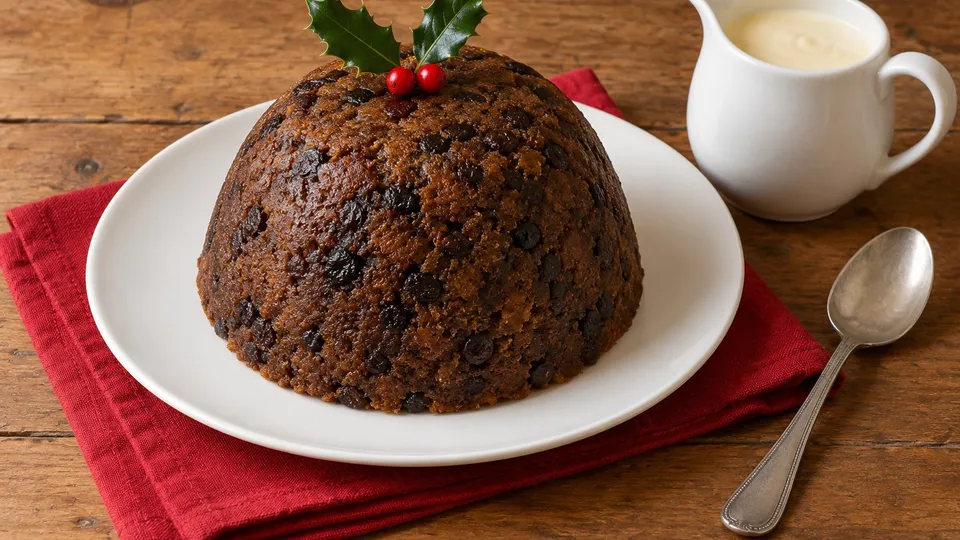 Cook it todayPlum Pudding (1854)
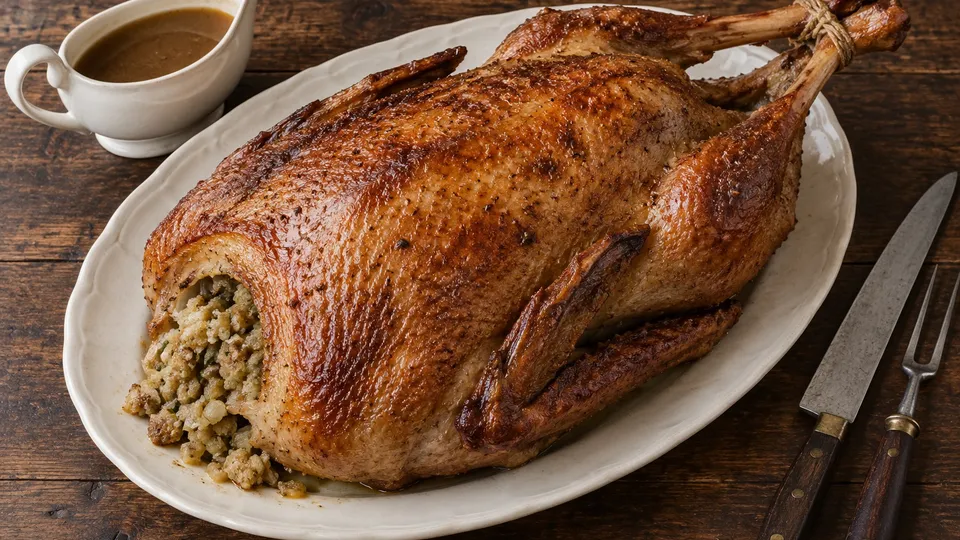 Cook it todayRoast Goose with Sage and Onion Stuffing (1861)
Sources
- Charles Dickens, A Christmas Carol in Prose, Being a Ghost Story of Christmas (London: Chapman & Hall, 1843), Staves Three and Five, pp. 77–95 and 155–158, read in the facsimile of the first edition (Boston: Atlantic Monthly Press, about 1920).
- Isabella Beeton, The Book of Household Management (London: S. O. Beeton, 1861), nos. 363, 504, 554, 968, 1145 and 1328.
- Alexis Soyer, A Shilling Cookery for the People (London: Routledge, 1854), nos. 85, 232, 275, 334 and 414, and “On Meat in Baker’s Oven,” pp. 93–94.
- Present-day equivalents: Bank of England inflation calculator basis (composite price index to 1948, then consumer prices).