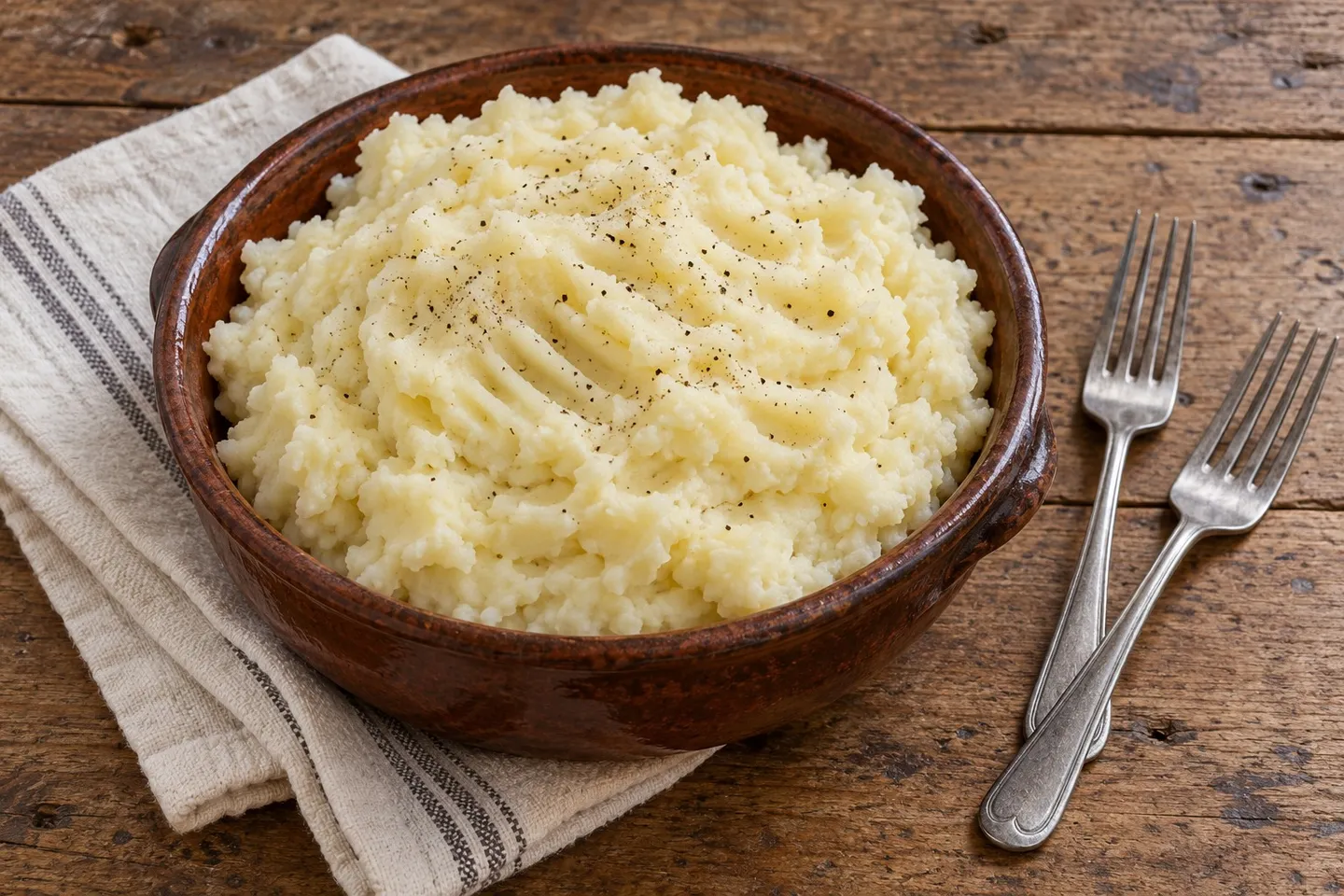
Mashed Potatoes (1854)
Reader ratingsAlexis Soyer’s mashed potatoes from his 1854 cookbook for working families, beaten light with two forks and a little butter and milk, as served with the Cratchits’ Christmas goose.
- Recipe makes
- 6 servings
- Prep
- Cook
- Total
The potatoes boil for about 25 minutes and dry for 3. The mashing takes a few minutes of hard work with two forks.
Mashed potatoes beaten light with two forks.
The story behind the recipe
Master Peter Cratchit’s job on Christmas Day was the potatoes, and he mashed them “with incredible vigour.” Dickens doesn’t say how. The chef Alexis Soyer does, in a cookbook he wrote eleven years later for working families, and his way needs nothing but two forks.
Two forks and no spoon
Soyer’s A Shilling Cookery for the People came out in 1854, addressed to a correspondent he calls Eloise, with a Christmas dinner that “can all be done with the black pot.” His potatoes are boiled until mealy and broken up in a bowl with “two forks in one hand, with the points of the prongs turned outwards.” Butter, milk, salt and pepper go in while they are broken, and then they “should be beat a great deal, until they become quite light.” The thing to avoid was a mash “hard like paste, as is often the case when stirred with a spoon.”
He adds a second way for large potatoes, cut in four before they go into the water and dried by the fire before they meet the forks.
The Cratchits needed the potatoes to stretch the goose. Dickens says plainly that the bird, “eked out by the apple-sauce and mashed potatoes,” was enough for the whole family.
Read more about this recipe
Making it today
We follow Soyer’s second method, the one he gives for large potatoes, peeled and quartered before they boil. His sentence puts an ounce of butter, a gill of milk “or a little more,” and half a teaspoon of salt “to every pound.” We read the pound as applying to the salt, and use one ounce of butter and one gill of milk for the whole batch; his “or a little more” leaves room for a looser mash.
Serve it with Roast Goose with Sage and Onion Stuffing (1861), and spoon the gravy over both. Peter’s potatoes and the rest of the meal are set out in What Did the Cratchits Eat for Christmas Dinner?
275. Mashed Potatoes.—After having boiled twelve middling sized potatoes until mealy, peel them, if with the skins on, and remove the eyes or specks; put them into a bowl, and take two forks in one hand, with the points of the prongs turned outwards; break the potatoes up with them; when breaking, add an ounce of butter and a gill of milk or a little more to them, and half a teaspoonful of salt, to every pound, and a pinch of pepper; they should be beat a great deal, until they become quite light; they should never be hard like paste, as is often the case when stirred with a spoon.
Potatoes, if large, might be peeled, and cut in four pieces, put in boiling water with some salt, boiled rather fast, and well drained when done; let the pan stand near the fire to dry your potatoes—three minutes will do it—and mash them as above.
Recipe makes: 6 servings
Ingredients
For 6 servings. Quantities are shown as written.
Quantities as written here, for 6 servings.
- Floury potatoes, such as russet or Maris Piper1.4 kg
- Salt for the cooking water1 tbsp
- Butter30 g
- Whole milk150 ml
- Salt for the mash1 1/2 tsp
- Black pepper1 pinch
Measurement notes
Ingredients as written here
- 1.4 kg floury potatoes, such as russet or Maris Piper
- 1 tbsp salt for the cooking water
- 30 g butter
- 150 ml whole milk
- 1.5 tsp salt for the mash
- 1 pinch black pepper
Equipment
- Large saucepan with a lid
 Colander
- Large warm bowl
- Two forks
 Small saucepan
Instructions
Peel the potatoes, take out any eyes or dark specks, and cut them into quarters.
Bring a large saucepan of water to a boil with the salt for the cooking water. Add the potatoes and boil fairly fast for 20 to 25 minutes, until a fork slides through them easily.
Drain them well in the colander, return them to the hot pan and set it over very low heat for 3 minutes, shaking it now and then, until the potatoes look dry and floury on the outside.
Meanwhile, warm the butter and milk together in the small saucepan until the butter melts.
Tip the potatoes into the warm bowl. Hold two forks together in one hand with the prongs pointing outward and break the potatoes up, adding the milk and butter a little at a time, then the salt for the mash and the black pepper.
Keep beating with the forks for a few minutes, until the mash is smooth and light. Add a little more milk if it seems stiff. Serve hot.
Nutrition
235calories per serving
- Recipe makes
- 6 servings
- Servings
- 6
Estimated per serving (6) from USDA FoodData Central values for boiled potatoes, butter and whole milk.
Recipe notes
When adjusting quantities
Soyer’s twelve middling potatoes weigh about 1.4 kg. Keep about half a teaspoon of salt to each pound of potatoes.
Notes
Quantities mentioned in these notes don’t change when you adjust the servings.
A potato ricer or masher can stand in for the forks, as long as the mash is beaten and never stirred into paste, which was Soyer’s point. Beeton’s 1861 version, from the same years, browns the top “with a salamander, or before the fire”; a hot broiler does that job today. Our changes: Soyer’s second method, salt in the cooking water, and the milk warmed with the butter before it goes in. Cool leftovers within 2 hours and use them within 4 days. Contains milk.
Scaling changes the ingredients only; pan sizes and cooking times need their own judgment. To adapt this recipe further, try the recipe tool at TuneMyRecipe (opens in a new tab), our sister site.
Sources and attribution
After Alexis Soyer, A Shilling Cookery for the People (London: Routledge, 1854), Mashed Potatoes, no. 275
Recipe details
- Course
- Side dish
- Dish family
- Vegetables & Sides
- Region
- British
- Era
- 19th century
- Source decade
- 1850s
- Main ingredient
- Vegetables
- Difficulty
- Easy
- Occasion
- Christmas
- Season
- Winter