Roast Goose with Sage and Onion Stuffing (1861)
Reader ratingsIsabella Beeton’s 1861 roast goose, stuffed with her mild sage and onion stuffing of parboiled onions and breadcrumbs, with a giblet gravy made ahead, for the goose at the Cratchits’ Christmas dinner.
- Recipe makes
- 1 goose, serving 8
- Prep
- Cook
- Total
A 4.5 kg goose roasts for about 2¼ hours, then rests for 20 minutes while you finish the gravy. The giblet stock simmers for an hour and can be made the day before.
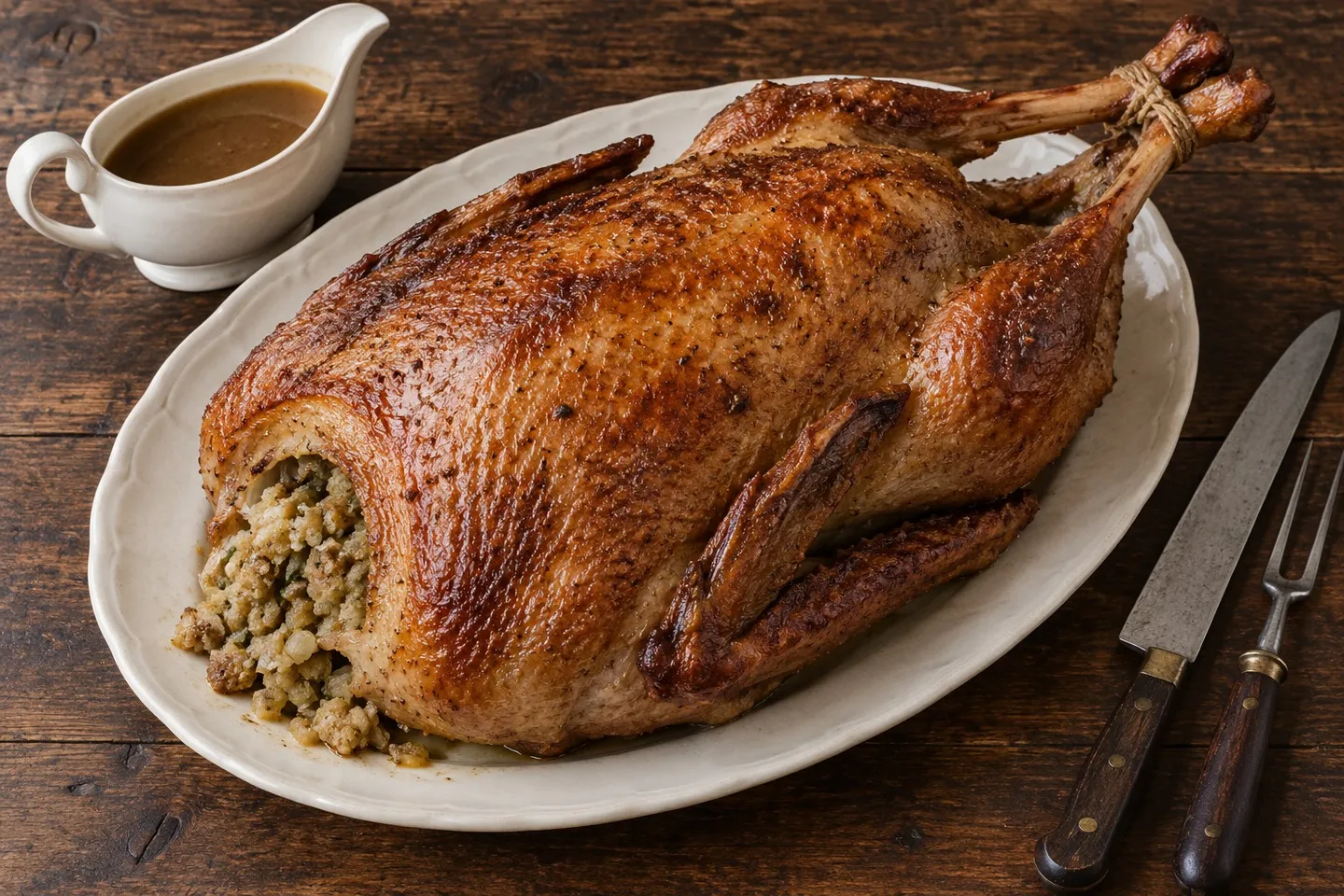
Whole roast goose with sage and onion stuffing and a boat of gravy.
The story behind the recipe
Isabella Beeton sent her roast goose to the table with “a tureen of good gravy, and one of well-made apple-sauce”: the same three things the Cratchits ate on Christmas Day in A Christmas Carol, where the younger children knew their goose by its smell outside the baker’s before it ever came home. Her recipe, from The Book of Household Management of 1861, fills the bird with sage and onion, as the Cratchits’ was.
Mild or strong?
Beeton’s stuffing is onions, sage, breadcrumbs, butter, seasoning and an egg yolk, and the question she cared about was the onion. She parboiled hers, with the sage dropped in at the end “to take off their rawness.” Some cooks used them raw, she noted, but “to many tastes, its strong flavour would be very objectionable,” and of the two methods “the mild seasoning is far superior.” Where money was short, she added, the egg could be left out.
She priced the goose at 5s. 6d., about £30 today by UK consumer prices (Bank of England), enough for eight or nine people, and marked it in season from September to March, at its best between Michaelmas at the end of September and Christmas. Dickens has the Cratchits praise their bird’s “size and cheapness” in the same breath. A footnote on the same page quotes Dr. Kitchener: a Michaelmas goose “is as famous in the mouths of the million as the minced-pie at Christmas.”
Beeton roasted in front of a brisk fire, keeping the bird well basted, and suggested stewing the giblets “down to make gravy.” Mrs. Cratchit had her gravy made before the goose came home, so the giblet stock here is made first.
Read more about this recipe
Making it today
A spit and an open fire are replaced by an oven at 350°F (180°C), the setting modern British goose recipes use, at about 30 minutes per kilogram. We pour the fat off as it collects, because a goose gives a great deal. Beeton put the stuffing in the body, and so do we, with a thermometer to say when its center is hot enough. The giblet gravy, thickened with a little of the goose’s own fat and flour, is our choice for her unnamed “good gravy.”
Serve it with Apple Sauce for Goose (1861) and Soyer’s Mashed Potatoes (1854), as the Cratchits did. Beeton’s 1906 edition puts a sage and onion stuffing into the Roast Duckling with Apple Sauce (1912) from the Titanic’s first-class dinner card. What Did the Cratchits Eat for Christmas Dinner? follows the Cratchits’ own goose home from the baker’s.
ROAST GOOSE.
968. INGREDIENTS.—Goose, 4 large onions, 10 sage-leaves, ¼ lb. of bread crumbs, 1½ oz. of butter, salt and pepper to taste, 1 egg.
Choosing and Trussing.—Select a goose with a clean white skin, plump breast, and yellow feet: if these latter are red, the bird is old. Should the weather permit, let it hang for a few days: by so doing, the flavour will be very much improved. Pluck, singe, draw, and carefully wash and wipe the goose; cut off the neck close to the back, leaving the skin long enough to turn over; cut off the feet at the first joint, and separate the pinions at the first joint. Beat the breast-bone flat with a rolling-pin, put a skewer through the under part of each wing, and having drawn up the legs closely, put a skewer into the middle of each, and pass the same quite through the body. Insert another skewer into the small of the leg, bring it close down to the side bone, run it through, and do the same to the other side. Now cut off the end of the vent, and make a hole in the skin sufficiently large for the passage of the rump, in order to keep in the seasoning.
Mode.—Make a sage-and-onion stuffing of the above ingredients, by recipe No. 504; put it into the body of the goose, and secure it firmly at both ends, by passing the rump through the hole made in the skin, and the other end by tying the skin of the neck to the back; by this means the seasoning will not escape. Put it down to a brisk fire, keep it well basted, and roast from 1½ to 2 hours, according to the size. Remove the skewers, and serve with a tureen of good gravy, and one of well-made apple-sauce. Should a very highly-flavoured seasoning be preferred, the onions should not be parboiled, but minced raw: of the two methods, the mild seasoning is far superior. A ragoût, or pie, should be made of the giblets, or they may be stewed down to make gravy. Be careful to serve the goose before the breast falls, or its appearance will be spoiled by coming flattened to table. As this is rather a troublesome joint to carve, a large quantity of gravy should not be poured round the goose, but sent in a tureen.
Time.—A large goose, 1¾ hour; a moderate-sized one, 1¼ to 1½ hour.
Seasonable from September to March; but in perfection from Michaelmas to Christmas.
Average cost, 5s. 6d. each. Sufficient for 8 or 9 persons.
Note.—A teaspoonful of made mustard, a saltspoonful of salt, a few grains of cayenne, mixed with a glass of port wine, are sometimes poured into the goose by a slit made in the apron. This sauce is, by many persons, considered an improvement.
SAGE-AND-ONION STUFFING, FOR GEESE, DUCKS, AND PORK.
504. INGREDIENTS.—4 large onions, 10 sage-leaves, ¼ lb. of bread crumbs, 1½ oz. of butter, salt and pepper to taste, 1 egg.
Mode.—Peel the onions, put them into boiling water, let them simmer for 5 minutes or rather longer, and, just before they are taken out, put in the sage-leaves for a minute or two to take off their rawness. Chop both these very fine, add the bread, seasoning, and butter, and work the whole together with the yolk of an egg, when the stuffing will be ready for use. It should be rather highly seasoned, and the sage-leaves should be very finely chopped. Many cooks do not parboil the onions in the manner just stated, but merely use them raw. The stuffing then, however, is not nearly so mild, and, to many tastes, its strong flavour would be very objectionable. When made for goose, a portion of the liver of the bird, simmered for a few minutes and very finely minced, is frequently added to this stuffing; and where economy is studied, the egg may be dispensed with.
Recipe makes: 1 goose, serving 8
Ingredients
For 1 goose, serving 8. Quantities are shown as written.
Quantities as written here, for 1 goose, serving 8.
Giblet gravy
- Set goose giblets (neck, heart and gizzard)1
- Onion for the gravy, quartered1
- Water850 ml
- Flour20 g
- Salt for the gravy1/2 tsp
Sage and onion stuffing
- Large onions4Author measures: about 800 g.
- Fresh sage leaves10
- Fresh white breadcrumbs115 g
- Butter40 g
- Salt for the stuffing1/2 tsp
- Black pepper1/4 tsp
- Egg yolk1
Goose
- Oven-ready goose4.5 kg
- Salt for the skin1 tsp
Measurement notes
Ingredients as written here
- 1 set goose giblets (neck, heart and gizzard)
- 1 onion for the gravy, quartered
- 850 ml water
- 20 g flour
- 0.5 tsp salt for the gravy
- 4 large onions (about 800 g)
- 10 fresh sage leaves
- 115 g fresh white breadcrumbs
- 40 g butter
- 0.5 tsp salt for the stuffing
- 0.25 tsp black pepper
- 1 egg yolk
- 4.5 kg oven-ready goose
- 1 tsp salt for the skin
Equipment
- Large roasting pan with a rack
- Two saucepans
- Skewers or kitchen string
- Heatproof bowl or jar for the fat
 Instant-read thermometer
- Gravy boat
Instructions
Make the gravy stock first. Put the goose giblets, the quartered onion for the gravy and the water in a saucepan, bring to a boil, skim, and simmer gently, partly covered, for 1 hour. Strain and keep the stock hot.
Heat the oven to 350°F (180°C).
Peel the large onions, put them into a saucepan of boiling water and simmer for 5 minutes. Drop in the sage leaves for the last 2 minutes, then drain both well.
Chop the onions and sage very finely. Mix them in a bowl with the breadcrumbs, butter, salt for the stuffing and black pepper, then work in the egg yolk.
Pull the loose fat from inside the goose and pat the bird dry inside and out. Prick the skin all over with a skewer, without piercing the meat, so the fat can run out. Spoon the stuffing loosely into the body, close the opening with a skewer or string and tie the legs together. Rub the skin with the salt for the skin.
Set the goose breast up on a rack in the roasting pan and roast for about 2¼ hours, about 30 minutes per kilogram. Every 30 minutes, spoon some of the hot fat over the breast and pour the rest of the fat into the heatproof bowl.
The goose is done when the thickest part of the thigh reaches 165°F (74°C) and the center of the stuffing also reaches 165°F (74°C). If the stuffing is behind, spoon it into a buttered dish and bake it beside the goose until it gets there.
Lift the goose onto a warm platter and leave it to rest for 20 minutes.
Pour off most of the fat from the roasting pan, leaving just enough to mix with the flour. Stir in the flour and cook over medium heat for 2 minutes, until it browns. Whisk in the hot giblet stock, scraping up the browned bits, and simmer for 3 minutes until it thickens a little. Season with the salt for the gravy and strain into a warm gravy boat.
Carve the goose at the table and serve the stuffing and the gravy separately.
Nutrition
900calories per serving
- Recipe makes
- 1 goose, serving 8
- Servings
- 8
Estimated per serving (8) from USDA FoodData Central values for roast goose meat and skin after the fat is poured off, with the stuffing and gravy.
Recipe notes
When adjusting quantities
Scales by the bird. Allow about 30 minutes per kilogram at 350°F (180°C) and go by the thermometer.
Notes
Quantities mentioned in these notes don’t change when you adjust the servings.
Beeton’s cooking times, an hour and a half to two hours in the Mode and less in her Time line, are for roasting before an open fire and a bird of unstated weight; the oven time here follows the goose’s weight and the thermometer. Her Note suggests pouring a glass of port mixed with mustard, salt and cayenne into the goose through a slit in the apron, which “by many persons” was “considered an improvement.” Some of the goose’s liver, simmered and finely minced, can go into the stuffing as she suggests. Our changes: the oven in place of the fire, the giblet gravy, salt on the skin, pricking the skin and pouring off the fat, and amounts for her “salt and pepper to taste.”
Keep the goose fat in a covered jar in the refrigerator. Cool leftover goose and stuffing within 2 hours and use them within 4 days, following USDA guidance on leftovers. Contains wheat and egg.
Scaling changes the ingredients only; pan sizes and cooking times need their own judgment. To adapt this recipe further, try the recipe tool at TuneMyRecipe (opens in a new tab), our sister site.
Sources and attribution
After Isabella Beeton, The Book of Household Management (London: S. O. Beeton, 1861), Roast Goose, no. 968, and Sage-and-Onion Stuffing, no. 504
Recipe details
- Course
- Main course
- Dish family
- Meat & Poultry
- Region
- British
- Era
- 19th century
- Source decade
- 1860s
- Main ingredient
- Poultry & game birds
- Difficulty
- Intermediate
- Occasion
- Christmas
- Season
- Winter