The Christmas truce on the Western Front, December 24 to 26, 1914 · The Western Front, Flanders and northern France
What Did the Soldiers Share in the Christmas Truce of 1914?
In the Christmas truce of 1914, cigarettes, cigars, rum, wine, cake and, by December 26, plum puddings crossed no man’s land, as soldiers’ letters tell.
Cigarettes and cigars, a bottle of rum, wine, a cake and, by December 26, some plum puddings. In the letters soldiers wrote home at the end of 1914, those are the things that changed hands between the trenches, most of them small enough to carry in a pocket. Each exchange happened on one stretch of the line, between particular men, and the fullest of those letters keeps the gifts apart from the Christmas dinners each side then ate in its own trenches.
A truce in many places
There was no single truce. Along parts of the line in Flanders and northern France, firing died down on Christmas Eve or Christmas morning, and men met between the trenches in groups from a handful to a hundred or more. In other places the shooting went on. What changed hands depended on what each man had with him.
Edward Hulse’s Christmas Day
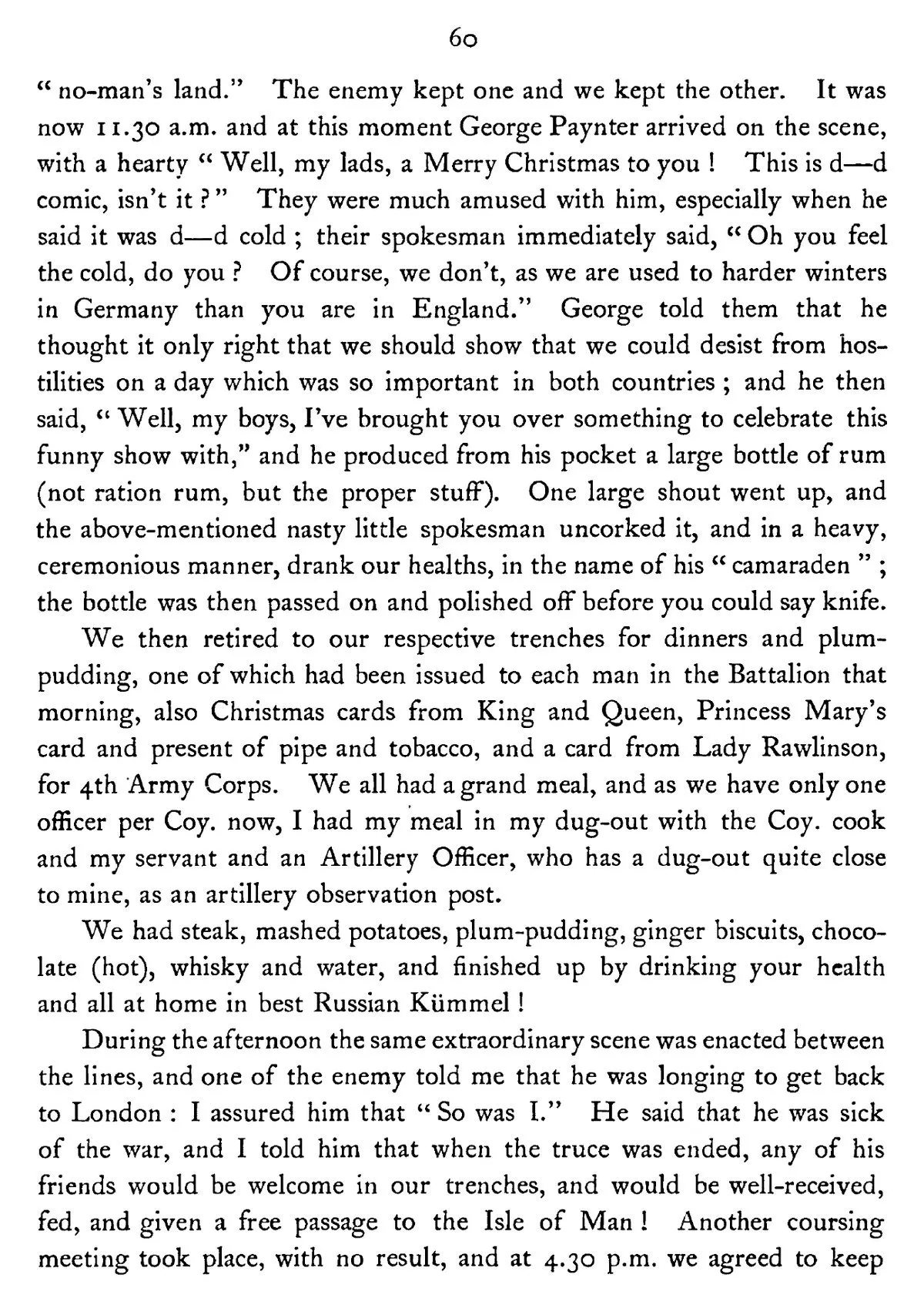
The fullest account of one sector comes from Edward Hulse of the 2nd Battalion, Scots Guards, who wrote to his mother on December 28. He was killed the following March, and his letters were privately printed in 1916. On Christmas morning four unarmed Germans walked toward his lines, and after half an hour’s talk the men parted “after an exchange of Albany cigarettes and German cigars.” By ten o’clock both sides had poured out into crowds at the halfway line. Two German officers he met there looked to him “full of sausage and beer and wine.”
Then a hare started up between the lines. British and German soldiers chased it together across the plowland, caught it and later a second one, and split the bag: “The enemy kept one and we kept the other.” Around half past eleven a fellow officer, George Paynter, arrived with a large bottle of rum, “not ration rum, but the proper stuff.” A German spokesman uncorked it, drank the health of the British in the name of his comrades, and the bottle went round until it was empty.
Hulse is just as plain about what came next. Each man in the battalion had been issued a plum pudding that morning, with Christmas cards from the King and Queen and Princess Mary’s gift of a pipe and tobacco, and the sides went back to their own lines to eat. He dined in his dugout with his company cook, his servant and an artillery officer on steak, mashed potatoes, plum pudding, ginger biscuits and hot chocolate.
The truce held into the next day on his front, and by the time it ended that afternoon some of the puddings had crossed the line: “We had sent them over some plum-puddings,” Hulse wrote, “and they thanked us heartily for them.”
Cake for wine
Other letters, printed in British local papers in January 1915, tell of other trades. Rifleman C. H. Brazier of the Queen’s Westminsters wrote of Germans calling across on Christmas Eve and asking for cigarettes and pudding. In the meeting that followed, as his letter in the Hertfordshire Mercury of January 9 is transcribed today, the Germans handed over wine and cigars, and the British gave cake and cigarettes. He doesn’t say what kind of cake it was. Gloucestershire Archives identifies a letter from Corporal James Philpotts of the Royal Warwickshire Regiment, printed in the Gloucester Journal the same day, that names Christmas pudding among the things exchanged on his part of the front.
Some of what crossed came from the Christmas issue. Hulse’s men had their puddings and Princess Mary’s tobacco that very morning. The fund in Princess Mary’s name, launched in October 1914, sent a brass gift box to those serving in the King’s uniform, and what went inside depended on who received it: smokers got tobacco, and the Royal Collection notes chocolate for nurses, and sweets and spices for Indian soldiers whose religion forbade tobacco.
Plum pudding had gone short at a wartime Christmas before. In besieged Paris in 1870, Henry Labouchere expected few tables to have one, and camel stood in for turkey at one English Christmas dinner, as What Did Paris Eat Under Siege in 1870? recounts. In Hulse’s battalion in 1914, every man had a pudding, and some of them crossed the wire.
The German side
The truce reached German newspapers too. On January 6, 1915, the Bergedorfer Zeitung, the local paper of Bergedorf near Hamburg, printed letters from the front under the heading “Feldbriefe.” In one, a soldier the paper doesn’t name, writing on Christmas Day, described about ten Frenchmen climbing out of their trench and coming as far as the wire, calling out in good German. He and his comrades climbed out to meet them. “Wir geben den Franzosen Zigarren und Zigaretten, und sie geben uns Wein” (We give the Frenchmen cigars and cigarettes, and they give us wine). The artillery was firing that day, he added, but the infantry kept the promise both sides had made.
The same page carried a letter from a young Hamburg volunteer signed only “Hans,” and it shows the other half of the season. His platoon sang carols on Christmas Eve while French bullets whistled over, then toasted the people at home in steaming grog. On Christmas Day he and Rudi warmed up tongue and asparagus by their little tree, with marzipan and nuts to follow. His letter tells of no truce.
The recipes
None of these letters gives a recipe or says how Brazier’s cake or Hulse’s puddings were made, so the menu here is three household recipes of the kinds the letters name, from cookbooks printed in England and Germany:
- A Very Good Seed-Cake (1861) (opens in a new tab), on TuneMyRecipe: Isabella Beeton’s butter cake with caraway seeds, mace and nutmeg.
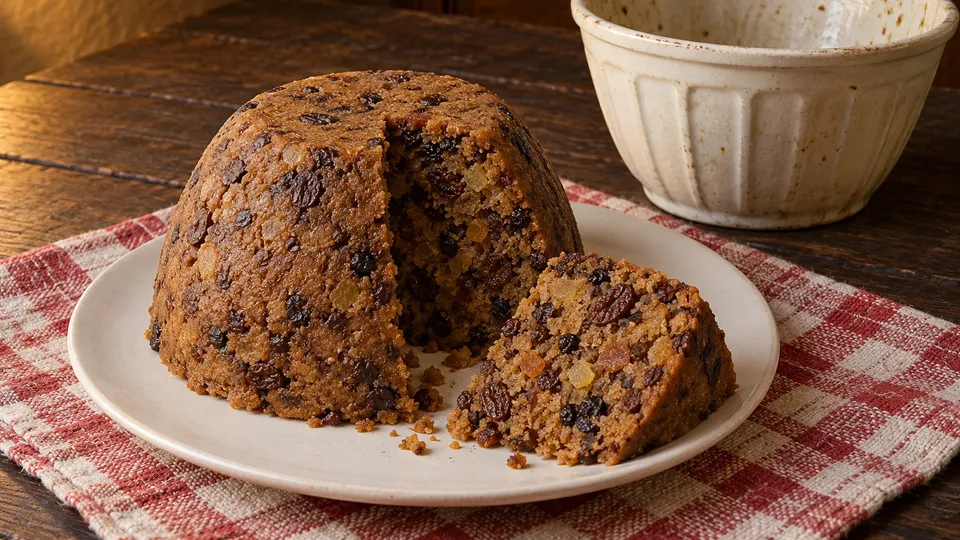
- Christmas Plum Pudding (1861): Beeton’s pudding of raisins, currants, peel, breadcrumbs, suet and eggs, with no sugar or flour in it.
- Lübeck Marzipan (1858): Henriette Davidis’s almond paste, the sweet Hans had for dessert, from her Praktisches Kochbuch.
Cooking it
Start the Christmas Plum Pudding (1861) in the morning, since it steams for five hours, and the marzipan can be rolled and cut while the pot simmers. The pudding and the marzipan are both among our Victorian recipes.
 Cook it todayChristmas Plum Pudding (1861)
Sources
- Edward Hamilton Westrow Hulse, Letters Written from the English Front in France between September 1914 and March 1915 (privately printed, 1916), letter of December 28, 1914, pp. 56–65.
- Bergedorfer Zeitung, January 6, 1915, “Feldbriefe,” as digitized by the Staats- und Universitätsbibliothek Hamburg.
- C. H. Brazier, letter in the Hertfordshire Mercury, January 9, 1915, as transcribed by the National WWI Museum and Memorial and Herts Memories.
- Gloucestershire Archives, The Christmas Truce, 1914 (teaching resource), on James Philpotts’s letter in the Gloucester Journal, January 9, 1915.
- Royal Archives, “The First World War in the Royal Archives,” and Royal Collection Trust, Princess Mary Gift Boxes, RCIN 69472.
- Iain Adams, “A Game for Christmas? The Argylls, Saxons and Football on the Western Front, December 1914,” University of Central Lancashire.
- Isabella Beeton, The Book of Household Management (London: S. O. Beeton, 1861).
- Henriette Davidis, Praktisches Kochbuch für die gewöhnliche und feinere Küche, 7th ed. (Bielefeld: Velhagen und Klasing, 1858).