Lübeck Marzipan (1858)
Reader ratingsHenriette Davidis’s Lübeck marzipan: almonds ground with orange flower water, stirred with sugar over low heat, rolled and cut into small soft white shapes.
- Recipe makes
- About 500 g, 30 small shapes
- Prep
- Cook
- Total
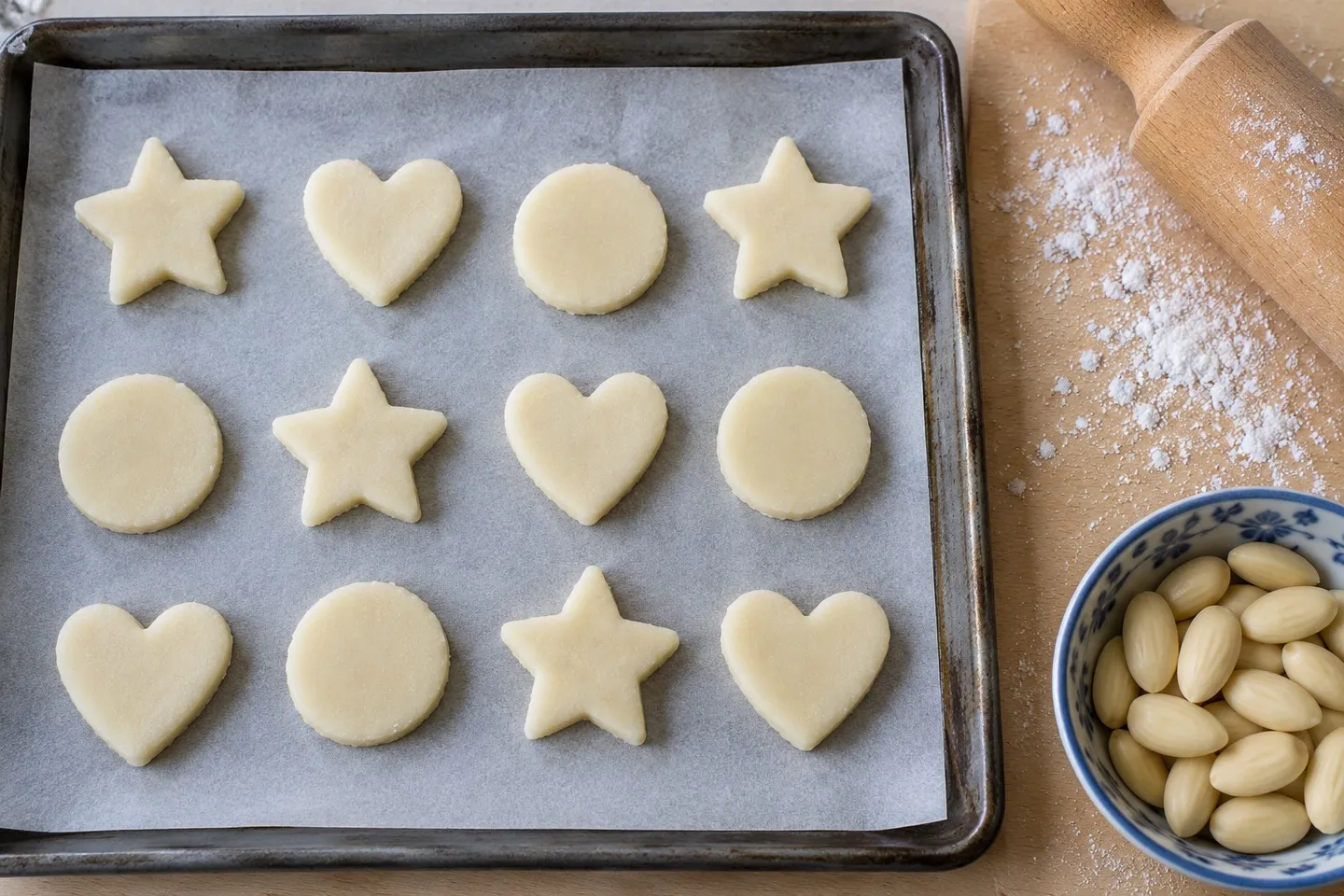
Grinding and stirring take about 40 minutes. The cut shapes then dry, uncovered, for about 3 hours at room temperature, until the outside is dry to the touch and the inside still soft.
Small cut shapes of homemade white marzipan with blanched almonds.
The story behind the recipe
Marzipan came after the tongue and asparagus. A young volunteer from Hamburg who signed himself Hans wrote home that on Christmas Day 1914 he and his comrade Rudi heated up tongue and asparagus and ate by the glow of their small Christmas tree, with marzipan and nuts for dessert and a good cigarette after. The Bergedorfer Zeitung printed the letter on January 6, 1915. He doesn’t say where the marzipan came from. This is how a German household cookbook of the period made it: Henriette Davidis’s Lübeck marzipan, from the seventh edition of her Praktisches Kochbuch, printed in Bielefeld in 1858.
How did Davidis make marzipan?
It is a cooked marzipan. Davidis pounds skinned almonds “as fine as flour” with orange flower water, then stirs them with sifted sugar in a small copper pan over a gentle fire until the paste no longer sticks to the hand, and no further: “it must not become any drier.” The paste is rolled out on a sugared board and cut into little figures, or shaped into a torte decorated with sugar flowers and fine leaves of bitter-orange peel. The figures dry a little in an oven that has cooled, and the recipe insists that the marzipan “must stay soft and snow-white.”
Almonds, sugar and orange flower water are the whole of it. Her book places it among the cakes and tortes, between a colored sugar for decorating and a Marseilles torte.
Read more about this recipe
Making it today
Davidis’s pound of almonds and pound of sugar are halved here. A food processor does the pounding, and powdered sugar stands in for her fine sifted sugar. The biggest change is the drying: the shapes dry uncovered at room temperature, since her “oven that has cooled” gives no heat to follow. The translation of her recipe is our own.
What Did the Soldiers Share in the Christmas Truce of 1914? sets Hans’s letter beside the truce with the French printed on the same page. On the British side of the wire, Edward Hulse’s battalion had been issued plum puddings that morning, and Isabella Beeton’s Christmas Plum Pudding (1861) is an English household recipe for one.
LÜBECK MARZIPAN.
1 pound of almonds, 1 pound of sugar, and besides that more sugar for strewing underneath, orange-flower water.
The almonds are skinned, every blemish cut away from them, then washed, dried with a cloth, pounded with orange-flower water as fine as flour, and stirred with the fine, sifted sugar in a little copper saucepan over a gentle fire until it no longer sticks to the hand; but it must not become any drier. Then lay the almond paste on a pastry board dusted with sugar and roll it out, using as much sifted sugar above and below as the rolling needs; shape it into a torte, or cut little figures from it with small molds, and let these dry a little in an oven that has cooled; but the marzipan must not become hard, it must stay soft and snow-white. As a torte it is prettily decorated with fine little sugar flowers and bitter-orange peel cut into fine leaves.
Recipe makes: About 500 g, 30 small shapes
Ingredients
For about 500 g, 30 small shapes. Quantities are shown as written.
Quantities as written here, for about 500 g, 30 small shapes.
- Blanched whole almonds250 g
- Orange flower water15 ml
- Powdered sugar, sifted250 g
- Powdered sugar for rolling60 g
Measurement notes
Ingredients as written here
- 250 g blanched whole almonds
- 15 ml orange flower water
- 250 g powdered sugar, sifted
- 60 g powdered sugar for rolling
Equipment
 Food processor
 Fine sieve
- Heavy saucepan
 Wooden spoon
- Rolling pin
- Small cutters, about 1½ inches (4 cm) across
- Baking sheet lined with parchment
Instructions
Put the almonds and orange flower water in the food processor and pulse in short bursts, scraping down the sides, until the almonds are as fine as flour. Stop before they turn into a paste.
Sift the powdered sugar into the heavy saucepan and add the ground almonds. Set the pan over low heat and stir constantly for 5 to 8 minutes, until the mixture comes together into a soft paste and a pinch of it, cooled for a moment, no longer sticks to a clean, dry finger. Take it off the heat at once; it should not dry out or color.
Dust a board with some of the powdered sugar for rolling. Turn the paste out onto it and leave it for about 10 minutes, until it is cool enough to handle.
Knead the paste briefly until smooth. Roll it out ¼ inch (6 mm) thick, dusting it above and below with more of the rolling sugar as needed, and cut it into small shapes. Gather the scraps, roll them again and cut more.
Lay the shapes on the parchment-lined sheet and leave them uncovered at room temperature for about 3 hours, turning them once, until the outsides are dry to the touch. They should stay soft inside and white.
Nutrition
85calories per serving
- Recipe makes
- About 500 g, 30 small shapes
- Servings
- 30
Estimated per piece (30) from USDA FoodData Central values for blanched almonds and powdered sugar, counting about half the rolling sugar.
Recipe notes
When adjusting quantities
Half of Davidis’s pound of almonds and pound of sugar. Doubled, stir it in a wider pan so it heats evenly.
Notes
Quantities mentioned in these notes don’t change when you adjust the servings.
Davidis skins her own almonds; blanched whole almonds save that step. Powdered sugar in the United States contains a little cornstarch, which her fine sifted sugar did not. Neither the orange flower water nor the sugar for rolling is measured in her book, so we chose both, and her torte with its sugar flowers and bitter-orange peel is not made here.
Keep the marzipan in an airtight tin in a cool, dry place for up to 2 weeks. Contains tree nuts.
Scaling changes the ingredients only; pan sizes and cooking times need their own judgment. To adapt this recipe further, try the recipe tool at TuneMyRecipe (opens in a new tab), our sister site.
Sources and attribution
Translated and adapted from Henriette Davidis, Praktisches Kochbuch für die gewöhnliche und feinere Küche, 7th ed. (Bielefeld: Velhagen und Klasing, 1858), Lübecker Marzipan, no. 15
See the original pages (scan at Internet Archive) (opens in a new tab)
Recipe details
- Course
- Dessert
- Dish family
- Desserts & Sweets
- Region
- German
- Era
- 19th century
- Source decade
- 1850s
- Difficulty
- Easy
- Occasion
- Christmas
- Season
- Winter