The Siege of Paris · Paris, France
What Did Paris Eat Under Siege in 1870?
Horse first, then dog, cat, rat and the zoo’s elephants, and by January a daily ration of 300 grams of bread with straw in it. What Paris ate, and four to make.
Horse, above all. From October 1870 Parisians shut in by the Prussian army bought horsemeat at a price fixed by the government. Those who could pay went on to dog, cat and rat, and in the last weeks to the animals of the zoo, the elephants Castor and Pollux among them. Most people lived on small rations of meat, cheap soup and, by January, a gray bread with little wheat in it. Henry Labouchere, an English journalist who stayed in the city, wrote it all down in letters to the London Daily News, collected in 1871 as Diary of the Besieged Resident in Paris.
Four months shut in
The siege began on September 19, 1870, and ended with the armistice of January 28, 1871. In October the population was put at 2,036,000, Labouchere reported, not counting the troops. Bread and meat were sold under a “maximum,” a ceiling on their price, and nothing at first was rationed. Bread was rationed only in the last weeks. Until then, people who had money and had laid in stores ate well, and people who lived on a National Guardsman’s pay of a franc and a half a day did not. A franc then bought roughly what four to five euros buy today, so that pay came to about seven euros a day. (The estimate uses the French statistics office’s franc–euro converter, which starts in 1901, assuming prices of the same order as in 1870.)
Horse first
The Gazette Officielle published a decree on the sale of horseflesh in September, and on October 8 a tariff: the choice cuts at 1 franc 40 centimes the kilo (about €6 today, by INSEE’s franc–euro converter from its earliest year, 1901), the rest at 80 centimes. The best horse cost a guardsman nearly a day’s pay for a kilo. Labouchere already suspected that “most of the beef I have eaten of late is horse.” Cab horses and omnibus horses went the same way, and horse remained the meat of the siege until its end.
The restaurants adapted their bills. At a large popular one in October, he complained, “each person only gets enough cat or horse to whet his appetite for more,” while in the cafés of the Boulevards “feasts worthy of Lucullus are still served to those who are ready to part with their money.” By late December, eating at what he called a second-class restaurant, he had had enough of the variety: “Cat, dog, rat, and horse are very well as novelties, but taken habitually, they do not assimilate with my inner man.”
Soup for five centimes
For the poor, the city’s answer was soup. In each arrondissement, Labouchere reported in November, there were cantines économiques, “where a mess of soup made from vegetables and a small quantity of meat can be bought for five centimes,” about a quarter of a euro today. The government also handed out orders for ten centimes’ worth of bread, which every baker accepted as money. “No one is absolutely starving,” he wrote, “but many are without sufficient nourishment.”
By the end of December the canteens were all that stood between many families and hunger. Labouchere described a workman who spent his pay in the pot-house while his wife and children “only just keep body and soul together” by going to the national canteens for soup and to the town halls for an occasional order for bread. At a meeting of the mayors, he added, it was stated that more than 400,000 people were receiving relief.
Rats, cats and a slice of Pollux
Rats were eaten too. Labouchere tried a salmis of them in November and liked it, but in his letters they stay a curiosity and a joke about prices, never the meat people lived on.
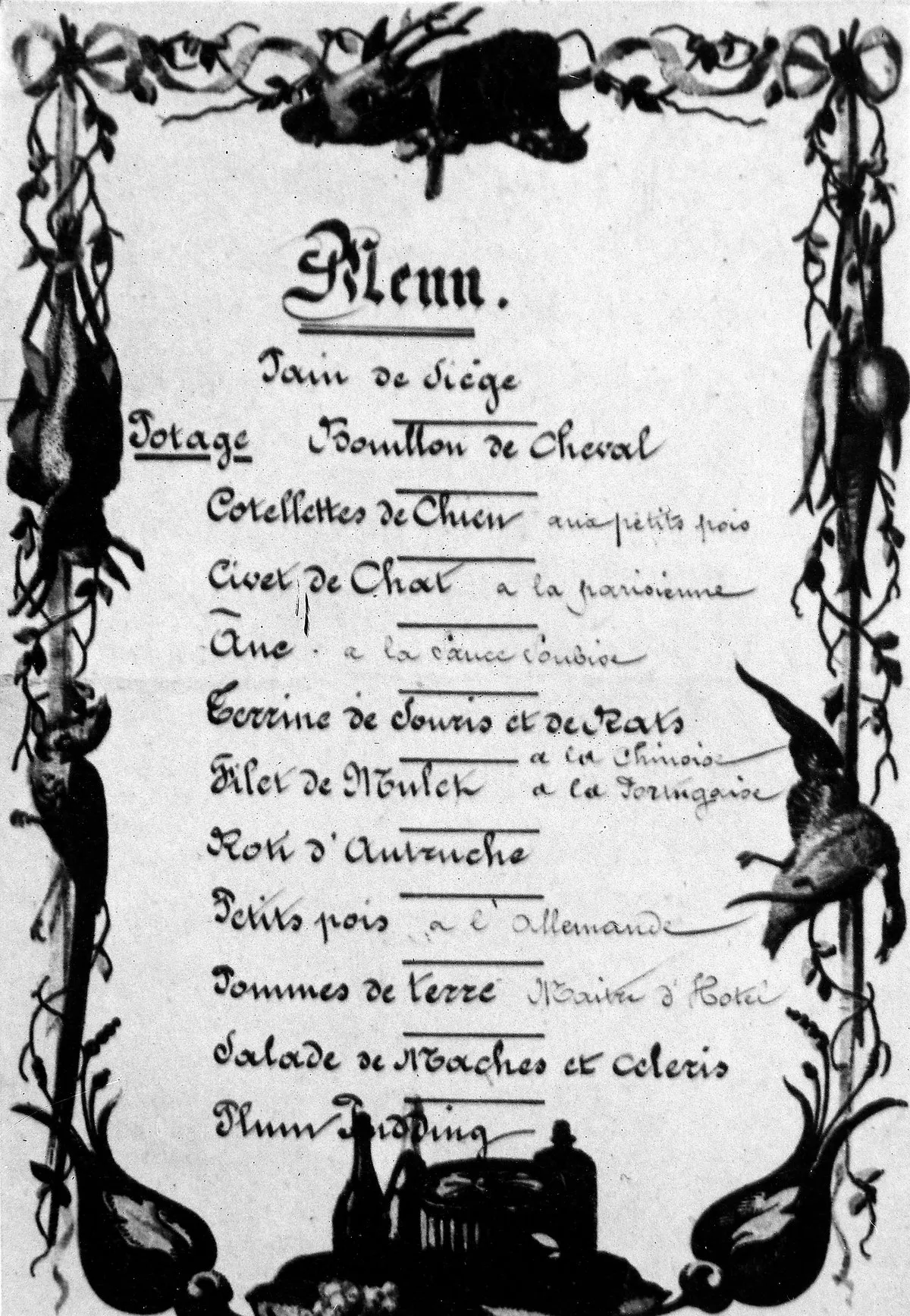
When the other meat ran short, the animals of the city’s zoos were slaughtered and sold. In mid-December the bill of fare at the restaurant Voisin’s offered ass, horse and a wolf from the zoo. A handwritten siege menu, known from a 1929 photograph in the Wellcome Collection in London, undated and naming no restaurant, runs from “Pain de siège” and horse broth through dog cutlets, cat stew, donkey and a terrine of mice and rats to roast ostrich, and ends with plum pudding. Early in January Labouchere wrote: “Yesterday, I had a slice of Pollux for dinner.” Pollux and his brother Castor were two elephants. The meat was “tough, coarse, and oily,” and the trunks had sold for 45 francs a pound (about €200 today), a month of a guardsman’s pay.
Bread at the end
Bread lasted longest, and it got worse as it went. At the New Year it was to be mixed with oats and rice. In the middle of January came the ration: “No one is to have more than 300 grammes per diem; children only 150.” Soaked in water, Labouchere wrote, the bread gave up bits of straw and hay.
When it was over he judged that the hunger and cold had “fallen almost exclusively on the women and children.” The well-to-do had gone without luxuries. The wives and children of the poor, “scantily clad, ill fed, without fuel,” had spent half of each day waiting at the bakers’ doors for their bread. Fuel mattered as much as food: after the armistice he wrote that poor families could not cook the meat they were given or make soup for want of coal, and he asked English charities to send fuel along with food.
A piece of that bread survives, glued to a souvenir card that was sent to Henry Wadsworth Longfellow and is shown by the National Park Service at his house in Cambridge, Massachusetts. Its caption, as the Park Service gives it, reads “300 grams of bread after five hours of waiting in 12 degrees of cold.”
Christmas Day, 1870
Christmas came with a frost. It was not the great holiday in Paris that it was in England, Labouchere explained, and that year there was little to celebrate it with. The English in the city did their best. One restaurant had saved two turkeys for the day, only to see them die beforehand. “One fortunate Briton has got ten pounds of camel,” he wrote, “and has invited about twenty of his countrymen to aid him in devouring this singular substitute for turkey.” His own Christmas dinner, with a fellow correspondent, was two onions, some potatoes and a ham taken from the larder of a family who had left Paris, with a fowl.
The recipes
Labouchere wrote down what was on the plate but rarely how it was cooked. The four recipes here come from The Royal Cookery Book, the English edition of Le Livre de cuisine by Jules Gouffé, chef de cuisine of the Paris Jockey Club, published in London in 1868, two years before the siege. The same book gives the 1868 version in the story of Chicken Marengo. They show how a Paris cook of the time made each dish the siege accounts name, with the meat it was meant for (quail stand in for Gouffé’s larks in the salmi). The siege menu at the top of this page opens with horse broth and ends with plum pudding, and so does this meal, with beef in the pot.
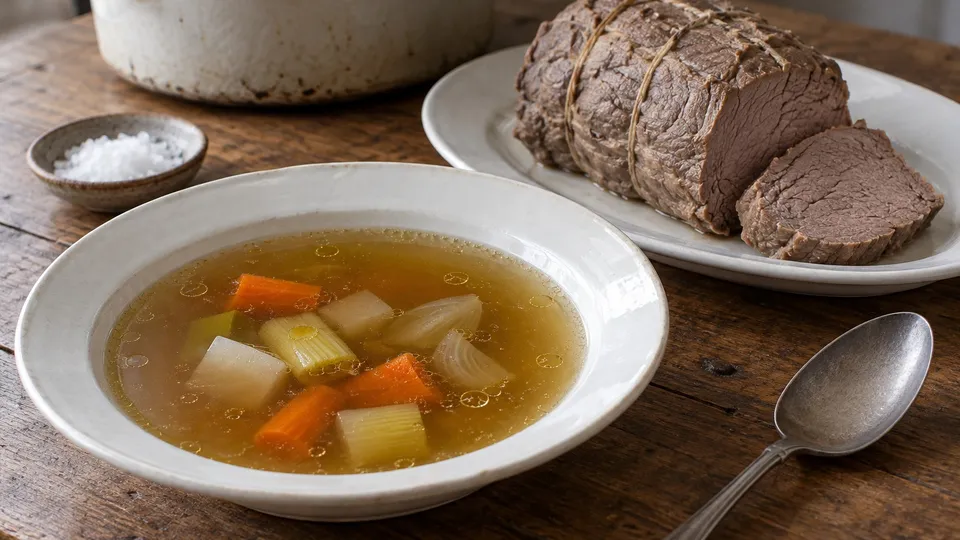
- Pot-au-Feu (1868): beef and vegetables simmered for hours into a clear broth, the soup the cheap canteens made with a little meat.
- Boiled Beef with Sauce Piquante (1868): the beef from the pot, sliced and reheated under a sharp shallot and gherkin sauce.
- Salmi of Quail (1868): small birds browned with bacon and mushrooms and finished in white wine, Gouffé’s household salmi.
- Plum Pudding with Rum (1868): the English Christmas pudding in a Paris cookbook, boiled four hours and flamed with rum.
Cooking a siege dinner
Begin with the Pot-au-Feu (1868). One pot gives the broth to eat as soup and the beef and broth for the sauce piquante, the two-meals-from-one way Gouffé meant it to be used. All four of Gouffé’s dishes are among our 19th-century recipes.
 Cook it todayPot-au-Feu (1868)
Sources
- Henry Labouchere, Diary of the Besieged Resident in Paris (opens in a new tab) (London: Hurst and Blackett, 1871), Internet Archive.
- Jules Gouffé, The Royal Cookery Book (Le Livre de cuisine), translated by Alphonse Gouffé (London: Sampson Low, Son, and Marston, 1868).
- “Siege of Paris (1870−71) (opens in a new tab),” Encyclopaedia Britannica.
- David R. Daly, “Siege of Paris Souvenir (opens in a new tab),” Longfellow House–Washington’s Headquarters National Historic Site, National Park Service, 2023.
- Siege of Paris Menu (opens in a new tab), photograph M0000295, Wellcome Collection.