Battle of Marengo · Marengo, Piedmont
Was Chicken Marengo Really Cooked on the Battlefield?
No record from 1800 says Bonaparte’s cook invented chicken Marengo. The cookbooks tell another story, with three recipes from 1868 to 1907.
There is no evidence that chicken Marengo was cooked on the battlefield. The story of Bonaparte’s cook improvising it after the battle of Marengo on June 14, 1800, was first written down in 1858, and nothing from 1800 backs it up. That first version had none of the crayfish and fried eggs that today’s tellings put on the plate. In the cookbooks, those arrive last, more than fifty years later.
The story and where it comes from
The story goes that after Bonaparte’s army beat the Austrians at Marengo, in Piedmont, his cook made dinner from whatever could be found nearby. The Fondation Napoléon still notes that Dunan, “chef to Napoleon’s army in Italy,” is “generally credited” with the recipe, frying the chicken in olive oil with tomatoes and onions found locally. Modern recipes, the foundation’s among them, add crayfish and fried eggs.
Pierre Leclercq, a food historian at the University of Liège, traced the story back in 2018. He found it first in 1858, in a dictation written for schoolchildren by Théophile Lepetit, built on a short anecdote by the writer Édouard Fournier. In that version the cook fries the chicken in oil with garlic, a little white wine, bread crusts and mushrooms. It names no cook and leaves out the garnish later tellings add. Leclercq’s verdict is blunt: the story « ne repose sur aucun document, ni aucun témoignage », resting on no document and no witness.
He thinks the name more likely came from Paris. In the excitement after the victory, he suggests, the chef of Les Trois Frères Provençaux, a celebrated Paris restaurant, gave a dish of fried chicken the name of the battle. An 1855 article in the Gazette pittoresque preserves a recipe by Maneille, a chef there, which Leclercq takes to be probably the original.
What the cookbooks show
The printed recipes can be dated, which the legend cannot. Leclercq cites a poulet à la Marengo in the tenth edition of Le cuisinier royal, by André Viard and Fouret, published in 1820. It already includes tomatoes, though he notes that most recipes of the next fifty years leave them out. By the 1840s the dish had crossed to London, and five cookbooks printed in London show what happened to it there.
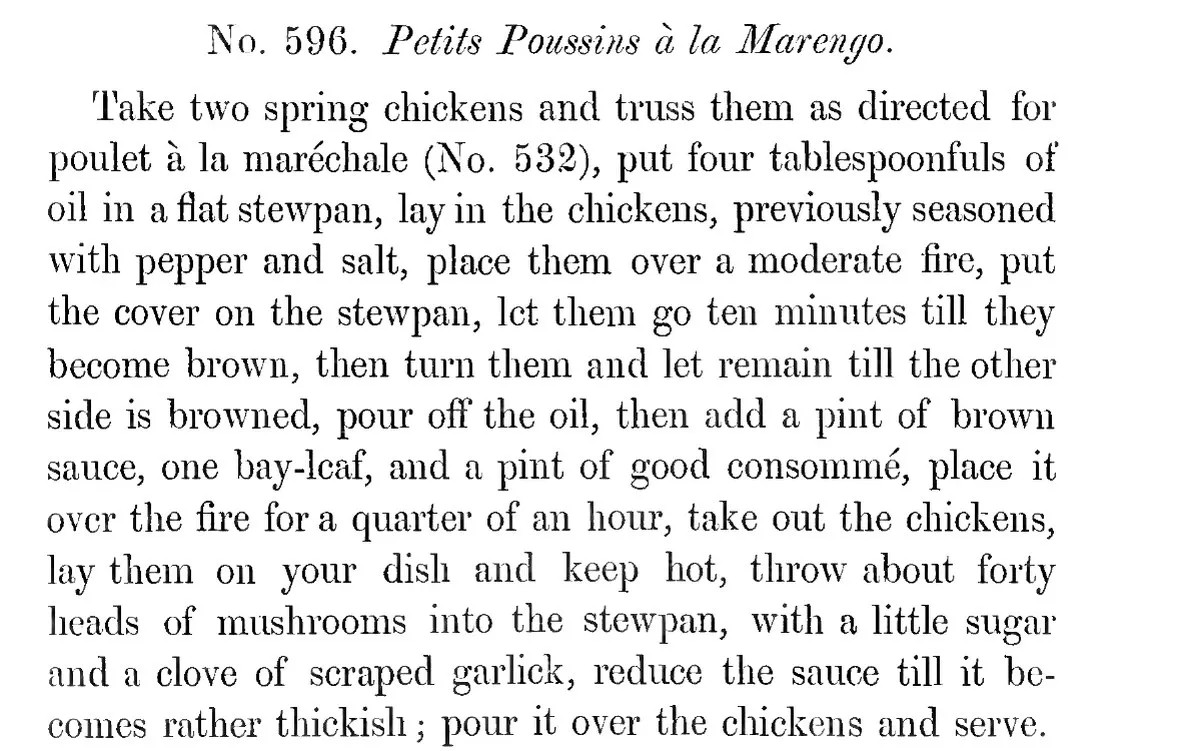
1846, Alexis Soyer. The chef of London’s Reform Club gives petits poussins à la Marengo in The Gastronomic Regenerator: spring chickens browned in oil, the oil poured off, then a pint of brown sauce, a bay leaf and a pint of consommé, with “about forty heads of mushrooms” and “a clove of scraped garlick,” reduced “till it becomes rather thickish.” Nothing of the later garnish appears.
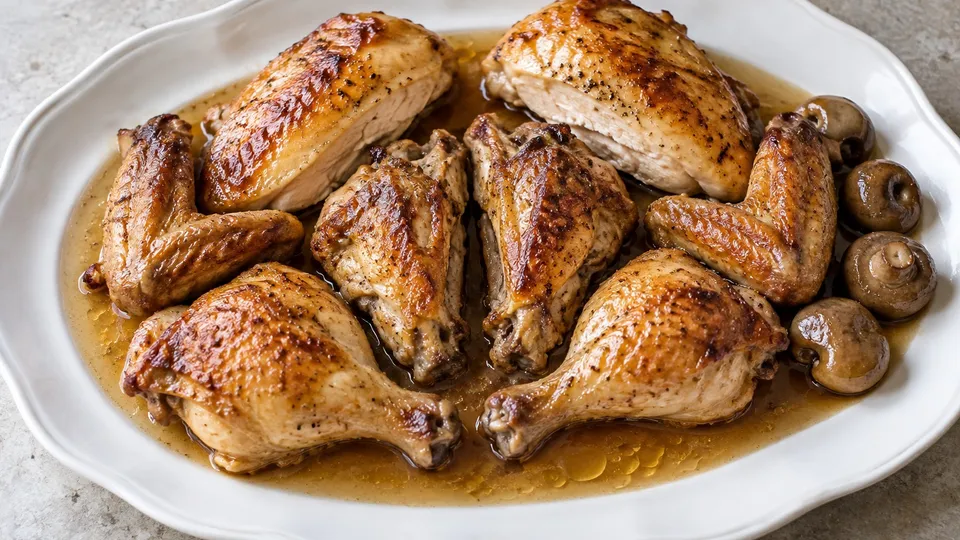
1868, Jules Gouffé. The Royal Cookery Book, translated from his Livre de cuisine by his brother Alphonse, is plainer still. The chicken is cut up and fried in oil with shallots, garlic, thyme, bay and parsley, then a sauce is made in the same pan with flour and broth. Gouffé adds a short instruction: “The fat is not taken off the sauce of Chicken à la Marengo.” Mushrooms are optional. The dish is set out like his fricassee of chicken, and there, a page earlier, he notes that “four fine crayfish at the corners will much improve the appearance of this dish.” The crayfish were already in the kitchen; they were not yet part of Marengo.
1890, Agnes Marshall. In Mrs. A. B. Marshall’s Cookery Book tomatoes come back, two or three of them, with onions, bacon and sherry, and the dish is finished “with fried eggs, little kite-shaped croûtons.” Eggs appear here for the first time in these five books.
1906, Mrs. Beeton. The Ward, Lock edition of Beeton simmers the chicken in Espagnole sauce with tomato, sherry, mushrooms, olives and truffle, and sets “a few fleurons, i.e., half-moon or crescent-shaped pieces of puff pastry, or croûtes of fried bread” around the dish.
1907, Auguste Escoffier. A Guide to Modern Cookery gives the plate the legend describes. The chicken is sautéed in oil, the pan swilled with white wine, then tomatoes, garlic, mushrooms and truffle go in, and the dish is surrounded with “heart-shaped croûtons, fried in butter; small, fried eggs, and trussed crayfish cooked in court-bouillon.”
Read in order, these books turn the legend around. Leclercq notes that tomato became a standard part of the dish only at the end of the nineteenth century, at the same time as the crayfish. In these five books, the crayfish and eggs that the story puts on Bonaparte’s plate in 1800 are the last parts of the recipe to reach print.
Why the legend stuck
A dish that begins in a field kitchen after a victory makes a better story than one named in a Paris dining room. As the garnish grew, the story could account for each piece: crayfish and eggs are what a forager might bring back. By the time Escoffier printed the crayfish in 1907, the story had been in circulation for half a century. None of this makes the dish less worth cooking.
The recipes
Three versions, in the order they were printed. Cook any one on its own, or two side by side to taste forty years of change.
- Chicken à la Marengo (1868): Gouffé’s version, chicken fried in oil with shallots, garlic and herbs and a pan sauce. No tomato.
- Chicken Marengo with Fried Eggs (1890): Agnes Marshall’s, with tomatoes, bacon, sherry and the first fried eggs.
- Chicken Marengo with Crayfish (1907): Escoffier’s, with white wine, tomato, mushrooms, crayfish, fried eggs and croûtons.
What the dish tells us
Leclercq’s reading is that a Paris kitchen named the dish and the story came later. If he is right, the name came first, the story second and the garnish last.
For the plainest taste of the early dish, start with Gouffé’s 1868 version: one pan, a chicken, oil, herbs and broth, on the table in about an hour. Gouffé’s chicken and the 1890 version with fried eggs both sit in our 19th-century recipes. Gouffé’s book is also our guide to what Paris ate under siege in 1870, two years after it was printed.
 Cook it todayChicken à la Marengo (1868)
Sources
- Pierre Leclercq, “Napoléon et le poulet à la Marengo (opens in a new tab),” University of Liège news, October 14, 2018.
- Fondation Napoléon, “Chicken Marengo (opens in a new tab),” napoleon.org.
- Alexis Soyer, The Gastronomic Regenerator (London: Simpkin, Marshall, 1846), p. 247.
- Jules Gouffé, The Royal Cookery Book, trans. Alphonse Gouffé (London: Sampson Low, 1868), pp. 135–138.
- Agnes B. Marshall, Mrs. A. B. Marshall’s Cookery Book (London: Simpkin, Marshall, 1890), p. 122.
- Mrs. Beeton’s Book of Household Management, new edition (London: Ward, Lock, 1906), No. 1149, p. 670.
- A. Escoffier, A Guide to Modern Cookery (London: William Heinemann, 1907), pp. 495–497, 504.