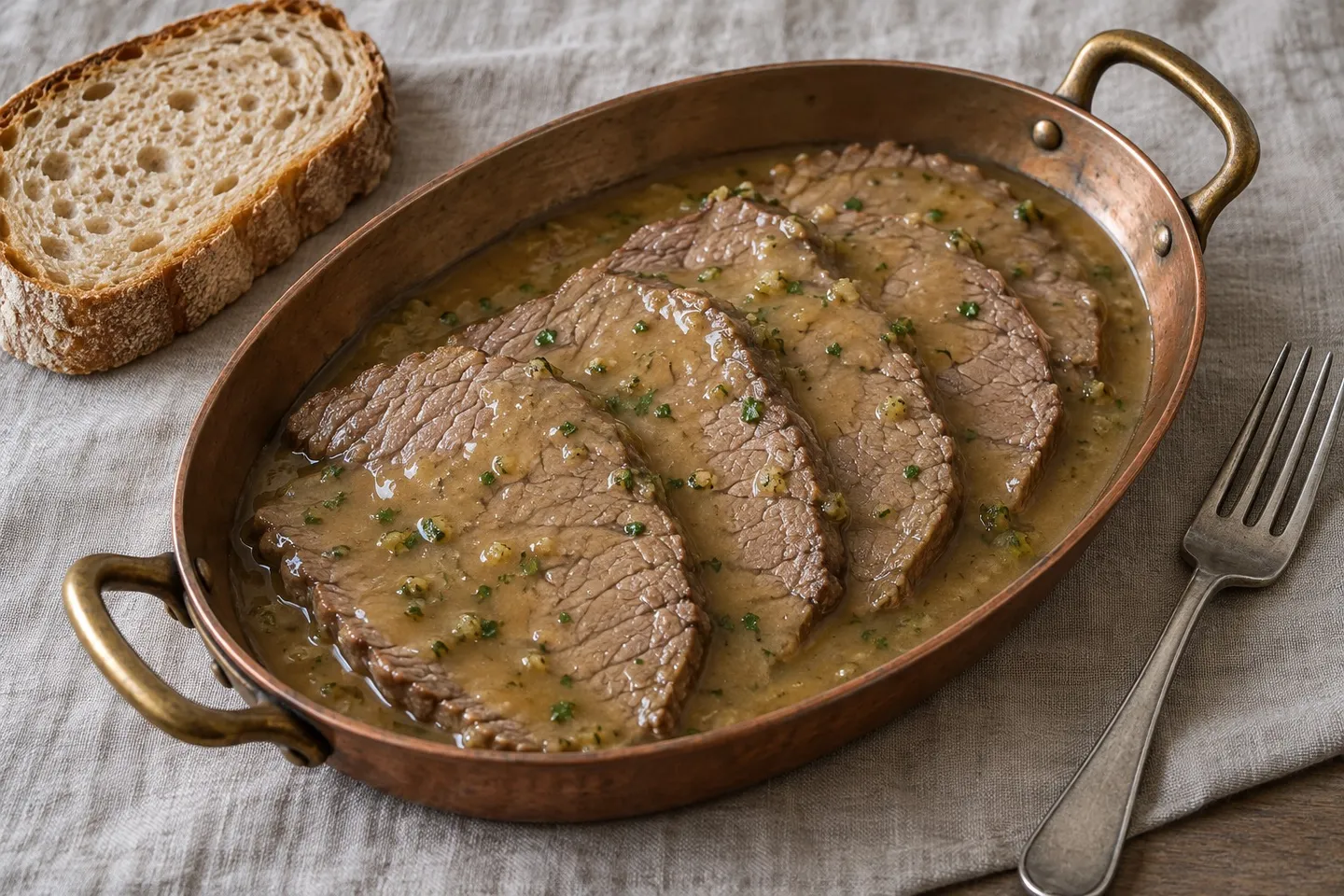
Boiled Beef with Sauce Piquante (1868)
Reader ratingsBoiled beef with sauce piquante from Gouffé’s 1868 Royal Cookery Book: slices from a pot-au-feu warmed in broth under a sharp sauce of shallots, vinegar, gherkins and parsley.
- Recipe makes
- 4 servings
- Prep
- Cook
- Total
Make the Pot-au-Feu first; the beef and broth keep for up to 3 days in the refrigerator. The sauce boils for 15 minutes while the beef warms in the oven.
Boiled beef in sauce piquante, in a copper gratin dish.
The story behind the recipe
“For myself,” a Paris cabman told Henry Labouchere in October 1870, demanding double his fare after driving him near the fighting, he would scorn to ask money for the risk, “but think of my horse.” Labouchere described the horse as one “whom I may possibly have the pleasure to meet again, served up in a sauce piquante.”
The second life of the boiled beef
The joke needed no explaining: boiled beef in a sharp sauce was everyday Paris food. The beef that came out of the pot-au-feu, the bouilli, went back to the table as a meal of its own, and Jules Gouffé’s Royal Cookery Book of 1868 gives half a dozen ways to serve it: with browned onions as a miroton, with tomato or Italian sauce, under crumbs, or fried in butter with parsley. The sharp sauce is the simplest of them: shallots, vinegar, butter, flour and broth, finished with gherkins and parsley. “The vinegar is to impart the necessary sharpness,” he explains. By the time of Labouchere’s cab ride, horsemeat had a price fixed by the government, and the meat under the sauce could well have been horse. What Did Paris Eat Under Siege in 1870? follows the horse from that tariff to the end of the siege.
Gouffé cared how boiled beef looked. He wanted it garnished with vegetables that could be eaten, and he would “hardly advocate the old-fashioned parsley garnishing, which has no practical use, as it cannot be eaten.” Here the parsley goes into the sauce.
Read more about this recipe
Making it today
Gouffé wrote the sauce for about a pound of boiled beef, and the amounts below are his. He puts the dish in the oven for fifteen minutes without saying how hot; we use a moderate 350°F (180°C) and cover the dish with foil, so the slices heat through without drying.
The beef and the broth for the sauce both come out of the Pot-au-Feu (1868), so one pot gives two meals, as it did in Gouffé’s kitchen.
Slice the same quantity of beef as for a Miroton (vide preceding recipe); set the slices in a gratin-pan; moisten with 1 gill of broth; and put in the oven for fifteen minutes; ...
Recipe makes: 4 servings
Ingredients
For 4 servings. Quantities are shown as written.
Quantities as written here, for 4 servings.
Beef
- Cold boiled beef from the Pot-au-Feu1 lb
- Broth for warming, from the Pot-au-Feu4 fl oz
Sauce piquante
- Shallots, finely chopped0.5 oz
- White wine vinegar2 fl oz
- Unsalted butter1 oz
- All-purpose flour1 oz
- Broth for the sauce, from the Pot-au-Feu20 fl oz
- Black pepper2 pinches
- Finely chopped gherkins (cornichons)1/2 fl oz
- Finely chopped parsley1/2 fl oz
- Salt
Measurement notes
Ingredients as written here
- 1 lb cold boiled beef from the Pot-au-Feu
- 4 fl oz broth for warming, from the Pot-au-Feu
- 0.5 oz shallots, finely chopped
- 2 fl oz white wine vinegar
- 1 oz unsalted butter
- 1 oz all-purpose flour
- 20 fl oz broth for the sauce, from the Pot-au-Feu
- 2 pinches black pepper
- 0.5 fl oz finely chopped gherkins (cornichons)
- 0.5 fl oz finely chopped parsley
- Salt
Equipment
- Shallow baking dish
- Foil
- Small saucepan, about 2 quarts
 Wooden spoon
 Whisk
 Instant-read thermometer
Instructions
Heat the oven to 350°F (175°C).
Cut the beef into slices about ¼ inch thick, trimming off any dry outside and the fat. Lay them in the baking dish, overlapping a little, and pour the broth for warming over them. Cover with foil.
Put the dish in the oven for 15 to 20 minutes, until the beef is hot through and reads 165°F (74°C).
Meanwhile, put the shallots, vinegar and butter in the saucepan over medium heat. Stir with the wooden spoon until the vinegar has cooked away and the butter looks clear again.
Stir in the flour and cook, stirring, for 4 minutes without letting it brown. Whisk in the broth for the sauce a little at a time and add the pepper.
Let the sauce boil gently for 15 minutes, stirring now and then. Add the gherkins and parsley, bring back to a boil, skim, and taste for salt; the broth may need none.
Pour off most of the broth from the beef, pour the sauce over it and serve hot.
Nutrition
310calories per serving
- Recipe makes
- 4 servings
- Servings
- 4
Estimated per serving from USDA FoodData Central values for the listed ingredients.
Recipe notes
When adjusting quantities
Gouffé’s sauce is written for about 1 lb of boiled beef. Scale both together.
Notes
Quantities mentioned in these notes don’t change when you adjust the servings.
Gouffé darkens the sauce with a few drops of burnt-sugar caramel; it changes only the color, so it is left out here. Half a fluid ounce of chopped gherkins or parsley is about a tablespoon. The sauce depends on the broth, so taste before salting; a well-seasoned pot-au-feu broth needs little more. Cornichons are the small French gherkins; any sour (not sweet) pickled gherkin will do. Contains milk, wheat and celery (from the broth).
Scaling changes the ingredients only; pan sizes and cooking times need their own judgment. To adapt this recipe further, try the recipe tool at TuneMyRecipe (opens in a new tab), our sister site.
Sources and attribution
After Jules Gouffé, The Royal Cookery Book, trans. Alphonse Gouffé (London: Sampson Low, 1868), Bouilli, with Sharp Sauce or Sauce Piquante, and Sharp Sauce
Recipe details
- Course
- Main course
- Dish family
- Meat & Poultry
- Region
- French
- Era
- 19th century
- Source decade
- 1860s
- Main ingredient
- Beef
- Difficulty
- Easy
- Occasion
- Everyday meal