The Mechanics’ Magazine reports Thomas Masters’s freezing machine · London
How Did a Cook Make Ice Cream in Four Minutes in 1844?
In 1844 a London magazine saw two and a half quarts of ice cream made in under four minutes. How the machine worked, what the clock left out, and the flavors.
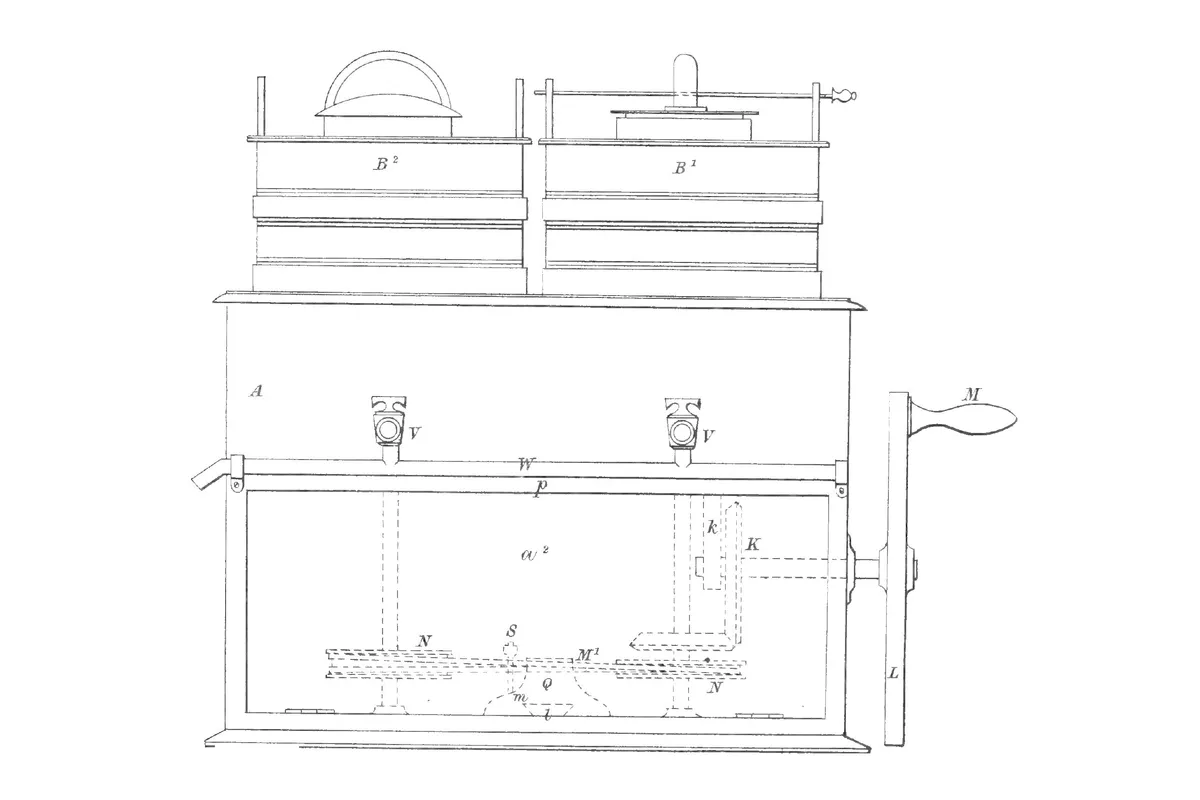
With a machine, and with the work done beforehand. In February 1844 a London magazine reported watching two and a half quarts of ice cream made in less than four minutes, in a machine “little bigger than an ordinary tea-pot.” The machine was Thomas Masters’s patent freezing apparatus. It spun the can of cream in a chemical freezing mixture while a fixed blade scraped the cream off the cold wall, so the mixture froze and was beaten in the same motion. The four minutes, as far as the report shows, timed only that turning: its thirty quarts an hour allow extra time just for “emptying and re-filling.”
A tea-pot and a stopwatch
Masters, who worked from Upper Charlotte Street near Fitzroy Square, published The Ice Book later in 1844: a history of ice, a manual for his machines and a collection of recipes for water ices and ice creams. In it he reprinted the Mechanics’ Magazine of Saturday, February 10, 1844. The magazine noted that the ice for London’s fashionable confectioners, “our Gunters and Verreys,” was still cut from suburban ponds, “as in the days of Pepys.” It expected Masters’s machine to bring “the speedy and entire abandonment of the present traffic in natural ice.”
Then came the demonstration. “We have ourselves seen two quarts and a half of ice cream manufactured by one of Mr. Masters’ machines, little bigger than an ordinary tea-pot, in less than four minutes.” The writer went further: “In an hour it would have produced full thirty quarts.” The second sentence is arithmetic: nobody watched for an hour. On the same occasion, they saw a ten-pound ice pail for cooling wine frozen “within half-an-hour.”
The book adds more praise. John Ryan, a physician and professor of chemistry at the Royal Polytechnic Institution, where the apparatus was on show, wrote to Masters in September 1844 that “without any previous preparation” he had been served cherry, ginger, lemon and vanilla ices “in the course of two minutes.” Those are the flavors Masters sold ready-made in bottles from his shop: add half a pint of water to a pint, freeze, and the work “may be performed in three or four minutes.” The preparation had most likely been done beforehand, by Masters. These are the inventor’s chosen witnesses, printed in his own sales book, and none of them says how the clock was kept.
A churn in a freezing mixture
The magazine called the machine “simply a rotary churn.” Its novelty was doing two jobs at once. Ice cream that freezes standing still separates, Masters explains, and “the poorer and more aqueous parts of the preparation” set apart from the rest. Confectioners beat it by hand while it froze. In his machine the freezer turned and a spatula held fixed inside it took the frozen cream off the sides “in fine flakes,” keeping the rest moving. Turning the wheel was work “which a child with a little exertion can perform.”
The cold came from salts. The report lists some of the mixtures Masters suggested: muriate of ammonia or nitrate of potash with snow and common salt, or crystallized chloride of calcium with snow. With such mixtures, he claimed, his machines could freeze solid blocks of ice from pure spring water. Across the Atlantic, Nancy Johnson had patented a hand-cranked ice cream freezer the year before, in 1843. Twenty-two years later a Washington confectioner put six ice creams and three fruit ices on the supper table at Lincoln’s second inaugural ball. Masters sold his as “ornamental pieces of furniture.” The price list at the back of his book runs from six guineas for a pedestal machine to sixteen for a double-motion model in oak or mahogany, about £1,100 to £3,000 today by UK consumer prices.
What the four minutes left out
His own instructions show how much came before the clock started. The water case was filled and fitted, the freezer put on its spindle and the freezing mixture packed and rammed down around it, then topped up after a few turns of the wheel. Only then was the “prepared” mixture poured in, the spatula fixed and the lid closed. Masters’s simpler machine couldn’t freeze and beat at the same time at all; those were “two separate operations.”
The recipes needed preparing too. Fruit was mashed and strained, custards were stirred over the fire and cooled, and every water ice used a stock of clarified sugar boiled ahead. A correction printed at the front of the book amends his directions: strawberry and raspberry ices, it says, “require straining.” The magazine doesn’t say which mixture went into the tea-pot machine, how cold it started or how firm it came out.
Ices in the street
Henry Mayhew’s London Labour and the London Poor, first collected in 1851, gives the street side. “The sale of ice-creams was unknown in the streets until last summer,” he writes. A man who knew the confectionery business bought ices from a confectioner in Holborn and sold them on to street sellers, but gave up after three or four weeks and later emigrated to America. Then, Mayhew was told, a Petticoat Lane seller “had become possessed, it was said, of Masters’s Freezing Apparatus.” He sold ices on Sunday mornings for two or three weeks, made them for four or five other sellers for a while, and stopped.
“The buyers had but a confused notion how the ice was to be swallowed,” Mayhew writes. Ices went for a penny each, about 80p today. One seller told him: “I sold mostly strawberry ices,” and remembered the first tastes: “They get among the teeth and make you feel as if you tooth-ached all over.” A young man who treated a servant maid to an ice was soon stamping, with the ice among his teeth, but she “knew how to take hern,” with the spoon right into the middle of her mouth. Stock was kept in a jar, not well enough covered or cooled. One confectioner told Mayhew that sellers sometimes offered ice to customers and could supply only water.
The recipes
All four come from The Ice Book itself: three of Masters’s ice creams and a strawberry water ice, the flavor one of Mayhew’s street sellers sold most.
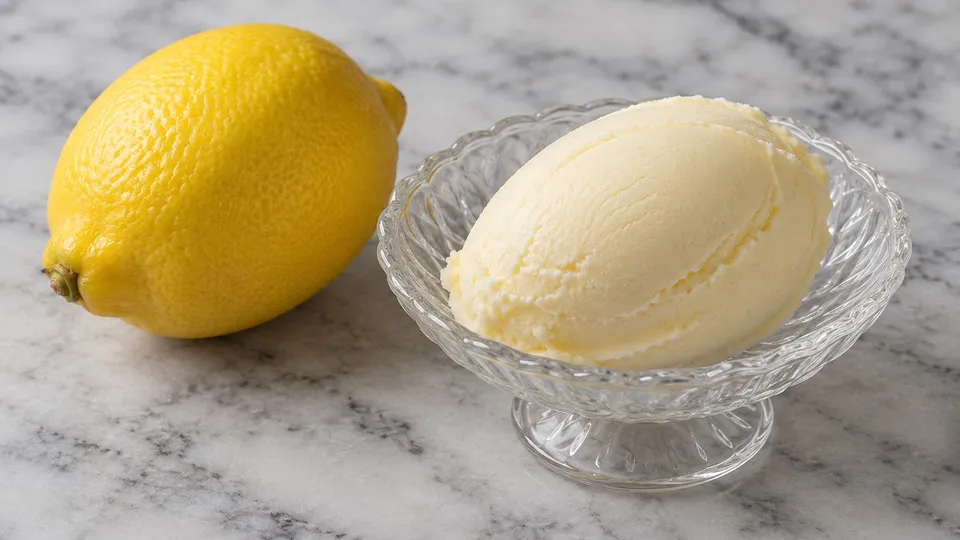
- Lemon Ice Cream (1844): cream, sugar rubbed with lemon peel and lemon juice, nothing else.
- Brown-Bread Ice Cream (1844): a cream thickened with browned bread and sponge fingers, with toasted crumbs stirred through.
- Howqua’s-Tea Ice Cream (1844): cream and sugar with a cup of black tea.
- Strawberry Water Ice (1844): strained strawberries, lemon and clarified-sugar syrup, with no cream at all.
Cooking it
A home ice cream maker does what Masters’s wheel did, turning and scraping at once, though it takes twenty minutes or more. We keep his quantities for the three ice creams, about a quart each, in imperial pints and ounces as he wrote them, and halve the strawberry ice. Start with the Lemon Ice Cream (1844): three ingredients stirred together cold, with nothing to cook, as close as a home kitchen comes to Masters’s “Mix; freeze.” All four of Masters’s ices are in our old-fashioned ice cream recipes, where the Titanic’s iced punch and Leslie’s vanilla keep them company.
 Cook it todayLemon Ice Cream (1844)
Sources
- Thomas Masters, The Ice Book (London: Simpkin, Marshall, & Co., 1844), correction at the front, pp. 68 to 72, 77 to 81, 92 to 93, 96, 106, 109, 168 to 174, 185 to 186, and the “Ices” and price-list advertisement pages.
- Henry Mayhew, London Labour and the London Poor, vol. I (London: Griffin, Bohn, and Company, 1861), pp. 207 to 208.
- Nancy M. Johnson, “Artificial Freezer,” US Patent 3,254 (opens in a new tab), September 9, 1843.
- “London Labour and the London Poor, Volume 1 (opens in a new tab),” London, 1851, Royal Collection Trust.